
If you follow longevity experts, biohackers, or modern nutritional science, you have undoubtedly heard the golden rule of morning nutrition: consume 30 grams of protein for breakfast within 30 minutes of waking up. It sounds like a simple, highly effective protocol to stabilize your blood sugar, stop mid-morning cravings, and ignite your metabolism for the day.
But let’s talk about the reality. At 6:30 AM, when you are bleary-eyed and rushing out the door, the last thing you want to do is pull out a digital food scale, measure out exactly 112 grams of egg whites, and spend ten minutes thumbing through a clunky calorie-counting app to make sure you hit that magic number. The friction of tracking early in the morning is the exact reason why most people fail this protocol by Tuesday.
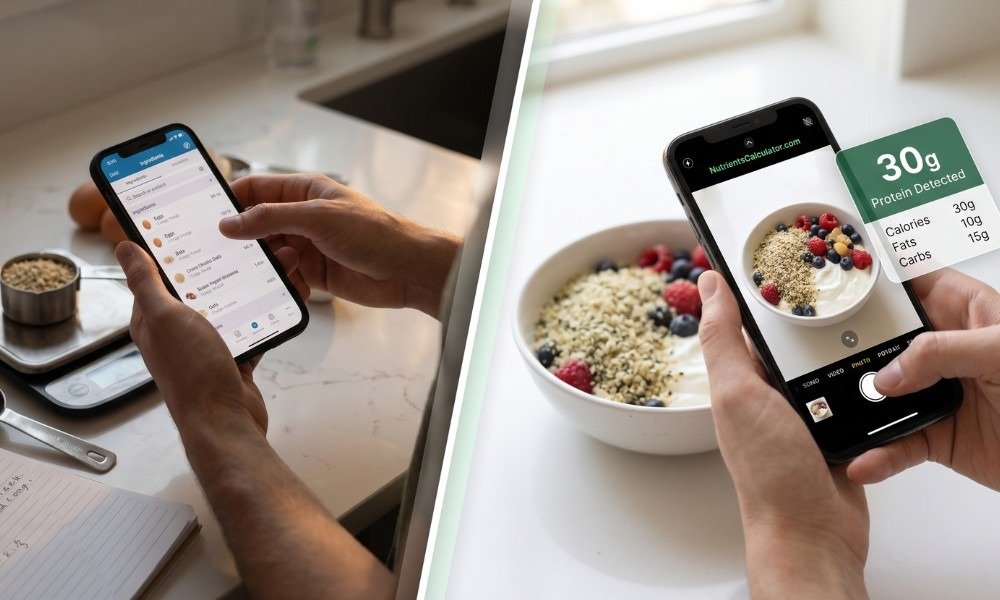
Fortunately, it doesn’t have to be a mathematical nightmare. In this comprehensive guide, we will break down the science of the 30-within-30 rule, provide you with five actionable 30g protein breakfast recipes, and show you how to instantly track your morning macros using nothing but your smartphone camera.
Why You Need 30 Grams of Protein for Breakfast (The Science)
The “30 within 30” rule isn’t just a catchy internet trend; it is deeply rooted in human physiology and metabolic function. When you wake up, your body is in a fasted, catabolic state. Your cortisol levels are naturally peaking to help wake you up, but without immediate nourishment, this can lead to muscle breakdown and erratic blood sugar spikes later in the day.
Here is what happens when you hit that 30-gram threshold early in the morning:
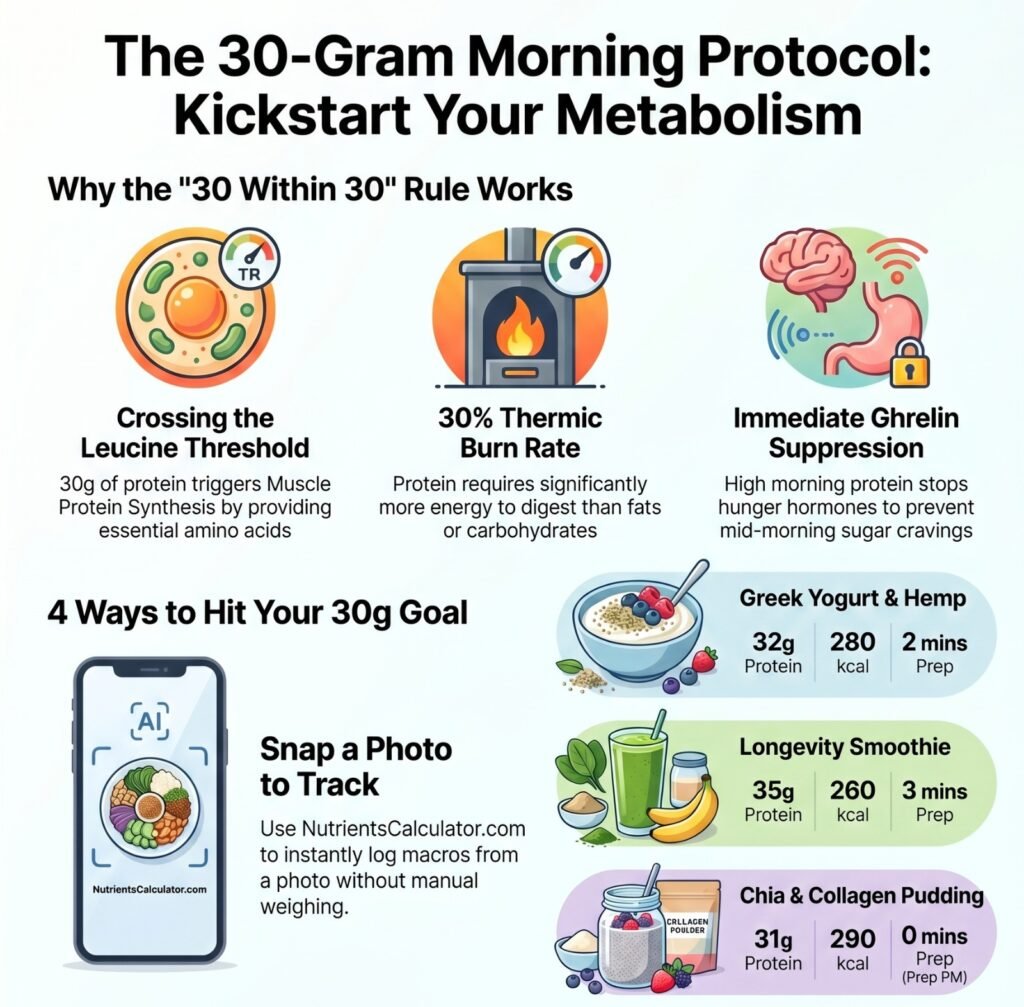
- Crossing the Leucine Threshold: Leucine is the crucial amino acid responsible for triggering Muscle Protein Synthesis (MPS). Research shows that to flip the “switch” on MPS, you need roughly 2.5 to 3 grams of leucine in a single sitting. Coincidentally, 30 grams of high-quality animal or blended-plant protein contains exactly this amount.
- The Thermic Effect of Food (TEF): Protein requires significantly more energy to digest than fats or carbohydrates. Up to 30% of the calories in protein are burned off just through the digestion process. A high-protein breakfast literally forces your body to burn calories simply to process your meal.
- Suppression of Ghrelin: Ghrelin is your body’s “hunger hormone.” A massive dose of early-morning protein drastically suppresses ghrelin secretion while simultaneously increasing leptin (the satiety hormone). This prevents the dreaded 10:30 AM donut craving.
The Morning Struggle: Escaping the Tracking Trap
Despite the physiological benefits, the mechanics of executing this habit are notoriously frustrating. The pain point isn’t eating the food; it is measuring the food.
Traditional macro tracking requires you to weigh your ingredients, scan barcodes, search databases for the correct generic entry (“Is this an extra-large egg or a jumbo egg?”), and manually input portion sizes. Trying to log a complex scramble with spinach, feta, and turkey bacon can easily take five to ten minutes. When you are rushing to get dressed or get the kids to school, this friction leads to “macro guessing,” which often results in under-consuming protein.
The Frictionless Solution: NutrientsCalculator.com
This exact frustration is why we built NutrientsCalculator.com. You shouldn’t need a spreadsheet to eat breakfast.
With NutrientsCalculator, the era of manual logging is over. To ensure you hit your 30-gram goal, all you have to do is take your freshly plated breakfast, point your phone at it, and snap a photo.
Our smart analysis engine instantly scans the image, identifies the food items, estimates the portion sizes, and provides an immediate, highly accurate nutritional breakdown. There is no typing, no searching through databases, and absolutely no weighing required. You simply track macros from a photo. It is the ultimate, frictionless way to guarantee you are adhering to your morning protocol without losing precious time.
5 High Protein Morning Meals to Hit Your Goal
To take the guesswork out of your morning routine, here are five high protein morning meals meticulously designed to cross the 30-gram threshold.
1. The Greek Yogurt & Hemp Seed Power Bowl
Greek yogurt is the undisputed king of morning convenience.
- Ingredients: 1.5 cups of plain non-fat Greek yogurt (approx. 26g protein), 2 tablespoons of hemp hearts (6g protein), 1/2 cup of mixed berries.
- The Benefit: Zero cooking required. Hemp hearts provide an excellent dose of Omega-3 fatty acids alongside the slow-digesting casein protein of the yogurt.
2. Cottage Cheese & Egg White Scramble
- Ingredients: 1 whole large egg (6g protein), 1/2 cup of liquid egg whites (13g protein), 1/2 cup of low-fat cottage cheese mixed into the scramble (14g protein).
- The Benefit: Mixing cottage cheese into your eggs makes them incredibly fluffy while acting as a massive protein multiplier.
3. The “Longevity” Protein Smoothie
- Ingredients: 1 scoop of high-quality Whey Isolate or Plant-based protein powder (25g protein), 1 tablespoon of chia seeds (3g protein), 1 cup of soy milk (7g protein), a handful of spinach.
- The Benefit: Liquid nutrition is often the easiest way to consume protein within 30 minutes of waking, especially if you don’t naturally have a big appetite in the morning.
4. Smoked Salmon & Edamame Toast
- Ingredients: 2 slices of Ezekiel sprouted grain bread (10g protein), 3 oz of smoked salmon (16g protein), 2 tablespoons of smashed edamame spread (4g protein).
- The Benefit: A savory, nutrient-dense option that avoids the traditional egg route while providing incredible micronutrients and complex carbohydrates.
5. Overnight Chia & Collagen Pudding
- Ingredients: 1/2 cup high-protein milk (like Fairlife) (6g protein), 3 tablespoons chia seeds (5g protein), 2 scoops of unflavored collagen peptides (20g protein).
- The Benefit: You prep this the night before. Wake up, open the fridge, and eat. Collagen also provides specific amino acids that support joint and skin health.
Macro Breakdown of the 30g Protein Breakfast Recipes
Use this handy reference chart to choose the meal that best fits your daily caloric needs.
| Breakfast Meal | Total Protein | Total Calories | Net Carbs | Healthy Fats | Prep Time |
| Greek Yogurt & Hemp Bowl | 32g | 280 kcal | 15g | 10g | 2 mins |
| Cottage Cheese Scramble | 33g | 240 kcal | 4g | 9g | 5 mins |
| Longevity Smoothie | 35g | 260 kcal | 8g | 6g | 3 mins |
| Salmon & Edamame Toast | 30g | 320 kcal | 28g | 8g | 4 mins |
| Chia & Collagen Pudding | 31g | 290 kcal | 12g | 11g | 0 mins (Prep PM) |
Real-World Scenarios: Surviving the Morning Rush
How does this protocol look in actual practice? Let’s look at two common scenarios where tracking friction usually ruins diets, and how NutrientsCalculator.com saves the day.
Scenario 1: The Commuter’s Coffee Shop Stop
Sarah is running late. She skips her planned meal and hits a local coffee shop drive-thru. She orders a spinach feta wrap and a cold brew with a splash of milk. In the past, she would have to guess the macros or search for a generic “coffee shop wrap” in an app, leaving her unsure if she hit her 30g goal.
- The Solution: Sarah unwraps her sandwich on her desk, opens NutrientsCalculator.com, and takes a quick photo of the wrap and her coffee. The AI identifies the ingredients and instantly calculates her meal at 22g of protein. Realizing she is 8g short, she grabs a handful of almonds she keeps in her desk to close the gap. Protocol saved in three seconds.
Scenario 2: The Sunday Meal-Prepper
David makes a massive breakfast casserole every Sunday to eat throughout the week. It contains eggs, turkey sausage, cheese, and potatoes. By Wednesday, scooping out a random square of casserole makes manual tracking impossible unless he weighs every single slice.
- The Solution: David scoops a portion onto his plate on Wednesday morning. He snaps a photo. The smart analysis engine visually assesses the volume of the slice relative to the plate and calculates the macros instantly based on the visual composition of the sausage, egg, and potato. No food scale, no math.
FAQ: Mastering the “Protein Within 30 Minutes of Waking” Rule
Here are the most common questions people ask when trying to adopt this metabolic hack.
1. Does coffee count towards the 30 minutes?
If you drink black coffee, it does not break your fast and does not affect the 30-minute window. However, if you load your coffee with sugar, cream, or oat milk, you are initiating a metabolic response (specifically an insulin spike) without the presence of protein. If you want a milky coffee, you must consume your 30g of protein alongside it.
2. What happens if I get 20g instead of 30g of protein?
While 20g of protein is better than a bagel, you likely will not cross the “leucine threshold” required to maximally stimulate muscle protein synthesis. You will still get some satiety benefits, but you miss out on the maximum metabolic kickstart. If you find yourself consistently at 20g, try adding a quick side of Greek yogurt or a small glass of high-protein milk.
3. Can vegans hit 30g of protein easily in the morning?
Yes, but it requires a bit more intention. Plant proteins are generally less bioavailable and have lower leucine concentrations than animal proteins. To hit 30g efficiently, vegans should rely on high-yield sources like tofu scrambles (firm tofu has roughly 20g per half block), fortified soy milk, hemp seeds, or a high-quality pea/rice protein powder blend.
4. How accurate is tracking macros from a photo?
With NutrientsCalculator.com, photo-based tracking is remarkably accurate for everyday use. By utilizing advanced visual recognition AI, the tool assesses the volume, density, and composition of the food on your plate. While a digital scale will always be the most microscopic method of measurement, photo tracking provides 90-95% accuracy without the 100% friction of manual entry, making it the superior choice for long-term consistency.
5. Do I have to eat exactly 30 minutes after waking?
The “30 minutes” is a guideline, not a ticking time bomb. The goal is to ingest protein shortly after your morning cortisol spike to stabilize blood sugar. If it takes you 45 minutes or an hour to get your meal ready, you will still reap the vast majority of the benefits. Don’t let perfection be the enemy of progress.
Conclusion
Getting 30 grams of protein for breakfast is one of the highest-leverage habits you can build for your metabolism, muscle retention, and daily energy. Stop letting the tedious nature of macro tracking hold you back. Prepare one of the meals above, head over to NutrientsCalculator.com, snap a photo of your breakfast, and take control of your morning nutrition with zero friction.