
Spring has officially arrived, and with it comes the undeniable, pastel-colored invasion of the grocery store aisles. From solid milk chocolate bunnies and marshmallow chicks to those irresistible peanut butter eggs, the Easter season is a virtual minefield for anyone trying to stay on track with their health, fitness, and body composition goals.
For many people, the arrival of holiday sweets triggers a familiar, emotionally exhausting cycle. You try to restrict yourself completely, staring longingly at the candy bowl in the office. Eventually, your willpower snaps, you eat half a bag of mini chocolate eggs, feel a crushing wave of guilt, and decide that since the day is “ruined,” you might as well eat everything in sight and start your diet again on Monday.

This “all-or-nothing” mentality is the fastest way to sabotage your metabolism and your mental health. It leads to binge eating and a terrible relationship with food.
People ask us all the time: Can I eat chocolate while tracking macros?
The answer is a resounding, scientifically backed yes. What if there was a way to eat the chocolate bunny, enjoy the holiday with your family, and still hit your fitness goals? Enter the most sustainable nutrition strategy in the fitness industry.
Here is exactly how to create a genuinely macro friendly Easter, eliminate the food anxiety, and learn how to track chocolate in macros like a pro.
What Are 80/20 Rule Macros? (The Secret to IIFYM Easter)
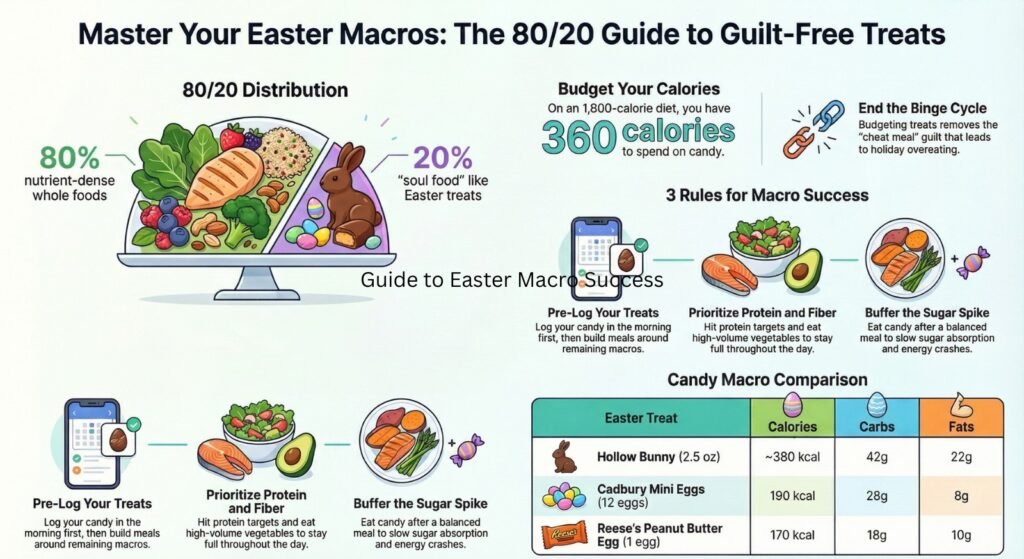
The solution to the holiday binge cycle is 80/20 rule macros (often associated with flexible dieting or IIFYM—If It Fits Your Macros). This nutritional philosophy champions balance over strict, miserable restriction. It proves that flexible dieting holidays are not an oxymoron; they are the key to long-term success.
The premise is straightforward:
- 80% of your daily calories should come from whole, nutrient-dense, minimally processed foods. Think lean proteins (chicken, fish, tofu), complex carbohydrates (oats, sweet potatoes), healthy fats (avocados, nuts), and plenty of fibrous vegetables and fruits. These are the functional foods that fuel your workouts, support your immune system, and keep you physically full.
- 20% of your daily calories are reserved for “soul food.” These are guilt-free Easter treats, the snacks, and the indulgences you genuinely love. They might not offer much in the way of vitamins or dietary fiber, but they provide massive psychological satisfaction, which keeps you compliant with your diet long-term.
Let’s look at the math: If you are wondering how to fit candy into a caloric deficit, it comes down to simple budgeting. If your daily caloric target for weight loss is 1,800 calories, the 80/20 rule dictates:
- 1,440 calories come from whole, nutritious foods.
- 360 calories are completely yours to spend on whatever you want—like a chocolate egg or a handful of jelly beans.
By purposefully budgeting for the treat, you remove the psychological taboo. The candy is no longer a “cheat” that derails your progress; it is a calculated, planned part of your daily energy intake.
Deconstructing the Basket: How to Track Chocolate in Macros
To master your Easter candy macros, you need to strip away the emotional weight of the food and look at it objectively through data. Chocolate is not inherently “bad” or “evil.” It is simply a combination of two macronutrients: Carbohydrates (sugar) and Fats (cocoa butter and dairy).
When you understand the exact macro profile of what you are eating, you can adjust the rest of your meals to accommodate it. Here is a breakdown of typical Easter basket staples so you can navigate them seamlessly:
1. The Classic Chocolate Bunny
Understanding chocolate bunny macros is crucial because this is often the centerpiece of the holiday.
- Calories in hollow chocolate bunny (approx. 2.5 oz): ~380 kcal
- Carbohydrates: 42g
- Fats: 22g
- Protein: 4g
- The Strategy: This is a hefty macro hit. If you want to eat the whole thing, treat it like a carbohydrate and fat side dish. Skip the rice, pasta, or heavy oils at dinner to make room for the macros, and use a very lean protein source (like white fish or chicken breast) to balance the meal.
2. Cadbury Mini Eggs (12 eggs / 40g)
- Calories: 190 kcal
- Carbohydrates: 28g
- Fats: 8g
- Protein: 2g
- The Strategy: These are incredibly easy to fit into your 20% budget. The danger here is portion control. Because they are small and candy-coated, mindless grazing will destroy your macro targets. Weigh out your 12 eggs, put the bag away, and log them before you eat a single one.
3. Reese’s Peanut Butter Egg (1 standard egg / 34g)
- Calories: 170 kcal
- Carbohydrates: 18g
- Fats: 10g
- Protein: 4g
- The Strategy: Thanks to the peanut butter filling, this treat is higher in fat. If you plan to eat one as an afternoon snack, simply hold back on the olive oil dressing or avocado in your lunch salad.
4. Peeps Marshmallow Chicks (5 chicks)
- Calories: 140 kcal
- Carbohydrates: 36g (pure sugar)
- Fats: 0g
- Protein: 0g
- The Strategy: Peeps are entirely fat-free, making them a pure, fast-digesting carbohydrate source. Because they lack fat and protein to slow down digestion, they will spike your blood sugar rapidly. It is best to eat these immediately after a high-protein meal or right before a heavy weightlifting session when your body can actively use the fast-acting glucose for energy.
3 Rules to Successfully Track Holiday Macros
Knowing the macros of your candy is only step one. Step two is actually fitting them into your day without starving yourself or missing your essential protein targets. If you want to pull off a macro friendly Easter, you must follow these three golden rules:
Rule 1: Pre-Log Your Treats
This is the most crucial step of flexible dieting. Do not eat the chocolate at 2:00 PM and hope you have enough macros left at 8:00 PM. In the morning, decide what treat you want. Open up your tracking app and log the chocolate first. Once the candy is locked into your daily budget, you can build your breakfast, lunch, and dinner around the remaining calories, carbs, and fats.
Rule 2: Protect Your Protein and Fiber
When you spend 300 calories on sugar and fat, you naturally have fewer calories left for food that physically fills up your stomach. To avoid feeling ravenously hungry, your 80% whole foods must be incredibly satiating. Do not compromise on your daily protein goal. If your goal is 130g of protein, hit it. Load up your meals with high-volume, low-calorie fibrous vegetables like spinach, zucchini, and broccoli. Fiber stretches your stomach receptors, sending signals to your brain that you are full.
Rule 3: Buffer the Sugar Spike
Eating a handful of jelly beans on an empty stomach will result in a severe blood sugar crash an hour later, leaving you fatigued and craving even more sugar. Instead of eating your Easter candy as a standalone snack, eat it as a “dessert” immediately following a balanced meal. The protein, fats, and fiber from your meal will slow down the absorption of the sugar in the candy, giving you a steady release of energy rather than a rollercoaster spike.
A Real-World Example: Your Macro Friendly Easter Menu
What does an IIFYM Easter actually look like in practice? Let’s say your daily targets calculated by our platform are 1,800 Calories | 130g Protein | 170g Carbs | 65g Fat.
Here is exactly how you can eat an entire Reese’s Peanut Butter Egg AND a handful of jelly beans while hitting your goals perfectly:
- Breakfast (High Protein / Low Fat):
- 1 cup liquid egg whites scrambled with spinach and tomatoes.
- 1/2 cup oatmeal with cinnamon.
- Lunch (High Volume / Moderate Carb):
- Massive grilled chicken salad (6 oz chicken breast) with loads of raw veggies.
- 2 tablespoons of low-fat vinaigrette.
- Afternoon Snack (The Easter Treat!):
- 1 Reese’s Peanut Butter Egg.
- 1 scoop of whey protein isolate mixed in water (to hit protein goals while buffering the sugar).
- Dinner (Balanced Whole Foods):
- 5 oz baked salmon.
- 1 cup roasted asparagus.
- 1/2 cup quinoa.
- Late Night Sweet Tooth:
- 15 Starburst Jelly Beans.
The Result: You hit your exact macro targets. You preserved your muscle mass, you fueled your body with vitamins and micronutrients, and you still enjoyed the quintessential tastes of the holiday without a single ounce of guilt.
The Bottom Line: Calculate Your Balance
A single day, or even an entire holiday weekend, will not ruin your progress unless you allow guilt to derail your habits for the following month.
The beauty of tracking your nutrition is that it puts you firmly in the driver’s seat. It transforms food from a stressful moral issue into a simple, manageable equation of energy balance.
This spring, don’t guess how much candy you can get away with. Know exactly where your baseline is. Head over to the Nutrients Calculator today to establish your customized daily caloric and macronutrient targets. Once you have your numbers, you can easily apply the 80/20 rule, ensuring you make consistent progress toward your goals while enjoying a truly happy, balanced holiday.