
Greek feta salad is a staple of Mediterranean cuisine, loved worldwide for its fresh vegetables, creamy feta cheese, and rich olive oil dressing. Whether you’re following a low-carb diet, managing your weight, or simply looking for a nutrient-dense meal, understanding the calorie and macronutrient content of this classic dish is essential. The beauty of Greek salad lies in its simplicity: tomatoes, cucumbers, olives, feta, and olive oil combine to create a balanced, satisfying meal.
But how many calories are actually in a serving of Greek feta salad? The answer depends on portion size, the amount of feta and olive oil used, and preparation methods. This guide breaks down the nutrition facts, compares common variations, and shows you how to enjoy this Mediterranean favorite without derailing your health goals.
Calories in Greek Feta Salad (Quick Answer)
A typical serving of Greek feta salad varies based on ingredients and dressing amount:
- 1 cup (150g) with standard dressing: 235 calories
- 1 large bowl (250g) with generous olive oil: 385 calories
- Restaurant-style serving (300g): 450–520 calories
Calorie counts vary significantly based on the ratio of feta cheese to vegetables, olive oil quantity, and whether you include olives.
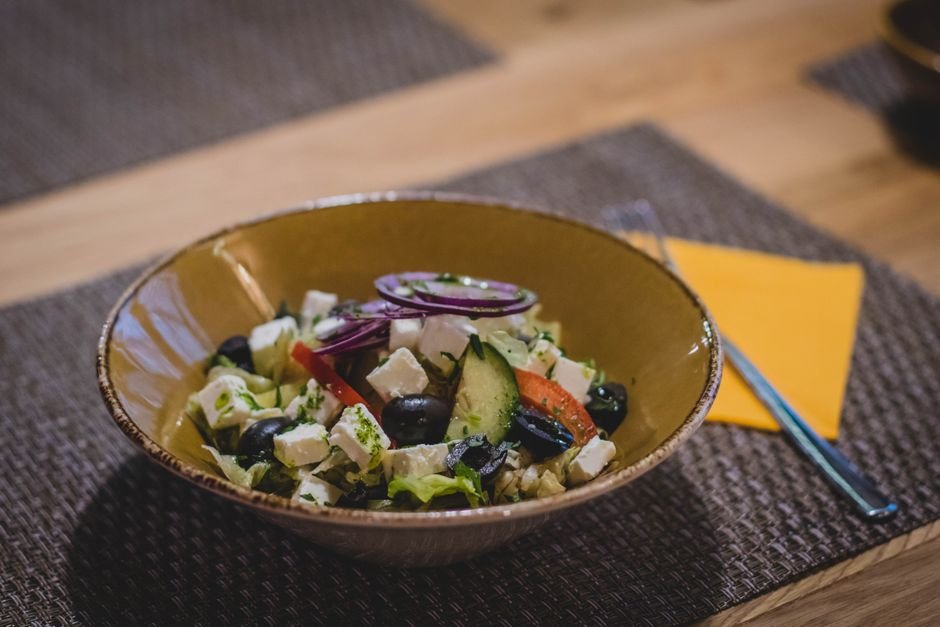
Full Nutrition Facts for 1 Cup (150g) of Greek Feta Salad
A standard 1-cup serving of Greek feta salad with typical proportions of tomatoes, cucumbers, red onion, olives, feta cheese, and olive oil-based dressing provides the following nutritional profile:
| Nutrient | Amount | % Daily Value |
|---|---|---|
| Calories | 235 | 12% |
| Total Fat | 17g | 26% |
| Saturated Fat | 6g | 30% |
| Cholesterol | 37mg | 12% |
| Sodium | 512mg | 22% |
| Total Carbohydrate | 9g | 3% |
| Dietary Fiber | 2g | 7% |
| Total Sugars | 5g | — |
| Protein | 6g | 12% |
| Calcium | 204mg | 16% |
| Iron | 1.3mg | 7% |
| Potassium | 286mg | 6% |
*Percent Daily Values are based on a 2,000-calorie diet. Source: USDA FoodData Central.
Key insight: Greek feta salad’s most notable feature is its high sodium content—22% of the daily value in just one cup—primarily from the feta cheese and olives. The fat content is predominantly unsaturated thanks to olive oil, making it heart-healthy despite the calorie density. The protein-to-carb ratio is excellent for those seeking a low-carb, nutrient-dense meal.

Etekcity Food Scale
0.1g accuracy — the perfect companion for exact portions.
Greek Feta Salad with Olive Oil Dressing vs. Vinegar Dressing
Greek Feta Salad with Olive Oil Dressing
- Contains 17g fat and 235 calories per cup due to the richness of extra virgin olive oil
- Provides heart-healthy monounsaturated fats and better fat-soluble vitamin absorption
- More authentic Mediterranean preparation, with a creamy, satisfying mouthfeel
Greek Feta Salad with Vinegar Dressing
- Contains only 3–4g fat and 110–130 calories per cup, cutting calories roughly in half
- Vinegar adds tangy flavor without fat or significant calories, plus may support blood sugar control
- Better choice for strict calorie restriction or those watching saturated fat intake
The takeaway: If you love Greek salad but want to cut calories significantly, replacing olive oil with vinegar-based dressing is the single most effective change. You’ll reduce calories by 50% without sacrificing flavor or the nutritional benefits of feta, vegetables, and olives.
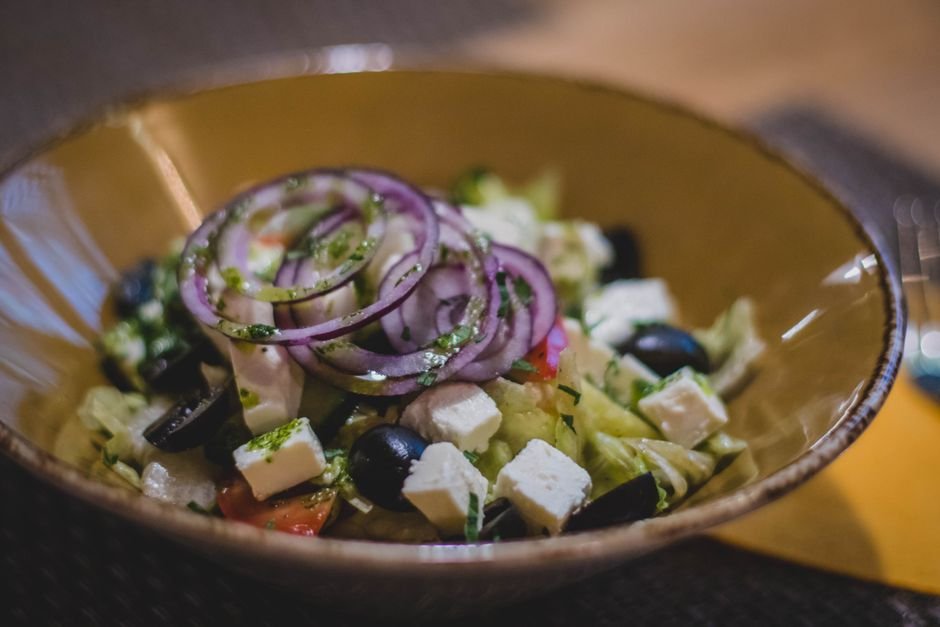
Is Greek Feta Salad Good for Weight Loss?
Greek feta salad can absolutely support weight loss when prepared mindfully. The salad is high in protein (6g per cup) and fiber (2g per cup), both of which promote satiety and reduce hunger. The vegetables provide volume and nutrients with minimal calories. The challenge is portion control of feta and olive oil—the two highest-calorie components. A vinegar-based dressing or using less olive oil can reduce calories substantially while keeping the salad satisfying.
Tips to Eat Greek Feta Salad Without Gaining Weight:
- Use vinegar or lemon juice instead of olive oil, or use just 1 tablespoon of olive oil instead of 2–3
- Measure or limit feta to 1.5 oz (about 3 tablespoons) per serving rather than filling the bowl
- Fill half your bowl with leafy greens or extra cucumbers and tomatoes to increase volume without calories
- Avoid pre-made salad mixes with added feta or oils; prepare fresh at home where you control portions
With these adjustments, you can enjoy Greek salad regularly as part of a weight-loss plan without guilt or excess calories.
How Portion Size Affects Calories
Portion size dramatically impacts the calorie content of Greek feta salad. Because feta, olives, and olive oil are calorie-dense, even small increases in portions add up quickly. A casual restaurant serving can contain 450–520 calories compared to a home-prepared cup at 235 calories. Understanding standard portions helps you make informed choices and track intake accurately.
Example:
- Small side salad (1 cup / 150g): 235 calories
- Large main-course bowl (2.5 cups / 375g): 590 calories
When ordering at a restaurant or preparing at home, be aware that Greek salad portions can easily double or triple, multiplying your calorie intake by the same factor.
Best Way to Measure Greek Feta Salad Accurately
Measuring Greek feta salad accurately requires attention to the highest-calorie components: feta, olives, and dressing. Unlike single foods, salads contain multiple ingredients that contribute different amounts. A food scale gives the most precise measurements, but cup measures work if you’re consistent. The dressing especially deserves attention, as it’s easy to underestimate tablespoons of olive oil.
Options:
- Food scale: Weigh the entire salad in a bowl, then subtract the bowl’s weight to get the salad weight in grams. Multiply by calorie per gram (roughly 1.6 calories/gram for Greek salad) for total calories.
- Cup or volume measure: Use a standard 1-cup (250ml) measure and fill consistently. This works reasonably well if you prepare your salad the same way each time.
- Measuring spoons for dressing: Always measure olive oil and vinegar separately by tablespoon (1 tablespoon olive oil = 120 calories) to avoid guessing.
Calculate Your Exact Calorie Intake
Want to know the precise calorie and macro breakdown of your specific Greek feta salad based on your exact portions and ingredients? Manual calculation is tedious when salads contain 6–8 components, each with different macros.
Try our free AI nutrients calculator at https://nutrientscalculator.com/. Simply enter your Greek salad ingredients, their exact amounts, and get an instant breakdown of calories, protein, carbs, fats, fiber, and micronutrients—customized to your recipe.
- Account for your exact portions of feta, olive oil, and olives without guesswork
- Compare calorie differences between vinegar and olive oil versions instantly
- Track daily intake across all meals to stay aligned with your health goals
Common Mistakes When Eating Greek Feta Salad
Even with the best intentions, it’s easy to make choices that inflate the calorie and sodium content of Greek salad. Here are the most common pitfalls:
❌ Using store-bought bottled dressing instead of making your own—commercial versions often contain 2–3 times the oil and added sugars
❌ Piling on feta cheese without measuring—it’s easy to add twice the intended amount, which doubles the calories
❌ Adding extras like croutons, pita chips, or “salad enhancers” that add 100+ calories while contributing little nutrition
❌ Eating a “salad” that’s mostly olives and feta with minimal vegetables—reversing the ratio defeats the health benefits
Being mindful of these traps helps you enjoy Greek salad as a genuinely nutritious meal rather than a calorie bomb in disguise.
FAQ
How many calories are in 100g of Greek feta salad?
Approximately 157 calories per 100g, assuming standard proportions of vegetables, feta, olives, and olive oil dressing. Salads with extra dressing or feta may reach 180+ calories per 100g.
Is Greek feta salad fattening?
Not inherently. Greek salad is nutrient-dense and high in protein and fiber, which support satiety. It becomes “fattening” only when portions are excessive, feta and olive oil dominate the mix, or it’s paired with high-calorie sides. A moderate cup-sized portion is part of any healthy diet.
Can I eat Greek feta salad on a low-carb or keto diet?
Yes. One cup contains only 9g carbs (7g net carbs after fiber), making it suitable for low-carb and keto diets. Focus on the vegetables, feta, and olives, and use olive oil or vinegar dressing to keep the meal keto-compliant.
Why is Greek feta salad so high in sodium?
Feta cheese and olives are both preserved with salt, giving Greek salad its signature salty flavor. One cup provides 22% of the daily sodium limit. If sodium intake is a concern, reduce feta and olive portions, rinse canned olives, or choose low-sodium versions.
Conclusion
Greek feta salad is a nutritionally balanced, delicious meal that can fit into almost any diet—from Mediterranean eating patterns to low-carb plans to weight loss regimens. At 235 calories per cup with solid protein (6g) and fiber (2g), it’s more nutrient-dense than many “lighter” salads. The main consideration is managing portions of calorie-dense ingredients like feta and olive oil, and being mindful of sodium intake.
Whether you’re tracking calories for weight loss, counting macros for fitness, or simply eating well, knowing the nutrition facts of your food is the foundation of informed choices. Use a reliable **nutrients calculator** to dial in your exact portions and ingredients, then enjoy your Greek salad with confidence.
