
It happens every April. The heavy winter clothing starts going back into the closet, vacation plans are finalized, and a sudden wave of urgency hits: summer is practically here. If you spent the colder months in a surplus trying to build muscle, the time has come to pivot. However, the transition from building muscle to shedding body fat is where most people hit a wall. If you want to reveal the muscle you’ve built over the winter, you need to know exactly how to recalculate macros for pre-summer fat loss.
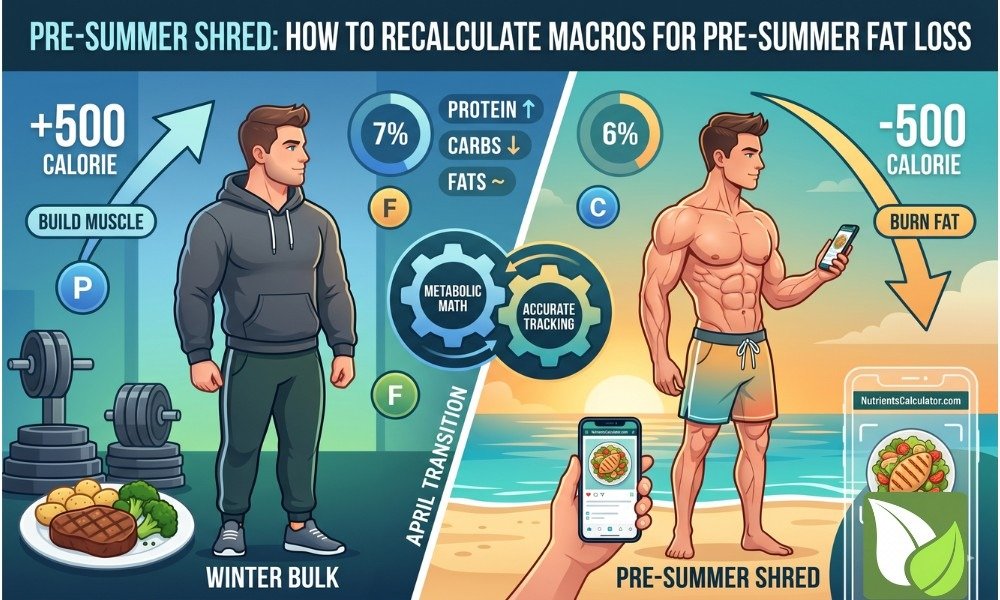
The biggest hurdle isn’t a lack of willpower; it’s the sheer frustration and mathematical fatigue of dietary transition. When you move into a caloric deficit, your margin for error shrinks drastically. Let’s dive deep into the nutritional science of the shred, the specific adjustments you need to make, and how modern technology can completely eliminate the tedious burden of tracking your food.
The Pain of the Pivot: Why Transitioning from Bulk to Cut Fails
When you are bulking, a miscalculation of 200 calories usually just means slightly more growth (and perhaps a tiny bit more fat). Your primary goal is ensuring you eat enough.
However, when you adjust macros for a summer shred, that exact same 200-calorie miscalculation can completely wipe out your daily deficit, leaving you stagnant for weeks. This is the hyper-specific pain point that ruins diets: the tyranny of manual logging in a strict deficit.
Imagine this scenario: You are eating a mixed bowl from a local restaurant. To log this traditionally, you have to guess the weight of the chicken, search for an entry that matches the mystery marinade, estimate the volume of the rice, and blindly guess how much oil the chef used on the vegetables. You spend ten minutes staring at your phone, typing in disparate ingredients, only to end up with a wildly inaccurate macro profile.
When your daily calorie limit drops from 3,000 to 2,200, this tedious, inaccurate guesswork is what causes plateaus. The friction of weighing every single grain of rice or reverse-engineering a 10-ingredient recipe leads to “tracking fatigue,” causing people to abandon their pre-summer shred entirely.
How to Recalculate Macros for Pre-Summer Fat Loss (The Science)
To properly execute a cut, you must manipulate your metabolic mathematics. Here is the step-by-step nutritional science behind a successful pre-summer recalibration.
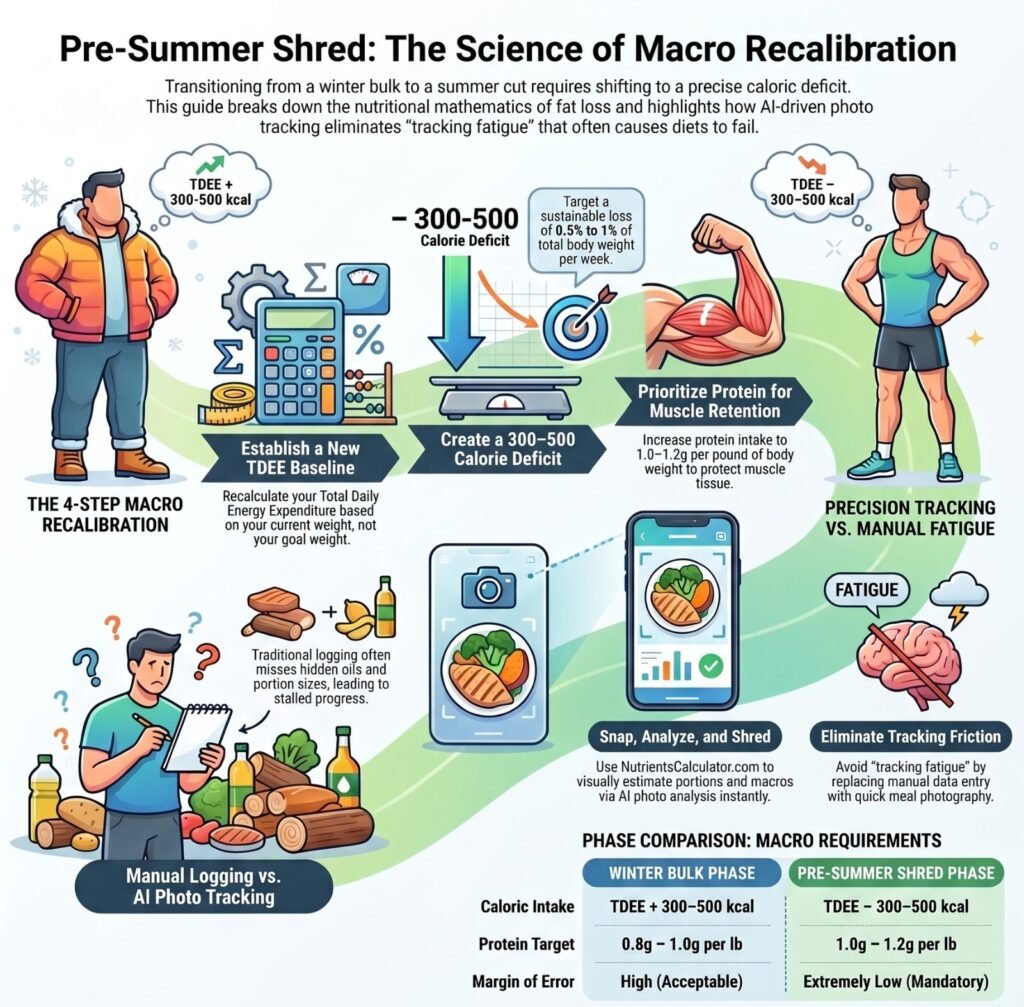
1. Establish Your New Baseline (TDEE)
Your Total Daily Energy Expenditure (TDEE) is not static. If you gained 10 pounds over the winter, your body now requires more energy just to exist than it did in the fall. Before you do anything else, recalculate your current TDEE based on your current body weight, not your goal weight.
2. Create the Deficit
For a safe, muscle-sparing shred, you should aim to lose between 0.5% to 1% of your total body weight per week. This generally requires a daily caloric deficit of 300 to 500 calories.
- Example: If your new TDEE is 2,700 calories, your pre-summer shred target should be set between 2,200 and 2,400 calories.
3. Pin down the Protein
When you transition from bulk to cut, protein becomes your most vital macronutrient. In a surplus, your body is highly anabolic and muscle is protected. In a deficit, your body looks for fuel anywhere it can find it, including your hard-earned muscle tissue. You must increase your protein ratio. Aim for 1.0 to 1.2 grams of protein per pound of body weight.
4. Modulate Fats and Carbs
Once calories and protein are locked in, fill the remaining calories with fats and carbohydrates.
- Fats: Keep dietary fat at around 20-25% of your total calories to maintain healthy hormone production (like testosterone, which is crucial for maintaining muscle mass in a deficit).
- Carbs: The rest of your caloric budget goes to carbohydrates. Carbs will fuel your intense workouts and keep your muscle bellies looking full. As you progress deeper into your cut, carbohydrates are the macronutrient you will gradually reduce to continue driving fat loss.
The Frictionless Solution: NutrientsCalculator.com
Understanding the math is only 10% of the battle; accurately executing it every single day is the other 90%. As established, manual tracking is the enemy of consistency.
This is where NutrientsCalculator.com changes the game. We designed this AI macro tracking app to completely eliminate the friction of dieting. Instead of searching, weighing, guessing, and typing, you simply snap a photo of your food.
Our platform uses advanced visual AI to instantly analyze your meal. Within seconds, NutrientsCalculator.com identifies the foods, estimates the portion sizes, and provides highly accurate calorie counts, protein, fats, and carbohydrate breakdowns.
There is absolutely no manual logging required. If you are at a restaurant trying to stay in your deficit, you don’t need to awkwardly deconstruct your meal or interrogate the waiter. You take a quick picture, the photo food tracker does the heavy lifting, and your daily totals are automatically updated. By removing the tedious mechanics of tracking, you can focus entirely on your training and consistency, guaranteeing you hit your pre-summer goals.
Real-World Scenarios: The Cut in Action
Let’s look at two common scenarios where a flawless tracking strategy makes or breaks a summer shred.
Scenario 1: The Office Catered Lunch Trap
It’s a Wednesday in early May. The office ordered catered Greek food: grilled chicken skewers, Mediterranean salad, pita, and hummus.
- The Old Way: You skip the lunch entirely, alienating your coworkers, or you try to manual-log it. You guess “1 cup of salad” and “4 oz of chicken.” You forget to log the heavy olive oil dressing and the generous scoop of hummus. You unknowingly consume 900 calories instead of your planned 500, wiping out two days’ worth of your caloric deficit.
- The NutrientsCalculator Way: You build your plate, snap a quick photo with your phone, and enjoy your meal with your team. The AI detects the hidden oils in the dressing and accurately gauges the hummus portion, logging 840 calories. Because you have the exact data instantly, you know to skip your afternoon carb-heavy snack and opt for a zero-calorie beverage, perfectly preserving your daily deficit.
Scenario 2: The “Healthy” Smoothie Overestimation
You are making a post-workout smoothie at home: protein powder, a banana, almond milk, and peanut butter.
- The Old Way: You measure the powder and milk, but you just scoop out a “spoonful” of peanut butter. That innocent-looking scoop is actually 2.5 tablespoons, packing an extra 150 hidden calories of fat. Over a week, this daily error adds over 1,000 extra calories to your diet, stalling your fat loss completely.
- The NutrientsCalculator Way: You snap a photo of the ingredients on your counter before blending. The AI recognizes the volume of the peanut butter scoop visually, logging the true caloric weight of the fats. You instantly see the macro breakdown and decide to halve the peanut butter to stay strictly within your cutting parameters.
Macro Adjustments: Bulking vs. Pre-Summer Shred Chart
To visualize the transition, use this reference chart comparing a bulking phase to a cutting phase for a hypothetical 180 lb individual.
Dietary Phase Comparison Chart
| Metric / Feature | The Winter Bulk Phase | The Pre-Summer Shred Phase |
| Primary Goal | Maximize muscle hypertrophy | Preserve muscle, maximize fat oxidation |
| Caloric Intake | TDEE + 300 to 500 calories | TDEE – 300 to 500 calories |
| Protein Target | 0.8g – 1.0g per lb of body weight | 1.0g – 1.2g per lb of body weight |
| Carbohydrate Target | High (Fuels heavy progressive overload) | Moderate to Low (Tapered as weight drops) |
| Fat Target | 20% – 30% of total calories | 20% – 25% of total calories (Strictly monitored) |
| Margin of Error | High (Overeating slightly is acceptable) | Extremely Low (Accuracy is mandatory) |
| Ideal Tracking Method | Lazy tracking / estimating | NutrientsCalculator.com (AI Photo Tracking) |
| Expected Timeline | 4 to 8 Months | 8 to 12 Weeks |
FAQ: Mastering Your Summer Shred Macros
1. How often should I adjust my macros when cutting?
You do not need to adjust your macros every single day or even every week. A good rule of thumb is to recalculate your macros for pre-summer fat loss only when your weight loss stalls for two consecutive weeks. If the scale isn’t moving and your visual progress has halted, drop your daily intake by another 100-150 calories, primarily by reducing carbohydrates, and monitor for another two weeks.
2. What is the best macro ratio for a summer shred?
While exact ratios vary by individual genetics and activity levels, a highly effective starting point for a shred is 40/40/20 (40% Protein, 40% Carbohydrates, 20% Fats). This ensures high protein for muscle retention, enough carbs to sustain gym performance, and the minimum required fats for hormonal health.
3. How do I track macros accurately without using a food scale?
Traditionally, avoiding a food scale meant guessing, which leads to failed diets. However, utilizing a photo food tracker like NutrientsCalculator.com completely bridges this gap. By leveraging computer vision and vast nutritional databases, the app analyzes the spatial volume of the food in your photo, giving you scale-like accuracy without the need to carry digital measuring equipment everywhere you go.
4. Should I cut carbs or fats for pre-summer fat loss?
Once your protein target is hit (which is non-negotiable), it is generally better to cut carbohydrates to drive further fat loss. Fats should rarely drop below 20% of your total daily intake, as very low-fat diets can cause your testosterone and other essential hormones to crash, which will make you feel lethargic and cause muscle loss. Keep your fats stable and slowly taper your carbs.
5. Why am I losing weight but not looking shredded?
If the scale is going down but you look “soft” or “flat,” you are likely losing muscle tissue alongside body fat. This usually happens for three reasons: your caloric deficit is too aggressive (eating far too little), you aren’t eating enough protein, or you aren’t training with enough intensity to signal to your body that it needs to keep its muscle. Ensure your deficit is moderate (around 500 calories max) and utilize an AI macro tracking app to guarantee you are actually hitting your daily protein targets.
Final Thoughts: Execute with Precision
The window to get ready for summer is closing, but a well-executed plan starting right now in April will yield dramatic results by June. Remember, the science of fat loss is undefeated: maintain a caloric deficit, keep your protein high, and train hard.
The only variable that usually trips people up is the friction of data entry. Don’t let the tediousness of manual typing ruin your physique goals. By learning how to recalculate macros for pre-summer fat loss and utilizing the frictionless, photo-based tracking of NutrientsCalculator.com, you can remove the guesswork, eliminate tracking fatigue, and finally achieve the lean, shredded physique you’ve been working toward all winter. Grab your phone, snap your meals, and let the AI do the math while you do the work.