
Macadamia nuts are one of the world’s most luxurious and calorie-dense tree nuts, prized for their rich, buttery flavor and creamy texture. Originally native to Australia, they’re now widely cultivated in Hawaii, California, and other warm climates. They’re popular among those following keto and low-carb diets, but their high calorie content means careful portion control is essential for weight management.
If you’re adding macadamia nuts to your daily intake—whether for snacking, baking, or as a keto staple—understanding their exact calorie and nutrient profile is crucial. How many calories are in macadamia nuts, and how do they fit into a balanced diet? This guide covers everything you need to know about macadamia nut nutrition, portion sizes, and smart eating strategies.
Calories in Macadamia Nuts (Quick Answer)
A 1-ounce (28g) serving of macadamia nuts contains roughly 200 calories—among the highest of any tree nut.
- Raw macadamia nuts (1 oz / 28g): 204 calories
- Roasted macadamia nuts (1 oz / 28g): 204 calories
- Salted roasted macadamia nuts (1 oz / 28g): 204 calories
Exact values vary slightly depending on whether nuts are raw, roasted, or salted, but the calorie count per ounce remains remarkably consistent. Oil content varies by brand and processing method.
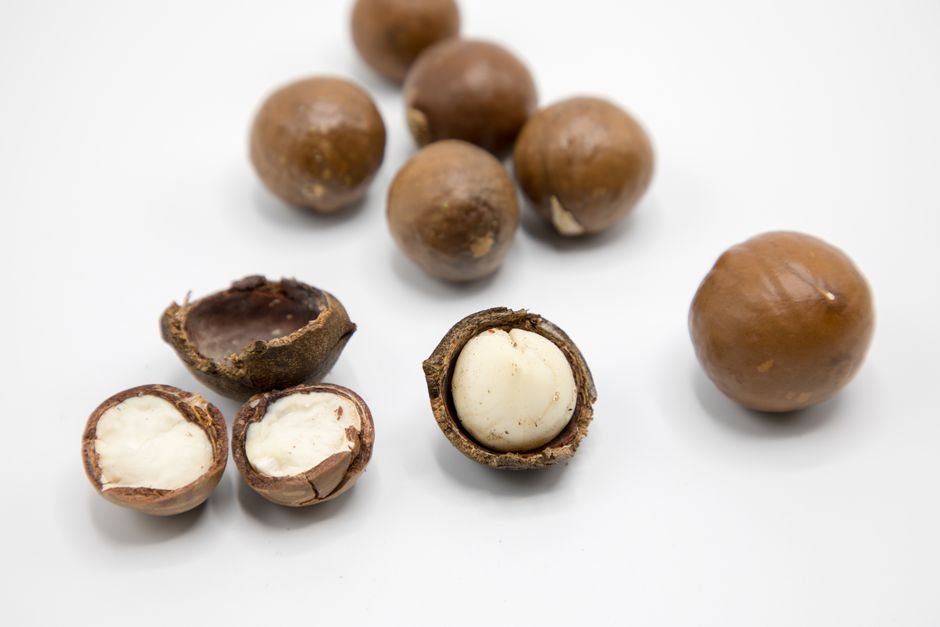
Full Nutrition Facts for 1 Ounce (28g) of Macadamia Nuts
Here’s the complete nutritional breakdown of raw macadamia nuts per 1-ounce serving, based on USDA FoodData Central data:
| Nutrient | Amount | % Daily Value |
|---|---|---|
| Calories | 204 | — |
| Total Fat | 21.5g | 28% |
| Saturated Fat | 3.4g | 17% |
| Cholesterol | 0mg | 0% |
| Sodium | 5mg | <1% |
| Total Carbohydrate | 3.9g | 1% |
| Dietary Fiber | 2.4g | 9% |
| Total Sugars | 1.3g | — |
| Protein | 2.2g | 4% |
| Manganese | 1.2mg | 60% |
| Magnesium | 37mg | 9% |
| Thiamine (Vitamin B1) | 0.2mg | 13% |
*Percent Daily Values are based on a 2,000-calorie diet. Source: USDA FoodData Central.
Key insight: Macadamia nuts are nearly fat calories—about 94% of their energy comes from fat, with almost no protein (just 2.2g per ounce). The fat is predominantly monounsaturated, which is considered heart-healthy, but the minimal protein and fiber relative to calorie density means they’re best paired with protein-rich foods or eaten in very small portions to maintain satiety. Their exceptional manganese content (60% of daily value per ounce) supports bone health and metabolism, but these nuts provide virtually no vitamin C, folate, or other micronutrients found in fresher plant foods.

Etekcity Food Scale
0.1g accuracy — the perfect companion for exact portions.
Raw vs. Roasted Macadamia Nuts
Processing method affects flavor, texture, and slight nutrient changes, though calorie density stays nearly identical.
Raw Macadamia Nuts
- Mild, subtle buttery flavor and softer, slightly pasty texture
- Retain all heat-sensitive micronutrients (thiamine, folate) with negligible enzyme degradation
- Lower sodium content (less than 5mg per ounce), making them ideal for low-sodium diets
Roasted Salted Macadamia Nuts
- Richer, toasted flavor and crunchier texture due to moisture loss during roasting
- Sodium content rises dramatically—from <5mg to 100–200mg per ounce depending on salt application
- Slight moisture reduction can marginally increase calorie density per gram, though per-ounce calories stay the same
Practical takeaway: Raw macadamia nuts are superior if you’re managing sodium intake or following a whole-foods diet. Roasted varieties offer better flavor and crunch but add 20–40 times more sodium per serving. Neither offers significant nutritional advantage; choose based on taste preference and dietary restrictions. Both contain identical macronutrient profiles and calorie density when measured by weight.
Is Macadamia Nuts Good for Weight Loss?
Macadamia nuts are extremely calorie-dense and protein-poor, making uncontrolled portions a weight-loss risk. A small handful (1 oz) supplies 204 calories but only 2.2g protein—insufficient to trigger satiety signals for most people. However, their monounsaturated fat content does support metabolic health, and their minimal net carbs (1.5g per ounce after fiber) make them compatible with ketogenic diets when portions are strict. The key is treating them as a luxury add-on rather than a standalone snack.
Tips to Eat Macadamia Nuts Without Gaining Weight
- Weigh your portions: Pre-measure 1-ounce (28g) servings and store in small containers. Mindless snacking from a bulk container can easily lead to 3–4 ounces consumed without awareness, totaling 600–800 calories.
- Pair with protein and fiber: Combine a small handful of macadamia nuts with Greek yogurt, an apple, or a boiled egg to enhance satiety and slow fat digestion, preventing blood sugar spikes.
- Limit frequency: Reserve macadamia nuts as an occasional treat 2–3 times weekly rather than a daily snack. This prevents calorie creep while allowing you to enjoy them guilt-free.
- Use them as flavor, not filler: Chop or crush macadamia nuts and sprinkle over salads, oatmeal, or roasted vegetables rather than eating whole. A tablespoon (about 10g) adds richness without derailing calorie budgets.
When eaten mindfully in strict portions, macadamia nuts can fit into a weight-loss plan. Their satiating monounsaturated fat and near-zero carb content align well with calorie-conscious and keto-focused eating strategies. The risk lies in portion creep—their addictive flavor and small physical volume make it easy to exceed intended intake.
How Portion Size Affects Calories
Macadamia nuts’ calorie density means small serving differences create significant calorie gaps. Because 1 ounce (28g) contains 204 calories and weighs very little by volume, it’s easy to underestimate intake by eye. Moving from a “small handful” (which many estimate as 1 oz) to an absent-minded “double handful” from a bulk container can mean the difference between 200 and 400+ calories consumed in seconds.
Example
- Small portion (½ oz / 14g): 102 calories, 10.75g fat, 1.1g protein
- Standard serving (1 oz / 28g): 204 calories, 21.5g fat, 2.2g protein
- Large handful (2 oz / 56g): 408 calories, 43g fat, 4.4g protein
Use a kitchen scale to measure portions. A digital scale accurate to 0.1g ensures you stay within your intended calorie and fat targets, especially when tracking macros for keto or calorie-restricted diets.
Best Way to Measure Macadamia Nuts Accurately
Visual estimation fails with macadamia nuts because their small, dense structure and irregular shapes create inconsistent volume-to-weight ratios. A handful can vary from 0.8 oz to 1.5 oz depending on hand size and packing force. Accurate measurement is non-negotiable if you’re tracking calories or managing portion control for weight loss or keto diets.
Options
- Digital kitchen scale (most accurate): Weigh nuts directly onto the scale’s pan. Set tare (zero) between items. Aim for 28g per serving. Cost: $15–$30. Accuracy: ±1g.
- Measuring cup (second choice): Use a standard 1/4 cup measuring cup; 1 oz of macadamia nuts fills roughly 1/4 cup when loosely packed. Less precise than a scale but far better than freehand estimation.
- Pre-portioned bags (convenience option): Buy individual 1-oz bags or portion them yourself into small containers at purchase. Eliminates the need to measure repeatedly, though slightly more expensive per ounce.
Calculate Your Exact Calorie Intake
Macadamia nuts’ high calorie density means even small deviations from your intended portion add up. If you’re combining them with other foods—nuts with dried fruit, nut butters, or nut-based desserts—the calorie total can exceed your targets rapidly without careful tracking.
Our site offers a free AI-powered nutrients calculator that instantly breaks down calories, macros, and micronutrients for macadamia nuts and thousands of other foods. Instead of relying on tables or guesswork, you can input your exact portion (by weight or volume) and see real-time nutritional data tailored to your diet goals.
- Personalized macro tracking: Input your specific portion and see exactly how many grams of fat, protein, and carbs you’re consuming—essential for keto and calorie-restricted diets.
- Compare varieties instantly: See side-by-side nutrition data for raw vs. roasted vs. salted macadamia nuts and other tree nuts (almonds, walnuts, pecans) to make informed swaps.
- Build balanced meals: Log macadamia nuts with other ingredients and see how the combination affects your daily calorie and macro totals.
Try the free nutrients calculator to take the guesswork out of macadamia nut portions.
Common Mistakes When Eating Macadamia Nuts
Even health-conscious eaters make portion and pairing errors with macadamia nuts. Here are the most frequent missteps:
❌ Eating directly from a bulk container or bag without measuring: Most people underestimate how quickly small, calorie-dense nuts accumulate. A “quick snack” of unmeasured macadamias often totals 400–600 calories without awareness, sabotaging calorie or macro targets.
❌ Treating macadamia nuts as a “healthy fat” with no calorie limit: While monounsaturated fats do support heart health, calories still count. Consuming unlimited quantities under the guise of “clean eating” leads to rapid weight gain, even on low-carb diets.
❌ Pairing them only with other fats or carbs (nut butter smoothies, chocolate-covered nuts, or sugary trail mix): Macadamia nuts need protein and fiber anchors to trigger satiety. A macadamia-heavy smoothie made with nut butter, coconut milk, and sweetener is 600+ calories of pure fat and carbs, leaving you hungry an hour later.
❌ Assuming roasted = healthier than raw: Both contain identical calories and macronutrients. Roasting adds crunch and flavor but also adds 100–200mg sodium per ounce in salted varieties, which is problematic for blood pressure or sodium-restricted diets.
Awareness of these pitfalls—especially the portion blindness that plagues dense nuts—is the first step to incorporating macadamia nuts without derailing your health goals.
FAQ
How many calories are in 100g of macadamia nuts?
100g of macadamia nuts contains approximately 718 calories. Since 1 ounce (28g) has 204 calories, 100g represents roughly 3.6 ounces. This makes macadamia nuts one of the most calorie-dense foods by weight—higher than olive oil or butter on a gram-for-gram basis.
Is macadamia nuts fattening?
Macadamia nuts are not inherently “fattening,” but their extreme calorie density (204 per ounce) makes overconsumption easy. In controlled portions (1 oz, 2–3 times weekly), they fit into weight-maintenance and weight-loss diets. Uncontrolled eating or daily portions of 2+ ounces will contribute to weight gain regardless of diet quality. The risk is portion creep, not the food itself.
Are macadamia nuts keto-friendly?
Yes—macadamia nuts are excellent for ketogenic diets. With only 1.5g net carbs per ounce (after subtracting fiber), they support ketosis. Their high monounsaturated fat content (15–16g per ounce) aligns with keto macros. However, they contain minimal protein (2.2g), so they should be paired with protein sources like cheese, eggs, or meat rather than eaten as a meal on their own.
Can macadamia nuts lower cholesterol?
Macadamia nuts are rich in monounsaturated fats, which have been shown in some studies to improve cholesterol ratios and reduce LDL (“bad”) cholesterol when substituted for saturated fats. However, nuts are not a cholesterol-lowering medication; any benefit comes from their fat profile when part of an overall balanced diet. Individual results vary based on genetics, baseline cholesterol levels, and overall diet quality.
Conclusion
Macadamia nuts are nutrient-dense but calorie-extremely dense, delivering 204 calories and 21.5g fat per ounce with minimal protein (2.2g) or carbs (3.9g). Their monounsaturated fat profile supports heart health, and their manganese and magnesium content contributes to bone and metabolic function. However, their low satiety-per-calorie ratio makes uncontrolled portions a risk for weight gain, and their minimal fiber and protein mean they’re best paired with whole foods rather than eaten solo.
If you enjoy macadamia nuts, prioritize strict portion control using a kitchen scale, pair them with protein and fiber, and reserve them as an occasional luxury rather than a daily staple. To remove guesswork from tracking and ensure you’re hitting your calorie and macro targets, use a reliable nutrients calculator to log your exact intake and see how macadamia nuts fit into your overall diet plan.
