
If you’ve searched “nutrition journal food diary 2026” recently, you’ve probably noticed something odd: most of the results either push you toward an app or tell you paper is old-fashioned. Both camps are wrong, honestly. The best tracking method is the one you’ll actually stick with past week two — and that answer is different for everyone.
Here’s the thing: food tracking works. Not because it’s magic, but because writing down what you eat forces a momentary pause before you eat it. A 2019 study published in Obesity found that participants who logged their meals six or seven days a week lost twice as much weight as those who tracked less consistently. The tool mattered far less than the habit.
Table of Contents
- Before You Buy: The Three Things That Actually Matter
- The Common Misconception Worth Clearing Up
- Best Nutrition Journals and Food Diaries in 2026: Paper vs App
- 1. Intelligent Change Nutrition Journal (Paper)
- 2. Fitlosophy Fitbook (Paper/Hybrid)
- 3. Cronometer (App, Free and Gold tiers)
- 4. MyFitnessPal Premium (App)
- 5. The 90-Day Planner by Papier (Paper, Custom Design)
- Paper vs App: An Honest Side-by-Side
- Who Should Pick What
But the tool still matters. A clunky app you hate opening will get abandoned by February. A journal that doesn’t fit in your bag will live on your desk untouched. So let’s actually compare what’s out there for the nutrition journal food diary 2026 landscape — paper, hybrid, and app-based — and figure out what fits your life.
Before You Buy: The Three Things That Actually Matter
Most buying guides tell you to look for “features” and “design.” That’s not wrong, but it’s not specific enough. Here are three sharper criteria worth using before you commit.
The Friction Test. How many steps does it take to log a meal? For an app, it might mean unlocking your phone, opening the app, searching a food, adjusting the portion, and confirming. For a paper journal, it might mean finding a pen. Whatever process takes fewer steps for you personally wins. If you hate typing on your phone, the most feature-rich app in the world won’t save you.
The Numbers Depth Check. Do you only need calories? Or do you need fiber, net carbs, sodium, and omega-3s broken out per meal? Paper journals by definition cap out at whatever you manually write. Apps connected to the USDA database (or a large food database) give you micronutrient data you simply cannot get from a ruled notebook. If you’re managing Type 2 diabetes or tracking a therapeutic keto diet, this is the deciding factor right there.
The Ecosystem Test. If you’re already using a Fitbit, Apple Watch, or a glucose monitor, picking a food diary that integrates with that ecosystem saves time and gives you genuinely richer data. A paper journal will never sync with your step count. But if you have no wearables and no intention of getting any, that integration is a non-factor — don’t pay for it.
The Common Misconception Worth Clearing Up
People assume apps are more accurate than paper. They’re not, automatically. Apps are only as accurate as the food database behind them and the portion sizes you enter. If you search “chicken breast” in a generic app and pick the first result without checking the weight, you might be off by 200 calories. Paper is only as accurate as your food knowledge and how honest you are. Neither medium is inherently precise — the user is the variable.
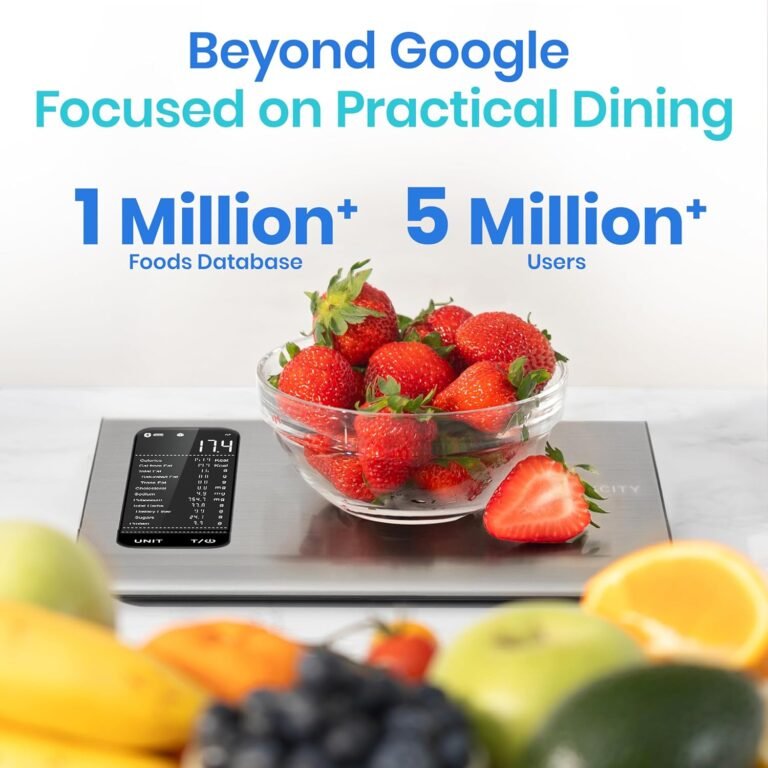
Etekcity Food Scale
0.1g accuracy — the perfect companion for exact portions.
Best Nutrition Journals and Food Diaries in 2026: Paper vs App
1. Intelligent Change Nutrition Journal (Paper)
The Verdict: A genuinely structured paper diary that goes beyond blank lines and actually teaches you to track properly.
Intelligent Change has built a reputation for habit journals that feel thoughtful rather than generic, and their dedicated nutrition journal carries that through. Each daily spread gives you space to log three meals and snacks, track water intake, note hunger levels before and after eating, and write a short reflection. That last piece is more useful than it sounds. Tracking emotional eating patterns — the afternoon desk-snack spiral, the late-night cereal bowl — is something most apps will never capture the way a written sentence does.
The honest limitation: there are no macro columns. You can write down “grilled salmon, sweet potato, broccoli” but if you actually need to know whether you hit 150g of protein today, you’ll be doing mental math or cross-referencing another tool. It works beautifully as a mindful eating companion, but it is not a macro tracker. People who buy it expecting a calorie log will be disappointed.
Best for: People in the early stages of building food awareness who find apps stressful or clinical — particularly those recovering from disordered eating who want a gentler, reflective approach rather than a numbers-heavy system.

2. Fitlosophy Fitbook (Paper/Hybrid)
The Verdict: The most structured paper tracker on the market, built specifically for people who want to log calories and workouts in one place.
Fitbook has been around since 2009, which in the wellness product world is an eternity. The 12-week format includes dedicated macro rows for protein, carbs, and fat per meal, a daily calorie target line, and a weekly check-in section where you review patterns. It’s the closest paper gets to mimicking an app’s structure without needing a screen. The layout is tight and logical — you can see a full day at a glance without flipping pages.
Real criticism: the portion of each page dedicated to workout logging competes with the food logging space. If you’re purely focused on nutrition and don’t train — or you train and track your workouts in a separate app — you’ll find yourself staring at half a page of unused gym fields every day. The 12-week lifespan also means you’re buying this roughly four times a year, which adds up to around $60-80 annually depending on where you buy it.
Best for: Gym-goers who want one analog tool for both nutrition and training, and who are motivated by filling in physical columns rather than tapping a screen.
3. Cronometer (App, Free and Gold tiers)
The Verdict: The most micronutrient-complete food diary app available right now, and it’s not particularly close.
If you’ve only used MyFitnessPal, opening Cronometer for the first time is a bit humbling. It tracks over 84 micronutrients including molybdenum and chromium, not just the standard calorie, protein, carb, fat breakdown. For anyone managing a health condition — hypothyroidism, kidney disease, diabetes, iron-deficiency anemia — this level of detail is genuinely transformative. You can set custom nutrient targets based on your specific lab values if you want to go that deep.
The database uses USDA-verified food entries as the foundation, which means far fewer of the obviously wrong crowd-sourced entries you find in competitor apps. That said, the free version does include ads, and the Gold tier ($8.99/month or around $49.99/year) is honestly worth it if you’re a serious tracker. The interface takes about a week to feel intuitive. It is not a casual app — it rewards people who actually want to understand their nutrition, not just hit a calorie number.
Best for: Nutrition-aware users managing a specific health condition, athletes dialing in micronutrients, or anyone who has outgrown the surface-level data that most food diary apps provide.
4. MyFitnessPal Premium (App)
The Verdict: The most widely used food diary app in the world — and that scale is both its biggest strength and its most annoying weakness.

Let’s be direct: MyFitnessPal’s database of over 14 million foods is unmatched. If you’re eating a specific supermarket product in the US, UK, Canada, or Australia, the barcode scanner will almost certainly find it in under three seconds. That convenience is real. The app also integrates with more third-party devices than any competitor — Apple Health, Garmin, Fitbit, Withings scales, Strava — making it the natural choice if you’re already living inside that ecosystem.
The honest problem is the database itself. Because it’s crowd-sourced, errors are rampant. Search “banana” and you’ll find entries ranging from 70 to 140 calories depending on which user submitted it. A 2019 analysis of food diary apps found that user-submitted entries in crowd-sourced databases had an average calorie error rate of over 50% for some foods. You have to learn to use verified entries only, which takes discipline. The free tier also became significantly more restricted in 2022, pushing most useful features like macro goal customization behind the $19.99/month Premium paywall — which is, frankly, expensive.
Best for: People who prioritize convenience and database size over data purity, particularly those tracking mainstream packaged foods and already using a fitness wearable.
5. The 90-Day Planner by Papier (Paper, Custom Design)
The Verdict: A beautifully designed paper journal that works as a nutrition diary if you set it up right — and doubles as a life planner.
Papier isn’t a nutrition brand. They make stationery. But their 90-day planners have quietly become a favourite among people who want to track food habits alongside broader wellness goals — sleep, mood, movement, hydration — in one aesthetic, portable notebook. You design the cover, choose a layout, and essentially create a custom wellness journal. For the nutrition journal food diary 2026 user who finds clinical macro-tracking de-motivating, Papier offers something different: a genuinely pleasant object you look forward to opening.
The limitation is obvious: this is a blank-slate system. There’s no built-in nutritional structure. You’re drawing your own food log columns, deciding your own tracking categories, and calculating your own numbers. That freedom is either exciting or exhausting depending on your personality. If you need the guardrails of a structured layout, this will frustrate you within a week. If you’re someone who thrives with a personalised system and already knows what data you want to capture, it’s one of the nicest physical tracking experiences available.
A realistic use case: pair this with a simple calorie app (even the free tier of Cronometer) for the numbers, and use the Papier journal for the qualitative stuff — how you felt after eating, whether you cooked or ordered in, patterns you’re noticing. That hybrid approach is genuinely underrated in the nutrition journal food diary 2026 space.
Best for: Creative, self-directed trackers who want a beautiful, flexible paper system and don’t need pre-built macro columns — especially useful as a companion to an app rather than a standalone calorie counter.
Visit our Best Food Scales section for more resources on Nutrients Calculator.
Paper vs App: An Honest Side-by-Side
| Feature | Paper Journal | App |
|---|---|---|
| Micronutrient tracking | Manual only (impractical) | Automatic with verified entries |
| Emotional/qualitative notes | Natural and fast | Possible but clunky |
| Accuracy | Depends on your food knowledge | Depends on database quality |
| Long-term data review | Manual, time-consuming | Instant charts and trends |
| No phone required | Yes | No |
| Cost per year | $15-80 depending on journal | Free to $240 (premium apps) |
| Privacy | Total | Data shared with third parties |
Who Should Pick What
- Managing Type 2 diabetes or a clinical condition: use Cronometer. The micronutrient data is not optional for you.
- Just starting to build food awareness and want to break emotional eating patterns: try the Intelligent Change Nutrition Journal first.
- Training for a sport and need calories plus workout logs in one place: Fitbook is built exactly for this.
- Already deep in the Apple or Fitbit ecosystem: MyFitnessPal Premium will
