
Lentils are one of the world’s most important legume crops, eaten across the Middle East, South Asia, North Africa, and increasingly popular in Western diets. They’re a staple for vegetarians and vegans seeking plant-based protein, and widely used by people managing diabetes, weight loss, and muscle building goals. Their affordability, long shelf life, and nutritional density make them a practical choice for millions of households.
But for anyone tracking their nutrition carefully, a simple question emerges: how many calories are in lentils? And does the answer change based on how they’re prepared? This guide breaks down the exact calorie counts, complete macronutrients, and practical tips for fitting lentils into your diet.
Calories in Lentils (Quick Answer)
Cooked lentils are a calorie-dense legume that packs significant protein and fiber per serving.
- 1 cup (198g) cooked lentils: 230 calories
- ½ cup (99g) cooked lentils: 115 calories
- 100g cooked lentils: 116 calories
- ¼ cup (49g) dry red lentils (uncooked): 170 calories
Calorie counts vary slightly based on lentil variety (red, green, brown, black), as dry lentils absorb water when cooked, reducing calorie density per cup. Storage time and cooking method can also affect the final nutritional value.
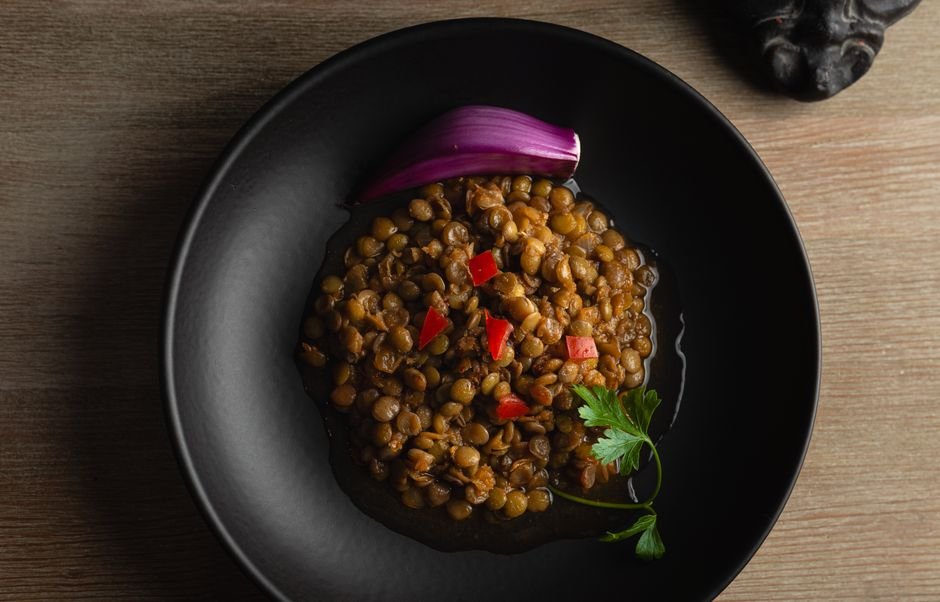
Full Nutrition Facts for 1 Cup (198g) Cooked Lentils
Here’s the complete nutritional profile for a standard serving of cooked lentils, which represents a satisfying main-dish portion.
| Nutrient | Amount | % Daily Value |
|---|---|---|
| Calories | 230 | — |
| Total Fat | 0.8g | 1% |
| Saturated Fat | 0.1g | <1% |
| Cholesterol | 0mg | 0% |
| Sodium | 4mg | <1% |
| Total Carbohydrate | 40g | 13% |
| Dietary Fiber | 16g | 56% |
| Total Sugars | 2g | — |
| Protein | 18g | 36% |
| Iron | 6.6mg | 37% |
| Folate | 358mcg | 90% |
| Magnesium | 71mg | 17% |
*Percent Daily Values are based on a 2,000-calorie diet. Source: USDA FoodData Central.
Key insight: A single cup of cooked lentils delivers 18g of protein and 16g of fiber—more fiber than most whole-grain breads—while remaining very low in fat and cholesterol-free. The 90% DV of folate makes lentils exceptional for vegetarians, pregnant individuals, and anyone supporting blood health. This combination of protein, fiber, and micronutrients with modest calories (230 per cup) explains why lentils are considered a nutritional powerhouse.
Etekcity Food Scale
0.1g accuracy — the perfect companion for exact portions.
Red Lentils vs. Green Lentils: Which Has Fewer Calories?
Red Lentils (Cooked)
- Slightly sweeter, softer texture; cook faster (15–20 minutes)
- 230 calories per cup; fractionally higher in carbs
- Mild earthy flavor; ideal for curries, soups, and purees
Green Lentils (Cooked)
- Firmer texture; hold their shape during cooking (25–30 minutes)
- 215 calories per cup; marginally higher in protein
- Slightly peppery taste; excellent in salads and grain bowls
Practical takeaway: The calorie difference between red and green lentils is negligible—both hover around 115–120 calories per half-cup. Choose based on your recipe and cooking time: red for quick, creamy dishes; green for salads and sides where you want lentils to stay intact.
Is Lentils Good for Weight Loss?
Yes, lentils are an excellent weight-loss food. Their high fiber content (56% DV per cup) promotes satiety, meaning you feel fuller longer on fewer calories. The 18g of protein per cup supports lean muscle preservation during calorie deficits, and the low fat content keeps calories manageable. A cup of cooked lentils delivers substantial nutrition for just 230 calories—comparable to a small bagel but with far superior nutrient density.
Tips to Eat Lentils Without Gaining Weight:
- Measure portions: Use a kitchen scale or measuring cup. A half-cup (99g) is a sensible side portion; a full cup works as a light main dish.
- Pair with vegetables: Mix lentils with leafy greens, broccoli, or carrots to bulk up meals without adding calories.
- Watch oil at cooking: Lentils need minimal oil to cook. If sautéing aromatics, use a spray or 1 teaspoon maximum per serving.
- Skip creamy sauces: Enjoy lentil soups broth-based rather than cream-based; add flavor with spices and lemon instead.
Incorporating lentils into a weight-loss diet is straightforward—just control portions and avoid high-calorie additions like excessive oil or cream.
How Portion Size Affects Calories
Lentil portion sizes dramatically affect your calorie intake. Because cooked lentils contain about 116 calories per 100g, small changes in portion size add up quickly. A half-cup serving (99g) is roughly what fits in your palm; a full cup is double that. Many people underestimate portion size by eating directly from the pot, potentially consuming 400+ calories without realizing it.
Example:
- Small portion (½ cup / 99g cooked): 115 calories, 9g protein, 8g fiber
- Large portion (1.5 cups / 297g cooked): 345 calories, 27g protein, 24g fiber
Using a kitchen scale or measuring cup ensures accuracy, especially if lentils are a diet staple.
Best Way to Measure Lentils Accurately
Accurate measurement is crucial because 100g of cooked lentils looks deceptively small in a regular bowl. Cooked lentils are dense and compact, so eyeballing portions typically leads to overestimation. The most reliable methods account for this density.
Options:
- Kitchen scale (most accurate): Weigh your cooked lentils to the nearest gram. Target 99g for a half-cup serving or 198g for a full cup.
- Measuring cup: Use a standard 8oz dry measuring cup, leveled at the top. One cup of cooked lentils = approximately 198g.
- Spoon method: If scales aren’t available, count tablespoons. One cup = 16 tablespoons; a half-cup = 8 tablespoons (easier to portion with a slotted spoon).
Calculate Your Exact Calorie Intake
If you’re tracking macronutrients or daily calorie goals, knowing the exact nutritional content of your lentil portions is essential. Even small variations in serving size—say, 150g versus 180g—can shift your daily targets by 50+ calories and 3–4g of protein.
Our free AI-powered nutrients calculator makes this simple. Enter your lentil portion size, and get instant breakdowns of calories, protein, fiber, and micronutrients for your specific meal. Whether you’re meal-prepping or adjusting recipes, the calculator removes guesswork and keeps you accountable.
- Instant calorie and macronutrient counts for any portion size
- Track protein, fiber, iron, and folate—especially valuable for vegetarians
- Compare different lentil varieties to optimize your nutrition plan
Use the free nutrients calculator to dial in your lentil portions precisely.
Common Mistakes When Eating Lentils
Even though lentils are nutritious, common preparation and consumption mistakes can undermine their benefits or inflate calorie counts unexpectedly.
❌ Cooking lentils in excessive oil or ghee—a tablespoon per cup can add 120 extra calories and 14g of fat, negating lentils’ low-fat advantage.
❌ Assuming all “lentil” products are equally nutritious—canned lentil soup often contains added salt (500+ mg per cup) and sometimes cream, while whole cooked lentils have minimal sodium and no added fats.
❌ Forgetting to account for lentils’ water absorption during cooking—dry lentils triple in weight and volume, so a ¼ cup dry becomes ¾ cup cooked. Many people don’t adjust their portions accordingly.
❌ Pairing lentils only with refined carbohydrates—lentil curry with white rice lacks the fiber synergy of lentils with brown rice or whole grains, creating blood-sugar spikes.
Avoiding these pitfalls keeps lentils in the healthy weight-loss and muscle-building category where they belong.
FAQ
How many calories are in 100g of cooked lentils?
Cooked lentils contain approximately 116 calories per 100g. This makes them easy to calculate: 150g = 174 calories, 200g = 232 calories, and so on.
Is lentils fattening?
No. Lentils are extremely low in fat (0.8g per cup) and high in fiber and protein, making them one of the least “fattening” plant proteins available. They support weight loss when portions are measured and preparation methods are simple (boiled or slow-cooked, not fried or creamed).
Do lentils cause bloating, and does cooking method affect this?
Lentils contain oligosaccharides and fiber, which can cause bloating in people unaccustomed to them. Soaking dried lentils briefly (30 minutes) before cooking, using a pressure cooker, and eating slowly reduce digestive discomfort. Red lentils tend to cause less bloating than whole varieties.
How do lentils compare to chickpeas in terms of calories and protein?
Cooked lentils have 230 calories and 18g protein per cup; cooked chickpeas have 269 calories and 15g protein per cup. Lentils are slightly leaner and more protein-dense, making them preferable for weight loss. Chickpeas contain more fat (4.3g vs. 0.8g), which some people prefer for satiety.
Conclusion
Lentils are a calorie-efficient, protein-rich legume that delivers exceptional nutritional value for 230 calories per cup. With 18g of protein, 16g of fiber, near-zero fat, and 90% of your daily folate, they’re among the best foods for weight loss, vegetarian diets, and sustained energy. The minor calorie differences between varieties (red, green, brown, black) are negligible—the choice should be driven by flavor and cooking time rather than nutrition.
Success with lentils hinges on accurate portion measurement, simple cooking methods, and pairing them with vegetables and whole grains. Whether your goal is weight loss, muscle building, or managing blood sugar, lentils deserve a regular place on your plate. Track your intake using a **reliable nutrients calculator** to stay accountable and optimize your results.
