
Let’s just admit it: tracking macros can feel like a part-time job. You weigh a chicken breast. You grab your phone to look up the entry. You type it into the app. By the time you finish logging it, you completely forgot to weigh your rice.
That tedious back-and-forth is exactly why the best smart food scales are blowing up in 2026. The whole point is to stop typing. A good Bluetooth scale talks directly to your phone. You put your food on the pad, and the app automatically logs the exact weight and calculates the macros for you. Zero manual entry.
If you love precision data but absolutely despise data entry, a smart scale is a massive game-changer for your meal prep. (Though, if you hate the idea of weighing food entirely, skip this and read my guide on [How to Count Calories Without Weighing] instead).
But not every scale is built the same. To find out which models actually deliver laboratory-level accuracy and which ones are just hype, I didn’t just read the Amazon spec sheets. I brought the top 5 smart scales right into my own kitchen and put them to work to find out exactly what is worth your money.
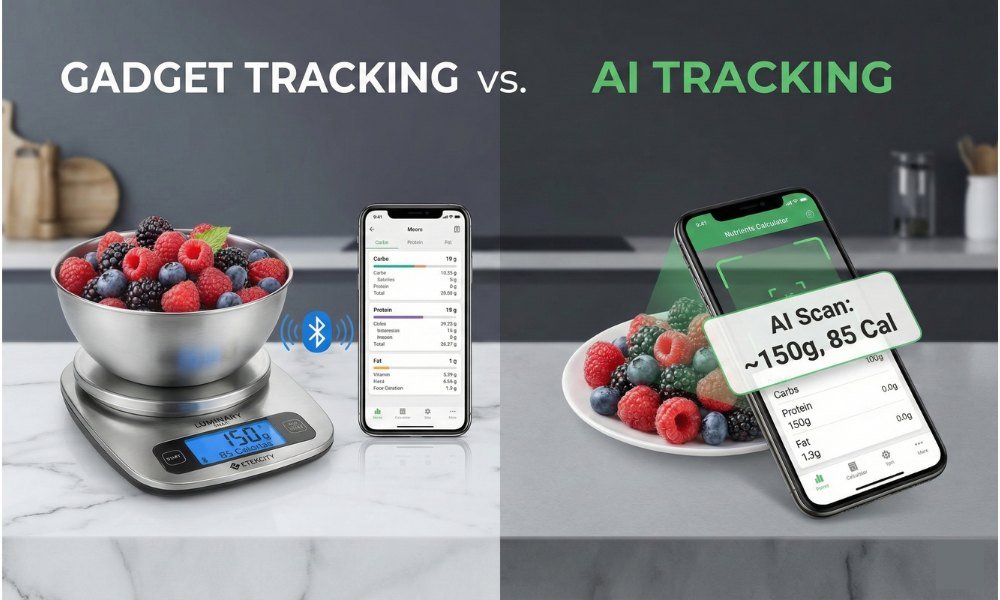
Quick Summary: The Best Smart Food Scales of 2026
| Best For… | Model | Price Point |
| Overall Winner | Etekcity Luminary Smart | Mid-Range |
| Budget Pick | Renpho Digital Scale | Affordable |
| Design | Greater Goods Nutrition | Premium |
| Travel | Oxo Good Grips | Basic (Not Smart) |
| The Alternative | Vision AI (No Scale) | Free |
How I Actually Tested These Smart Food Scales
Manufacturer spec sheets are useless if a device is frustrating to use in a real kitchen. So, I ditched the manuals and just started cooking.
The biggest chunk of my final score (25%) went straight to the nutrient database. If I scan a barcode and the app either doesn’t recognize it or suddenly demands a premium subscription to log the macros, it lost points fast.
Accuracy made up the next 20%. I didn’t rely on guesswork here. I bought certified 100-gram weights to test if the sensors drifted or struggled to register tiny amounts of olive oil.
Another 20% hinged on the app experience. If the Bluetooth lagged or disconnected constantly, the scale got penalized.
The remaining points came down to everyday usability (15%), how annoying the surface was to clean after a messy spill (10%), and basic value for your money (10%).
Bottom line: if a scale made my meal prep harder instead of easier, it tanked in the rankings.
1. Etekcity Luminary Smart (Best All-Around)
The Verdict: A beast of a scale. It handles massive meal-prep batches without flinching, and the VeSync app integration actually works instead of just getting in the way.
The Etekcity Luminary handles exactly what most compact scales fail at.
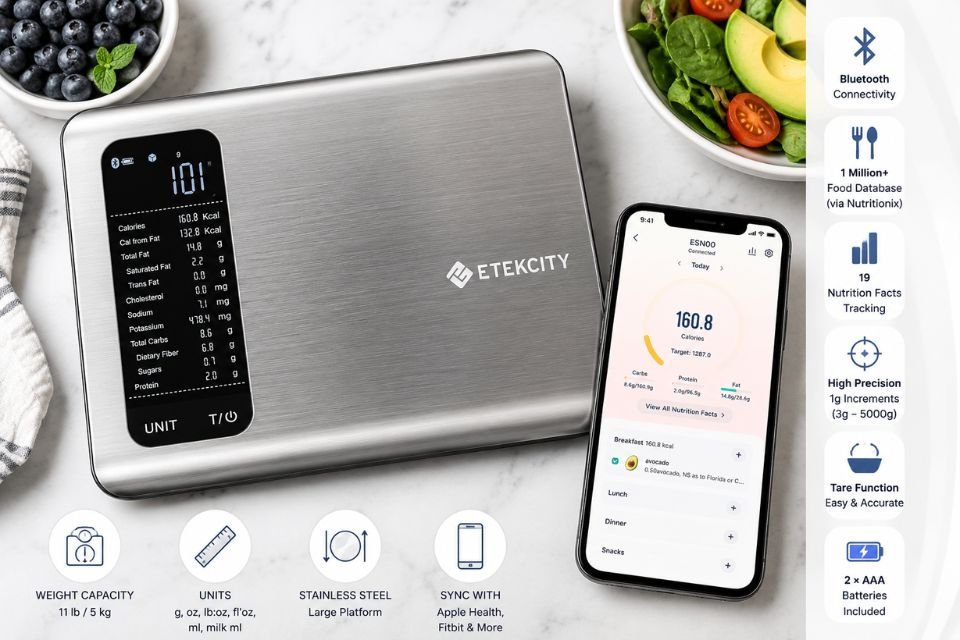
What really sold me was the VeSync app. I hate bouncing between three different fitness trackers just to log a meal. The Luminary pulls from a massive database (Nutritionix) with over a million entries. Then, it shoots all 19 tracked nutrients directly into Apple Health or Fitbit. One and done.
First, the capacity is ridiculous in the best way possible. Most smart scales tap out at 11 pounds. The Luminary holds up to 22 pounds (10 kg). I tossed my heaviest glass meal-prep bowls onto the wide 9.1 by 6.7-inch deck, and the screen was still perfectly visible.
Here is why it earned the top spot on my kitchen counter.
Precision did not take a hit under all that weight. It tracks anywhere from 3 grams up to 5,000 grams in strict 1-gram increments. Hitting the tare button instantly zeroes out those heavy containers so I only measured the actual ingredients.
But the absolute best part? No more digging through kitchen drawers for AAA batteries. It features a built-in 300mAh lithium-ion battery that charges via USB-C. Plug it in just like your smartphone, and you are good to go.
If you want a device that makes logging macros completely frictionless, this is the one to get.
What could be better
The exact thing that makes the Luminary great is also its biggest catch.
You are paying for connected nutrition tracking. If you just need a basic kitchen scale to measure out flour for baking, skip this entirely. You will be paying for app features you never open.
I also noticed some frustrating quirks when testing the VeSync app’s Nutritionix database. The search function can be ridiculously picky. For example, typing “blackberry” gave me zero results, forcing me to search the plural “blackberries” just to log my breakfast. Furthermore, if you rely heavily on scanning packages, you should know that the barcode scanner is currently only supported in the US.
The Bottom Line
This scale is strictly for people who want to track every single macro. If you want a heavy-duty unit that easily handles a massive 22-pound capacity while automatically syncing your nutrition logs straight to your phone, grab it. It is one of the strongest all-around options out there.
But if you just want to portion out some ground beef and do not care about logging apps, save your cash and buy a cheap, non-smart scale instead.
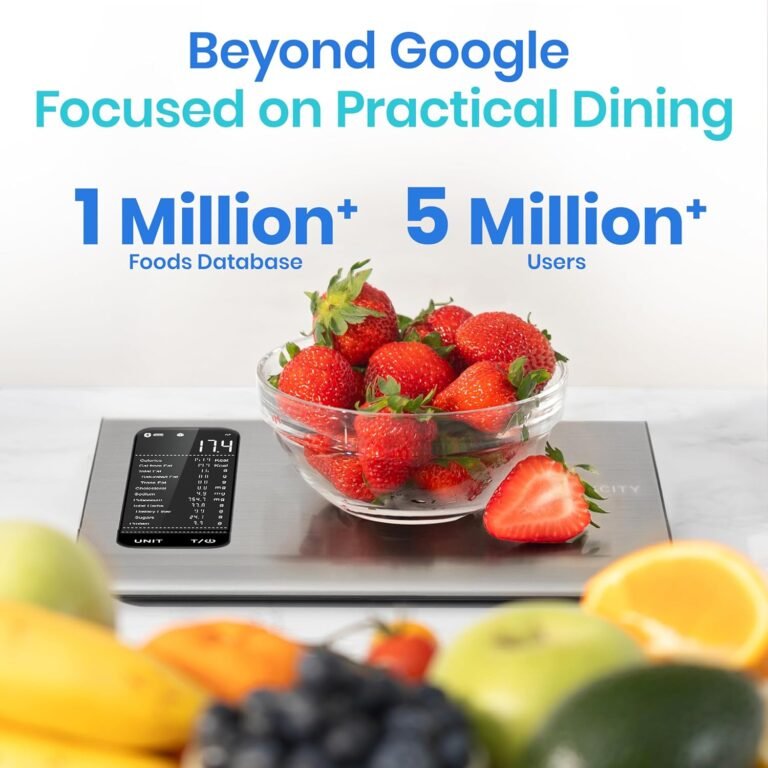
Etekcity Food Scale
0.1g accuracy — the perfect companion for exact portions.
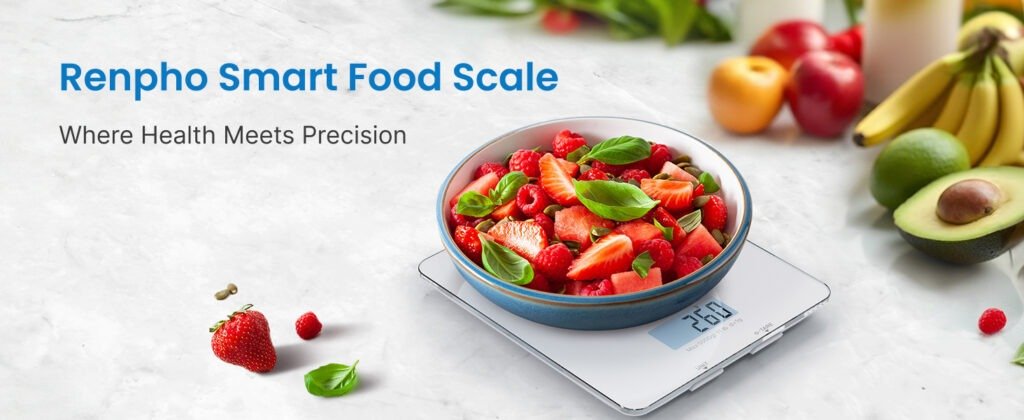
2: RENPHO Smart Nutrition Scale (Best Value)
The Verdict: A cheap, highly effective smart scale that gives you access to a massive USDA food database without forcing you into an expensive app subscription.
If you want the perks of an automated nutrition diary but absolutely refuse to spend a lot of money, the RENPHO Smart Nutrition Scale is the obvious choice.
I tested the standard 11-pound capacity model. It runs on three AAA batteries rather than a fancy rechargeable USB port, but for the low price tag, I can easily live with that.
Here is exactly why it won the value category on my kitchen counter.
Instead of locking basic food-logging features behind a monthly paywall, the scale connects straight to the free Gennec app (or Renpho Health) via Bluetooth. I dropped some food on the glass deck, opened the app, and searched their integrated USDA database. It instantly calculated up to 23 different nutrition facts—including calories, macros, and sugar—based on the exact gram weight.
The tare function works flawlessly. I placed my heavy ceramic mixing bowls on the deck, zeroed out the weight, and added my ingredients without doing any mental math.
It even has a weird but awesome hidden trick for coffee snobs. The app features a dedicated coffee maker mode that times your pour and tracks the exact ratio of beans to water.
You won’t get a massive, heavy-duty 22-pound weighing platform like the Etekcity Luminary, but you get incredibly accurate calorie tracking for a fraction of the cost.
Where It Falls Short & The Final Verdict
But if you hate touching your smartphone while your hands are covered in raw chicken juice, or you just want the absolute best app experience on the market, skip this one completely.
The biggest flaw with the RENPHO is exactly what makes it “smart.”
The digital screen on the physical scale only shows the weight. Want to see the actual calories or macros? You have to pull out your phone, unlock it, open the Gennec app, and sync it. Every single time.
And let’s talk about that app. It works, but it is definitely not premium. The interface feels a bit clunky compared to high-end dedicated trackers. Navigating your daily meal diary takes a few more taps than I’d like, which gets annoying when you are rushing to make breakfast before work.
The Bottom Line
If you are on a tight budget but still want connected, digital macro tracking, buy it. It does exactly what it promises—barcode scanning, meal logging, and daily nutrition reports—without emptying your wallet.
3: COSORI Smart Nutrition Scale (Best for AI Food Tracking)
The Verdict: The absolute best option if you despise manually searching for ingredients. The AI food scanning and barcode lookup make macro tracking completely effortless.
The COSORI Smart Nutrition Scale is built for people who want the path of least resistance when logging meals. It uses the VeSync app, but unlike basic scales, it leans heavily into automation.
Here is why it earned a permanent spot on my kitchen counter.
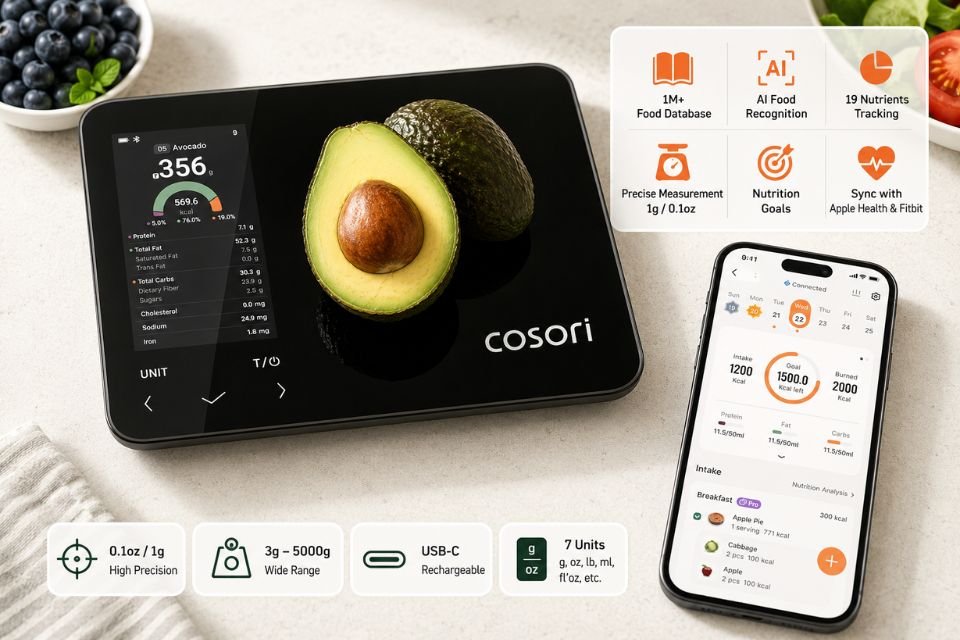
The standout feature is the AI Food Scanning. Instead of typing out every single ingredient and scrolling through generic database entries, I just used the app to scan my food directly. It instantly pulls up the nutritional profile from its massive million-item database.
It breaks down 19 different essential nutrients—so whether you are just tracking calories or dialing in your exact protein and fat macros, the data is right there.
I also tested the physical limits. It measures anything from 3 grams up to 5,000 grams in strict 1-gram increments, making it dead-on accurate for everything from a tiny splash of olive oil to a heavy meal-prep container. It even switches seamlessly between seven different units, including grams, ounces, and milliliters.
Best of all, it ditches the disposable batteries. It features a built-in rechargeable battery and charges via a standard USB-C cable, which is incredibly convenient.
If you want an app that actually helps you set and monitor daily, weekly, and monthly nutrition goals instead of just acting as a digital notepad, this is the one to get.
Where It Falls Short & The Final Verdict
But if you just want a standard, old-school kitchen tool for casual baking without any digital baggage, save your money and skip the smart features entirely.
Just like the others, the COSORI’s greatest weapon is also its main drawback.
Because it leans so heavily into AI scanning and app connectivity, it completely loses its appeal if you just want to grab a scale, drop a bowl on it, and weigh your flour without touching a screen. If you hate opening smartphone apps while cooking, this will just annoy you.
The Bottom Line
If you are a dedicated macro tracker or fitness enthusiast who wants modern tech—like AI food scanning, barcode lookups, and clear goal tracking—this scale makes logging meals infinitely easier.
4. Greater Goods Nutrition Scale — Best No-Phone Nutrition Tracking
The Verdict: The ultimate fix if you hate pairing Bluetooth, creating accounts, or touching your phone with messy kitchen hands. It puts the entire database right on the hardware.
Every other scale on this list forces you to stare at a smartphone screen. The Greater Goods Nutrition Food Scale does the exact opposite.
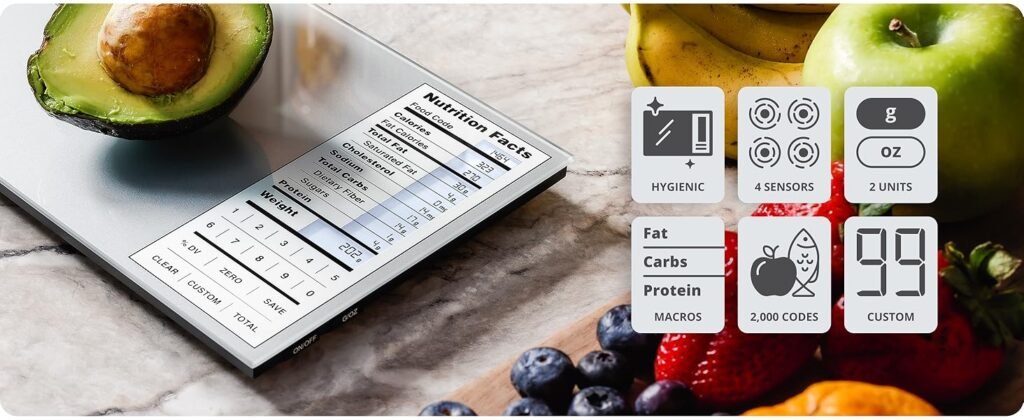
Instead of connecting to an app, the nutrition database is built straight into the physical device.
Here is why it deserves a spot on your counter.
You don’t need Bluetooth, an internet connection, or a login. It comes pre-programmed with codes for over 2,000 common foods. You just look up the code, type it in, drop your food on the glass deck, and the screen calculates everything right in front of you.
It tracks way more than just raw weight. The display breaks down calories, protein, carbs, fat, and sodium on the fly.
I also love the cumulative tracking feature. If you are building a complex bowl or a multi-ingredient recipe, you can use the tare function to add items one by one. The scale tallies up the total nutrition data for the whole plate as you go.
If you can’t find a specific item in the built-in library, you aren’t stuck—you can easily create and save your own custom food entries for branded products or personal recipes.
To top it all off, it features a smooth, food-grade glass surface that wipes clean in seconds, an 11-pound capacity, and precision down to a single gram.
If you want macro tracking without the digital baggage, this is your best option.
Where It Falls Short & The Final Verdict
But if you live for automated history charts, seamless fitness app integration, and endless cloud databases, skip this one and stick with a traditional smart scale.
That built-in database is a double-edged sword.
Because it is locked to the physical device, you don’t get the infinite, ever-expanding online database that you find on a smartphone app. If you eat a lot of niche, specialty, or heavily packaged foods, you are going to spend a fair bit of time manually programming custom entries using code books.
And obviously, since there is no Bluetooth, your data stays on the screen. It will not automatically sync your meals or spit out long-term fitness reports on your phone.
The Bottom Line
If you want to track your macros and calories without constantly unlocking your phone, dealing with dropped Bluetooth connections, or downloading another annoying app, buy this immediately. It is the best standalone system on the market.
5. KUAIVO Smart Nutrition Food Scale (Best for Clear Display)
The Verdict: A solid, no-nonsense budget smart scale that fixes one of the most annoying kitchen design flaws: a screen you actually can read.
If you are tired of squinting at dim digital screens while a giant mixing bowl casts a shadow over your workspace, the KUAIVO Smart Nutrition Food Scale solves that exact issue.
It bridges the gap between traditional digital scales and Bluetooth app tracking without breaking the bank.
Here is why it earned a spot on the list.
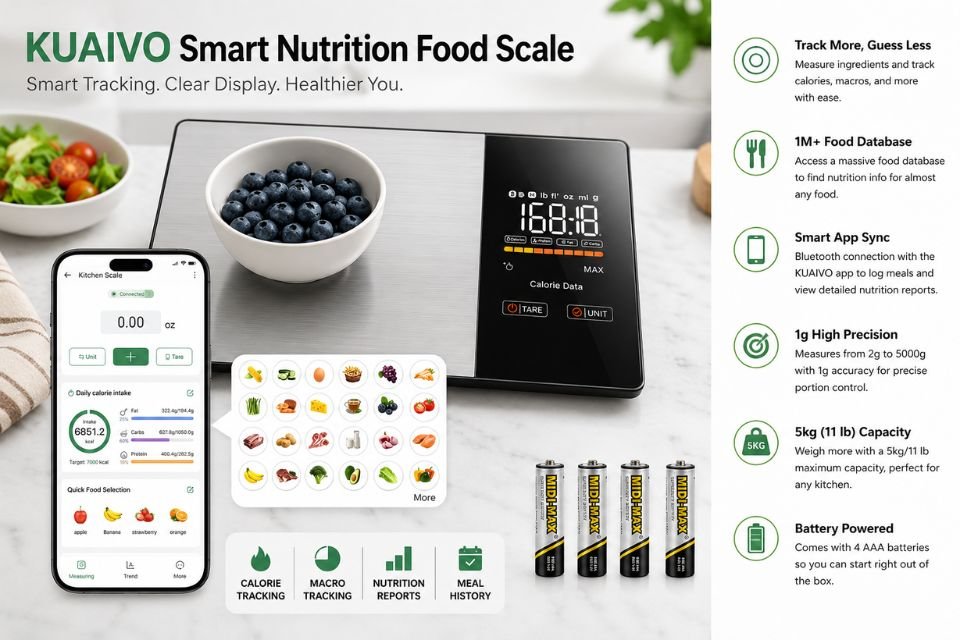
The standout feature is right on the front. It features a genuinely bright, high-contrast LED display that cuts right through the glare. Even when I piled wide plates and heavy meal-prep bowls onto the platform, the weight readings stayed crystal clear.
Underneath that display, it delivers the core tracking features you actually need.
The scale pairs via Bluetooth to a companion app packed with a massive 1-million-entry food database. Once you weigh your ingredients, you can search the database to log calories, protein, carbs, and fat without doing any manual math. It also tracks your long-term habits, spitting out daily, weekly, and monthly nutrition reports so you can see your progress over time.
When it comes to precision, it holds its own. It measures in strict 1-gram increments across a range from 2 grams up to 5,000 grams. Whether you are portioning out micro-amounts of spices or weighing heavy blocks of meat, the sensors are tight and reliable.
Combined with a smooth tare function for multi-ingredient recipes, it handles meal prep with zero fuss.
Where It Falls Short & The Final Verdict
But if you prefer a heavily established software ecosystem or cutting-edge AI tracking features, you’ll want to spend a bit more on a top-tier alternative.
The main drawback here comes down to ecosystem maturity.
KUAIVO simply doesn’t have the heavy brand recognition or polished software refinement of bigger names like Etekcity, RENPHO, or COSORI. The app gets the job done, but it doesn’t feel quite as robust.
You are also tethered to your phone for the deeper tracking features. If you hate opening an app or want advanced AI-driven food scanning, you are better off looking at COSORI. And if you want to skip apps entirely, stick with the Greater Goods standalone model instead.
The Bottom Line
If you want a budget-friendly smart scale that keeps things simple, offers rock-solid 1-gram precision, and features a display you can actually read through the glare, this is a very practical middle ground.
Recommended table | Best Smart Food Scales
| Scale | Best For | App | Nutrition Data | Capacity | Precision | Phone Required |
|---|---|---|---|---|---|---|
| Etekcity Luminary | Best Overall | VeSync | 19 nutrients | 22 lb | 1 g | Yes |
| RENPHO | Best Value | Gennec | Multiple nutrients | 11 lb | 1 g | Yes |
| COSORI | Best for AI Tracking | VeSync | 19 nutrients | 11 lb | 1 g | Yes |
| Greater Goods | Best for No-Phone Tracking | None | Built-in database | 11 lb | 1 g | No |
| KUAIVO Smart Nutrition Scale | Best for Clear Display | KUAIVO App | Calories & macros | 11 lb | 1 g | Yes |
The Final Verdict & A Simpler Alternative
Instead of hauling out a kitchen gadget, try the Nutrients Calculator AI Method. You just snap a quick photo of your plate on your phone. Our built-in AI estimates the volume and density of the food to instantly generate a reliable calorie count for weight loss—no physical weighing, no manual data entry, and zero kitchen clutter.
Our Top Picks at a Glance
Best Overall: Etekcity Luminary
Best Value: RENPHO
Best for AI Food Tracking: COSORI
Best for No-Phone Tracking: Greater Goods
Best for Clear Display: KUAIVO
Do You Actually Need a Smart Food Scale?
Let’s be real. Even with Bluetooth and fancy apps, using a smart scale still requires a physical routine. You have to pull the scale out. Set your bowl down. Tare the weight. Search through a database code.
If the thought of doing that for every single meal makes you want to quit before you start, you might want to skip the hardware entirely.
Buying Guide & Final Thoughts
As an Amazon Associate, I earn from qualifying purchases. This post may contain affiliate links, which means I may receive a small commission, at no cost to you, if you make a purchase through a link.
Buying Guide: How to Choose the Best Smart Food Scale
Before you pull the trigger, keep your eyes on the three features that actually dictate whether a scale is useful or just annoying:
The Ecosystem Test (App Integration): The physical hardware is usually decent on all of these, but bad software ruins everything. If you sync your health data with Apple Health or Fitbit, confirm the native companion app (like VeSync or Gennec) can actually bridge that gap. Etekcity dominates this space, while budget alternatives often struggle with reliable data syncing.
The “Screen-Off” Delay: There is nothing quite as infuriating as weighing out flour, turning around to grab sugar, and watching your scale shut down. Look for an auto-off duration of at least two minutes so you don’t lose your numbers mid-recipe.
Macro vs. Calorie Accuracy: Remember that smart tech is only as reliable as its database. Barcode scanning is usually bulletproof. But searching manually for something generic like “chicken breast” means the app is just guessing an average. Always cross-reference your first few manual searches against official USDA data to make sure your smart device isn’t feeding you bad metrics.
Conclusion: Final Thoughts
If you are deep-prepping for a bodybuilding show or managing a rigid medical diet, a heavy-duty option like the Etekcity Luminary is an incredible tool that completely eliminates the math from your routine.
But for about 95% of us, the best scale is simply the one you don’t abandon in a cabinet. If tracking feels like too much of a chore and you end up ignoring the device, ditch the hardware and use a Vision AI approach instead. Consistency will always beat hyper-accuracy.
