
Grapefruit is a popular breakfast staple and weight-loss favorite across North America, prized for its tart, refreshing taste and reputation as a metabolism-boosting food. Whether eaten plain, in juice, or as part of a morning routine, grapefruit appeals to people pursuing weight loss, heart health, and sustained energy without excessive calories.
But how many calories are actually in grapefruit, and what does its full nutrition profile look like? This guide breaks down grapefruit’s calorie count by variety and serving size, explores whether it supports your health goals, and explains how to incorporate it accurately into your diet plan.
Calories in Grapefruit (Quick Answer)
Here’s what you’ll find in common grapefruit servings:
- Half a medium grapefruit (123g) — 52 calories
- One medium grapefruit (246g) — 104 calories
- One cup of grapefruit segments (230g) — 97 calories
Calorie counts vary slightly by variety (pink/red vs. white) and ripeness, but the difference is minimal. Grapefruit juice and sweetened products contain significantly more calories and sugar.
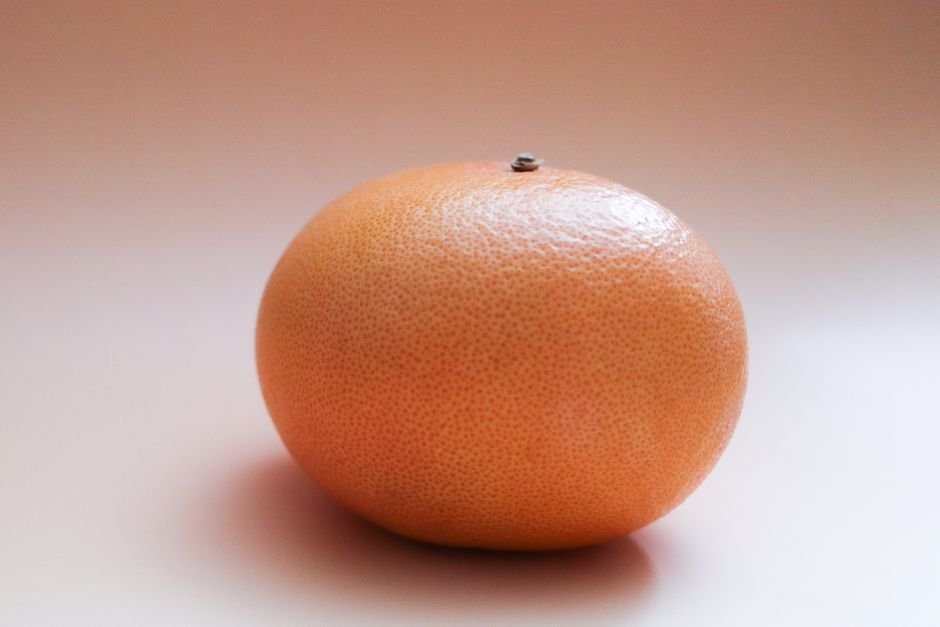
Full Nutrition Facts for Half a Medium Grapefruit
A half-medium grapefruit (123g) is a standard serving and represents roughly what you’d eat at breakfast. Here’s the complete nutrition breakdown:
| Nutrient | Amount | % Daily Value |
|---|---|---|
| Calories | 52 | — |
| Total Fat | 0.2g | <1% |
| Saturated Fat | 0g | 0% |
| Cholesterol | 0mg | 0% |
| Sodium | 42mg | 2% |
| Total Carbohydrate | 13g | 4% |
| Dietary Fiber | 2g | 7% |
| Total Sugars | 8g | — |
| Protein | 1g | 2% |
| Vitamin C | 38mg | 63% |
| Potassium | 166mg | 5% |
| Folate | 15mcg | 4% |
*Percent Daily Values are based on a 2,000-calorie diet. Source: USDA FoodData Central.
Key insight: Grapefruit is exceptionally low in calories yet delivers 63% of your daily vitamin C in just one half-fruit. Its high water content (about 90%) and 2g of fiber contribute to satiety without significant calorie impact, making it an ideal choice for weight-conscious eaters. The natural sugars (8g per half) are balanced by that fiber, which moderates blood sugar response.
Etekcity Food Scale
0.1g accuracy — the perfect companion for exact portions.
Pink Grapefruit vs. White Grapefruit
The two most common varieties have slightly different nutritional profiles, though calories are nearly identical. Pink and red grapefruit contain lycopene, the antioxidant also found in tomatoes, while white grapefruit is primarily carbohydrates and vitamin C.
Pink/Red Grapefruit (per half-medium, 123g)
- Calories: 52
- Sugars: 8g (same as white, but with added lycopene)
- Lycopene: 1,700mcg — an antioxidant linked to heart and prostate health
White Grapefruit (per half-medium, 123g)
- Calories: 52
- Sugars: 8g
- No lycopene: Trade-off is simpler, cleaner taste for some palates
Practical takeaway: If you want extra antioxidant benefits, pink grapefruit is the clear choice—the calorie and sugar content are identical, but you gain significant lycopene. White grapefruit is equally light and works fine if you prefer a milder flavor or have medication interactions (discussed below). Choose based on taste preference and antioxidant goals.
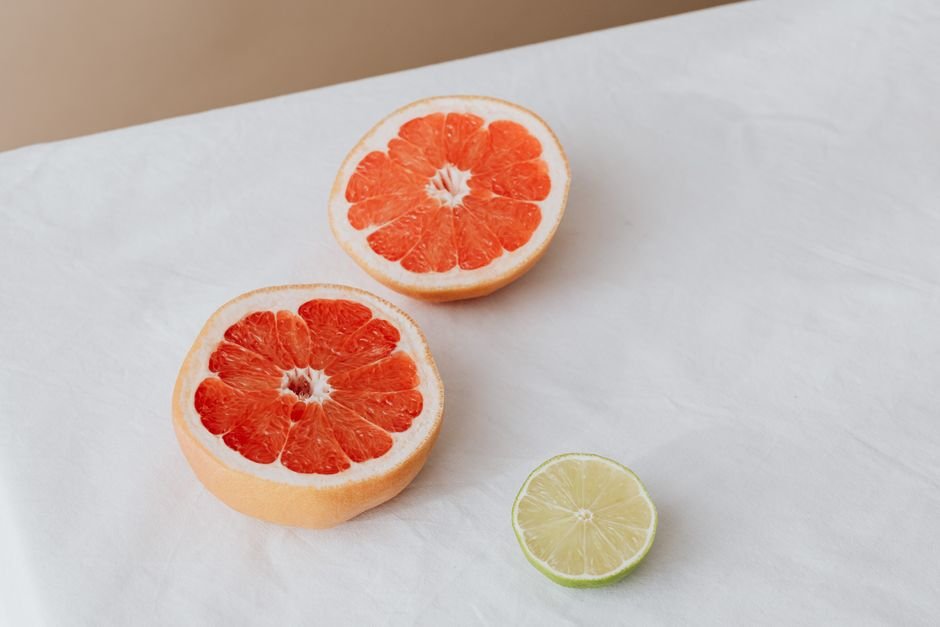
Is Grapefruit Good for Weight Loss?
Yes, grapefruit is genuinely supportive of weight loss goals. At 52 calories per half-fruit, it’s one of the lowest-calorie fruits available. Its fiber content (2g per half) promotes satiety, while the water and natural sugars satisfy a sweet craving without derailing a calorie deficit. Studies have shown that eating grapefruit at breakfast is associated with modest weight loss, though the effect is likely due to satiety and a deliberate eating pattern rather than any “metabolism-boosting” magic. The key advantage is that grapefruit lets you eat a substantial, filling portion for very few calories.
Tips to Eat Grapefruit Without Gaining Weight
- Eat whole grapefruit, not juice: Fresh grapefruit has 2g of fiber per half-fruit; a cup of grapefruit juice has almost none and adds 50 calories in a drinkable form, which doesn’t trigger satiety.
- Skip added sugar: Don’t sprinkle sugar or honey on top—you’ll double or triple the calorie and sugar load. The fruit is already naturally sweet.
- Pair with protein: Combine a half-grapefruit with Greek yogurt, eggs, or cottage cheese to extend satiety and stabilize blood sugar.
- Measure your portion: A “half-medium” is the standard serving. Eating a whole large grapefruit is fine but nearly double the calories (around 100); track this if you’re strict about your calorie target.
Grapefruit works best within a broader diet of whole foods and consistent calorie intake. It’s an excellent low-calorie fruit choice, but weight loss ultimately depends on total energy balance, not the grapefruit itself.
How Portion Size Affects Calories
Grapefruit calories scale almost linearly with weight. Because the fruit is about 90% water and has consistent nutrition throughout, a larger grapefruit simply means more of the same nutrients. Understanding portion size is important because “one grapefruit” is ambiguous—some are small, others are very large.
Example:
- Small grapefruit half (100g): 42 calories — good if you’re very strict with portions or eating multiple fruits per day.
- Large grapefruit half (150g): 63 calories — represents a filling, satisfying serving that most people eat at breakfast.
If you’re tracking calories precisely, weighing your grapefruit is more accurate than visual estimation.
Best Way to Measure Grapefruit Accurately
Because grapefruits vary in size, weight is the most reliable measurement. A kitchen scale removes guesswork and ensures consistency in your calorie tracking. If you eat grapefruit regularly, measuring the first few times will help you develop a visual sense for a standard serving.
Options:
- By weight (most accurate): Use a food scale and aim for 123g per serving (half a medium grapefruit). This takes 30 seconds and removes all ambiguity.
- By visual estimation (convenient): A half-medium grapefruit, halved neatly along the equator with a sharp knife, is roughly the size of your open palm. This works well if you’re not tracking obsessively.
- By count: If you buy consistently from the same source, learn that “one of those grapefruits = 2 servings” and portion accordingly. This works once you know your regular store’s fruit size.
Calculate Your Exact Calorie Intake
If grapefruit is a regular part of your diet, you already know its basic calorie cost. But if you’re eating it alongside other foods—yogurt, granola, honey—tracking the full meal becomes important. Manually adding up each ingredient is tedious and error-prone.
Our free AI nutrients calculator lets you log your entire meal—grapefruit, toppings, and all—and instantly see total calories, macros, fiber, and key micronutrients. No ads, no signup required. Just enter your food and get results.
- See your complete macro breakdown (protein, carbs, fat) for any meal
- Track micronutrients like vitamin C and potassium automatically
- Compare different portion sizes in seconds to find your ideal serving
Use the free AI nutrients calculator to build a grapefruit breakfast that fits your goals.
Common Mistakes When Eating Grapefruit
Grapefruit is straightforward, but a few habits undermine its weight-loss and nutrition benefits:
❌ Drinking grapefruit juice instead of eating the fruit. Juice removes all fiber and makes it easy to overconsume sugars—a cup of grapefruit juice has 96 calories vs. 52 for a half-fruit, and none of the satiety.
❌ Adding sugar, honey, or stevia to improve the taste. If you find grapefruit too tart, pair it with Greek yogurt or cottage cheese instead; these add protein and balance the flavor without turning breakfast into dessert.
❌ Eating grapefruit with medications without checking drug interactions. Grapefruit juice (and to a lesser extent, whole grapefruit) blocks a key enzyme that metabolizes dozens of common drugs, including statins, blood pressure medications, and antihistamines. Always ask your pharmacist or doctor.
❌ Assuming portion size doesn’t matter because it’s “healthy.” A large grapefruit has double the calories and sugar of a small one. If you’re tracking intake, weigh it.
Avoid these traps and grapefruit becomes a reliable, nutrient-dense low-calorie food.
FAQ
How many calories are in 100g of grapefruit?
100g of raw grapefruit contains 42 calories. This is useful for quick mental math—half a medium grapefruit (123g) is simply 42 × 1.23 = 52 calories.
Is grapefruit fattening?
No. At 42 calories per 100g, grapefruit is one of the lowest-calorie fruits. Weight loss depends on overall calorie balance, not individual foods, but grapefruit is an excellent choice if you want to eat a large, satisfying portion for minimal calories.
Does grapefruit interact with medications?
Yes, grapefruit juice is known to interact with many medications by blocking CYP3A4, an enzyme involved in drug metabolism. This affects statins, some blood pressure drugs, antihistamines, and others. Whole grapefruit has a weaker effect than juice. Always check with your pharmacist if you take daily medication.
Which variety has fewer calories, pink or white grapefruit?
Both pink and white grapefruit have essentially identical calories (52 per half-medium). Pink grapefruit offers extra lycopene, an antioxidant; choose it for added nutrition, or white for a milder taste. The calorie difference is negligible.
Conclusion
Grapefruit is a genuinely low-calorie, nutrient-dense fruit that delivers significant vitamin C, fiber, and hydration in roughly 50 calories per half-fruit. Its mild sweetness and high water content make it satiating without adding excess sugar or fat. Whether you eat it as a breakfast staple, post-workout snack, or light dessert, grapefruit fits easily into weight-loss and balanced nutrition plans.
The key to maximizing its benefits is choosing whole fruit over juice, measuring your portion accurately, and checking for medication interactions if you take daily drugs. Use a reliable calories and nutrition calculator to track your full meals and stay confident in your intake. Grapefruit is a smart, straightforward choice for anyone seeking low-calorie, high-nutrition fruit.
