We independently choose the products in this guide. As an Amazon Associate we earn from qualifying purchases, at no extra cost to you. How we make money.
Key takeaways
- Oil sprayers for cooking coat pans and air fryer baskets with a thin film, often saving 100+ calories per meal.
- Best overall: Evo trigger sprayer. Best classic mister: Misto. Best glass: Leeseph.
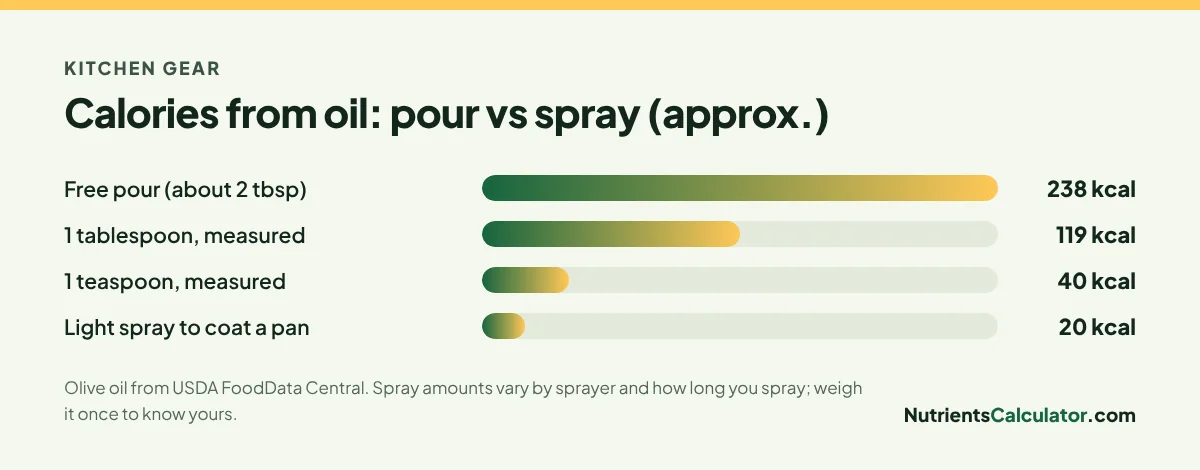
- A tablespoon of olive oil has about 120 calories, and a free pour is often two.
- Use thin oils and clean the nozzle often to prevent clogs.
Oil is healthy in sensible amounts. Olive oil, avocado oil and canola oil supply unsaturated fats your body needs; see our guide to healthy fats. The problem is how much we pour. A tablespoon of olive oil has about 120 calories, and a free pour into a pan is easily two tablespoons. Oil sprayers for cooking fix that by spreading a fine, even layer that covers more surface with less oil.
How many calories an oil sprayer can save

Using USDA data for olive oil, a measured tablespoon has about 119 calories and a teaspoon about 40. A light spray across a pan is usually closer to a teaspoon or less. Swap a free pour for a spray once a day and you could save over 1,000 calories a week, without giving up oil or crispness.
Etekcity Food Scale
0.1g accuracy — the perfect companion for exact portions.
What to look for in an oil sprayer
- Spray pattern: a wide, even fan coats better than a jet.
- Trigger vs pump: triggers spray instantly; pump misters need a few pumps to build pressure.
- Material: glass or stainless steel bottles; check that the nozzle comes apart for cleaning.
- Capacity and visibility: a see-through bottle shows when to refill.
The best oil sprayers for cooking
1. Evo Oil Sprayer: best overall

Evo’s trigger sprayer releases a consistent fan of oil with each squeeze, with no pumping and no aerosol. It’s easy to control and works well for pans, salads and air fryers.
- Good for: everyday cooking and air fryers.
- Watch out: plastic bottle; keep it away from the stove.
Check price on Amazon Evo Oil Sprayer Bottle
2. Misto Brushed Aluminum Oil Sprayer: best classic mister
The Misto is a long-time favorite pump mister. Pump the cap to build pressure, then spray a fine mist. It’s simple and refillable with any oil.
- Watch out: needs regular cleaning to prevent clogs.
Check price on Amazon Misto Brushed Aluminum Olive Oil Sprayer
3. OXO Good Grips Precision Pump Oil Mister: best for control
OXO’s pump mister gives a fine, controlled mist and is easy to hold and refill.
Check price on Amazon OXO Good Grips Precision Pump Oil Mister
4. Leeseph Oil Sprayer: best glass bottle
A glass oil sprayer with a fine mist nozzle, often sold in a pair so you can keep olive oil and vinegar in separate bottles.
Check price on Amazon Leeseph Oil Sprayer for Cooking Glass Bottle
5. Zulay Kitchen Oil Sprayer: budget pick
An affordable, refillable glass sprayer that’s popular for air fryers and salads.
Check price on Amazon Zulay Kitchen Oil Sprayer for Cooking
How to use oil sprayers for cooking

- Fill only partway (about half to two-thirds) so pressure builds.
- Spray the pan, not the food, for searing; spray the food for roasting vegetables in an air fryer.
- Use thin oils: olive, avocado or canola. Cold or thick oils can clog the nozzle.
- Clean weekly by spraying warm, soapy water through it, then plain water.
- Measure once: spray into a bowl on a food scale to learn how much oil one spray gives.
An oil sprayer pairs perfectly with an air fryer and a good nonstick or cast iron pan. For picking the right oil, see the best oils for cooking.
Pump mister or trigger sprayer?
There are two main kinds of oil sprayers for cooking:
- Pump misters (like Misto) build pressure when you pump the cap, then release a fine mist. They’re simple and refillable, but need a few pumps each time and can clog if not cleaned.
- Trigger sprayers (like Evo) spray instantly with each squeeze and give a consistent pattern. They’re quicker to use and easier to control, which is why many cooks prefer them.
Glass bottles look nice and don’t absorb odors; plastic bottles are lighter and won’t break if dropped. Either way, keep sprayers away from the stove’s heat.
Which oil to put in your sprayer
- Extra-virgin olive oil: great for salads, roasting and medium-heat cooking.
- Avocado oil: a neutral taste and high smoke point for air fryers and searing.
- Canola oil: inexpensive and neutral for everyday cooking.
Avoid very thick oils and solid fats like coconut oil, which clog nozzles. See the best oils for cooking for the full comparison.
Oil sprayers for cooking: smart uses
- Air fryers: a light spray on vegetables and potatoes for crisp results.
- Sheet pans: coat the pan evenly instead of pouring a puddle in one corner.
- Salads: spray a fine layer of olive oil, then add vinegar and salt.
- Popcorn: a quick mist helps seasoning stick.
- Grill pans and griddles: coat evenly without excess smoke.
- Baking: grease muffin tins and cake pans.
How small swaps add up
Healthy cooking often comes down to small habits repeated every day. Switching from pouring to spraying is one of the easiest. Pair it with other simple changes, like roasting instead of frying and choosing lean protein, and the calories you save add up quickly. Our healthy cooking methods guide and healthy food swaps list more.
Oil sprayer mistakes to avoid
- Overfilling, which stops pressure building.
- Leaving oil in for months, where it can go stale. Refill with fresh oil regularly.
- Skipping cleaning, the top cause of clogs.
- Spraying near an open flame.
The bottom line
Oil sprayers for cooking are one of the cheapest ways to cut calories without changing what you eat. The Evo trigger sprayer is our top pick, the Misto is a reliable classic, and the Leeseph glass sprayer is great for olive oil and vinegar. Spray instead of pour and you keep the flavor and health benefits of oil with a fraction of the calories.
Frequently asked questions
Are oil sprayers better than aerosol cooking spray?
Refillable oil sprayers let you use any oil you like with no propellants or additives, and they cost less over time. Aerosol cans are convenient but often contain emulsifiers and propellants.
Why does cooking spray say zero calories?
The label serving is a very short spray, about a quarter of a second, which has under 5 calories, and FDA rules allow that to be rounded to zero. A longer spray adds real calories.
Can I use an oil sprayer in an air fryer?
Yes. A refillable sprayer is ideal for air fryers. Avoid aerosol cooking sprays in air fryer baskets, as some manufacturers say they can damage nonstick coatings.
Why does my oil sprayer clog?
Thick or cold oil and leftover residue clog nozzles. Use thin oils, keep it at room temperature, and clean it regularly by spraying warm soapy water through it, then rinsing.
Can I put avocado oil in an oil sprayer?
Yes. Avocado oil is thin enough to spray well and handles high heat, which makes it a good choice for air fryers and searing.
Why does my oil sprayer squirt instead of mist?
The bottle may be overfilled, the oil too thick or cold, or the nozzle partly clogged. Fill it about halfway, use a thinner oil and clean the nozzle with warm soapy water.
Can I spray vinegar or lemon juice too?
Yes. Many people keep a second sprayer for vinegar or citrus juice to dress salads lightly and evenly.
How much oil comes out in one spray?
It varies by sprayer and how long you press. Spray into a bowl on a food scale a few times to see how much your sprayer delivers.
Is it safe to use an oil sprayer near the stove?
Keep it away from open flames and direct heat. Spray the pan before you heat it, or move it off the burner first.
How often should I clean an oil sprayer?
About once a week with regular use, or whenever the spray pattern becomes uneven.
Is an oil sprayer better than a brush?
For an even, thin coat, yes. A pastry brush works but tends to use more oil and leave uneven spots.
Sources
- USDA FoodData Central: Olive oil
- FDA: Food Labeling Guide (nutrient content rounding)
- Harvard T.H. Chan School of Public Health: Types of Fat
This article is for general information and isn’t medical advice. Talk to your doctor or a registered dietitian about your own needs, especially if you have a health condition, are pregnant or take medication.