We independently choose the products in this guide. As an Amazon Associate we earn from qualifying purchases, at no extra cost to you. How we make money.
Key takeaways
- Food thermometers are the only reliable way to know meat, poultry and fish are safe.
- Best overall: ThermoWorks Thermapen ONE. Best value: ThermoPro TP19H. Best wireless: MEATER Plus.
- Cook poultry to 165°F, ground meat to 160°F, and steaks, chops and fish to 145°F.
- A thermometer also stops you from overcooking lean protein into dry leather.
Chicken breast, pork tenderloin and fish are some of the healthiest proteins you can cook, and some of the easiest to ruin. Undercook them and you risk food poisoning; overcook them and they’re dry. Food thermometers fix both problems in a few seconds. Here are the best, plus the temperatures every home cook should know.
Why food thermometers matter for healthy cooking

The USDA is clear that color and juices aren’t reliable signs that food is cooked. A thermometer is. And because you can take food off the heat at exactly the right moment, lean cuts stay juicy, so you’re less tempted to add rich sauces to rescue them. That makes a thermometer one of the most useful tools for anyone cooking high-protein meals.
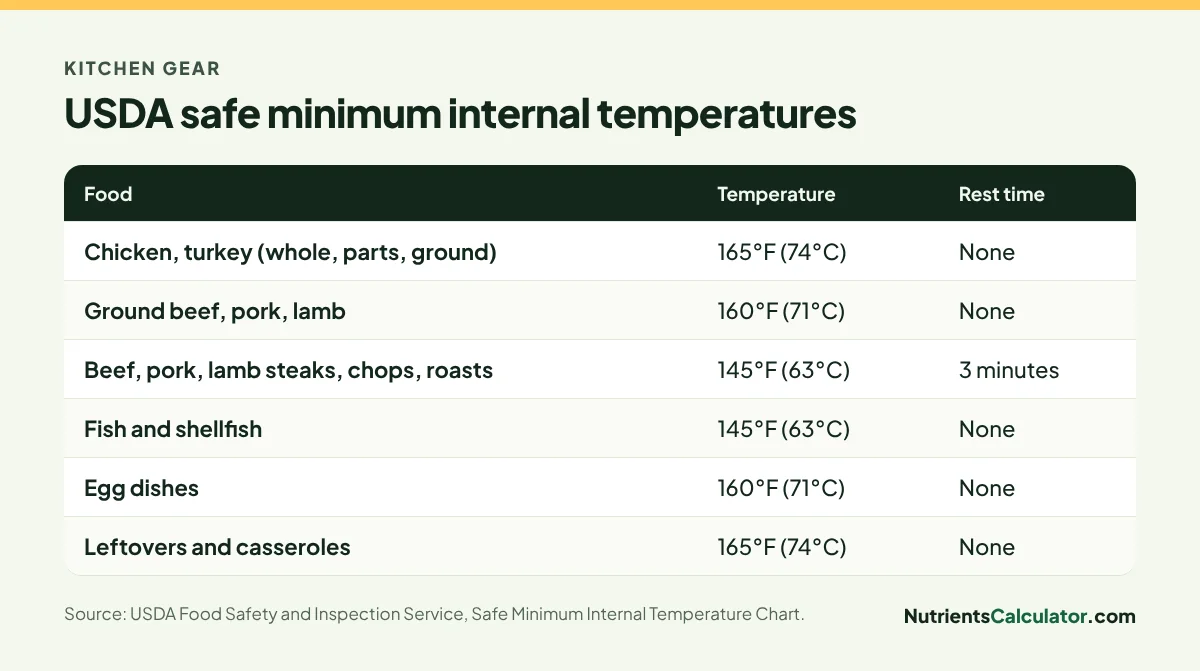
| Food | Temperature | Rest time |
|---|---|---|
| Chicken, turkey (whole, parts, ground) | 165°F (74°C) | None |
| Ground beef, pork, lamb | 160°F (71°C) | None |
| Beef, pork, lamb steaks, chops, roasts | 145°F (63°C) | 3 minutes |
| Fish and shellfish | 145°F (63°C) | None |
| Egg dishes | 160°F (71°C) | None |
| Leftovers and casseroles | 165°F (74°C) | None |

Etekcity Food Scale
0.1g accuracy — the perfect companion for exact portions.
What to look for in food thermometers
- Speed: 1 to 3 seconds for instant-read models.
- Accuracy: within about ±1°F on good models.
- Thin probe tip: for thin cuts like fish fillets.
- Readable display: backlit and ideally auto-rotating.
- Water resistance for easy cleaning.
The best food thermometers
1. ThermoWorks Thermapen ONE: best overall

The Thermapen is the thermometer many chefs use. It reads in about a second, is very accurate, and has a bright, auto-rotating display. It’s expensive, but it lasts for years.
- Good for: serious home cooks.
Check price on Amazon ThermoWorks Thermapen ONE
2. ThermoWorks ThermoPop 2: best compact
ThermoWorks’ budget model is pocket-sized and quick, with a rotating display. It’s a great value from a trusted brand.
Check price on Amazon ThermoWorks ThermoPop 2
3. ThermoPro TP19H: best value
Fast, accurate enough for home cooking, with a backlit, auto-rotating display and a magnet to stick it on the fridge. One of the most popular thermometers on Amazon.
Check price on Amazon ThermoPro TP19H Digital Meat Thermometer
4. Lavatools Javelin PRO Duo: best mid-priced pick
A folding probe, large auto-rotating display and quick readings. A well-reviewed middle option.
Check price on Amazon Lavatools Javelin PRO Duo Instant Read Thermometer
5. MEATER Plus: best wireless leave-in probe
A completely wireless probe that stays in the meat while it roasts and sends temperatures to your phone. Great for whole chickens, roasts and grilling.
- Watch out: pricier, and it’s not for checking thin cuts quickly.
Check price on Amazon MEATER Plus Wireless Smart Meat Thermometer
How to use food thermometers correctly

- Insert into the thickest part, avoiding bone and fat.
- For thin cuts, go in from the side to reach the center.
- Check whole poultry in the innermost thigh, the wing and the thickest part of the breast.
- Rest steaks, chops and roasts for 3 minutes after they reach 145°F.
- Clean the probe with hot, soapy water between uses.
- Check accuracy in ice water every few months.
Reheating batch-cooked meals? Leftovers should reach 165°F (74°C). Our meal prep container guide covers safe storage.
Healthy cooking pairings
- Air fryer chicken and salmon: see the best air fryers.
- Cast iron searing: see our cookware guide.
- Protein targets: how much protein per meal.
Food thermometers: instant-read vs leave-in vs wireless
- Instant-read thermometers are best for quick checks on chicken breasts, chops, burgers and fish. They’re fast and inexpensive.
- Leave-in probe thermometers have a wired probe that stays in the meat while a display sits outside the oven, with an alarm when the target is reached.
- Wireless probes like the MEATER Plus do the same with no wires and send temperatures to your phone, which is handy for grilling and roasting.
Most home cooks start with an instant-read thermometer; add a leave-in probe if you roast often.
Food thermometers and carryover cooking
Meat keeps cooking after you take it off the heat, often by a few degrees. For steaks, chops and roasts, many cooks remove them just below the target and let them rest, then check again. For poultry and ground meat, make sure it reaches the full safe temperature: 165°F for poultry and 160°F for ground meat.
Where people go wrong
- Checking near the bone, which reads higher than the meat.
- Checking too early and too often, letting heat escape from the oven or grill.
- Using a slow, cheap dial thermometer that takes 15 seconds or more.
- Not cleaning the probe, which can spread bacteria from raw meat to cooked food.
Healthy cooking with food thermometers
Lean proteins like chicken breast, turkey, pork tenderloin and white fish have little fat to keep them moist, so a few minutes too long makes them dry. With food thermometers, you can cook them exactly to temperature and enjoy them with simple seasonings instead of heavy sauces. That makes it easier to reach your protein target; see how much protein do I need a day? and calories in chicken.
Thermometer care
- Calibrate if your model allows it; check in ice water every few months.
- Store the probe in its sleeve to protect the tip.
- Replace batteries when the display dims or readings slow down.
The bottom line
Food thermometers are cheap insurance against both food poisoning and dry chicken. The Thermapen ONE is the best you can buy, the ThermoPro TP19H is the best value, and the MEATER Plus is the pick for roasts and grilling. Learn the key temperatures (165°F for poultry, 160°F for ground meat, 145°F for steaks, chops and fish) and your lean protein will come out perfect.
Frequently asked questions
Do I really need a food thermometer?
Yes, if you cook meat, poultry, fish or eggs. The USDA says color and texture aren't reliable signs of doneness. A thermometer is the only way to know food is safe, and it stops you from overcooking lean protein.
Where do I put the thermometer?
In the thickest part of the food, away from bone, fat or gristle. For thin foods like chicken breasts, insert it sideways into the center.
What's the difference between instant-read and leave-in thermometers?
Instant-read thermometers give a reading in seconds when you check, and aren't left in the oven. Leave-in or wireless probes stay in the food while it cooks and alert you when it reaches temperature.
How do I check if my thermometer is accurate?
Use an ice bath: fill a glass with ice and a little water, stir, and insert the probe. It should read 32°F (0°C). Many models can be recalibrated.
Can I leave an instant-read thermometer in the oven?
No. Instant-read thermometers aren't designed for oven heat. Use a leave-in probe or a wireless probe for roasts in the oven.
Do I need a thermometer for fish?
It helps. Fish should reach 145°F (63°C) or flake easily with a fork. A thermometer prevents overcooking delicate fillets like salmon and cod.
What temperature should chicken breast be?
165°F (74°C) in the thickest part, according to the USDA. Many cooks remove it just before and let it rest, but check that it reaches 165°F.
Can I use a meat thermometer for candy or oil?
Only if its range goes high enough. Most instant-read thermometers reach well above frying temperatures; check the specifications first.
How long do food thermometers last?
A good digital thermometer can last many years. Replace the battery when the display dims and protect the probe tip from bending.
Are wireless meat thermometers accurate?
Good wireless probes are accurate for roasting and grilling. Place the tip in the center of the thickest part and keep the app or base within range.
Do I need a thermometer for baking bread?
It helps. Many breads are done at an internal temperature of about 190 to 210°F, depending on the type, which is more reliable than tapping the crust.
What's the safe temperature for pork?
Whole cuts of pork such as chops and tenderloin are safe at 145°F (63°C) with a 3-minute rest. Ground pork should reach 160°F (71°C).
Sources
- USDA FSIS: Safe Minimum Internal Temperature Chart
- USDA FSIS: Kitchen Thermometers
- CDC: Four Steps to Food Safety
This article is for general information and isn’t medical advice. Talk to your doctor or a registered dietitian about your own needs, especially if you have a health condition, are pregnant or take medication.