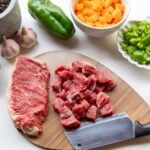
Calories in pork ribs: 198 calories per 1 rib without refuse (80 g)
- 22 g protein
- 0 g carbs
- 11 g fat
Source: USDA FoodData Central · 247 kcal per 100 g
One cooked pork rib (80 g, edible meat without refuse) has 198 calories in pork ribs by USDA FoodData Central’s cooked, braised country-style rib record. That serving gives 22 g of protein, 11 g of fat, and no carbohydrate. The USDA record is for separable lean meat only, so the numbers describe the meat, not the bone or the sauce.
What stands out is the protein-to-fat balance. Per 100 g, calories split about 46% protein and 54% fat, and the food contains no carbohydrate, fiber, or sugar. It is also a good source of selenium, zinc, and several B vitamins by the DATA’s % Daily Value figures.

Calories in Pork Ribs by Serving Size
Calories in pork ribs for each common serving, with protein, carbs and fat:
| Serving | Calories | Protein | Carbs | Fat |
|---|---|---|---|---|
| 1 rib without refuse (yield from 1 cooked rib, with refuse, weighing 141g) (80 g) | 198 | 22 g | 0 g | 11 g |
| 3 oz | 210 | 24 g | 0 g | 12 g |
| 100 g | 247 | 28 g | 0 g | 14 g |
| 1 oz | 70 | 7.9 g | 0 g | 4 g |
Pork Ribs Nutrition Facts
Calories in pork ribs and the full nutrition facts per 1 rib without refuse (yield from 1 cooked rib, with refuse, weighing 141g) (80 g):
| Nutrient | Amount | % Daily Value* |
|---|---|---|
| Calories | 198 kcal | |
| Protein | 22 g | 44% |
| Total Fat | 11 g | 15% |
| Saturated Fat | 4.1 g | 20% |
| Trans Fat | 0.1 g | |
| Cholesterol | 84 mg | 28% |
| Sodium | 48 mg | 2% |
| Total Carbohydrate | 0 g | 0% |
| Dietary Fiber | 0 g | 0% |
| Total Sugars | 0 g | |
| Vitamin D | 1 mcg | 5% |
| Calcium | 26 mg | 2% |
| Iron | 1.1 mg | 6% |
| Potassium | 238 mg | 5% |
| Magnesium | 18 mg | 4% |
| Zinc | 3.6 mg | 32% |
| Phosphorus | 166 mg | 13% |
| Selenium | 39 mcg | 71% |
| Vitamin E | 0.1 mg | 1% |
| Thiamin (B1) | 0.4 mg | 32% |
| Riboflavin (B2) | 0.2 mg | 18% |
| Niacin (B3) | 4.6 mg | 29% |
| Vitamin B6 | 0.4 mg | 23% |
| Vitamin B12 | 0.8 mcg | 31% |
Where the calories come from: 54% fat · 46% protein · 0% carbs
*Percent Daily Values are based on a 2,000-calorie diet (FDA reference values). Source: USDA FoodData Central — Pork, fresh, loin, country-style ribs, separable lean only, cooked, braised (FDC ID 168306, SR Legacy, published 4/1/2019). Values for other servings are calculated from the per-100 g data.
How Many Calories Are in Pork Ribs by Serving?
The DATA lists four servings. A 3 oz (85 g) portion has 210 calories, 24 g of protein, and 12 g of fat. A 1 oz (28 g) portion has 70 calories, 7.9 g of protein, and 4 g of fat. Per 100 g the figure is 247 calories, 28 g of protein, and 14 g of fat.
Because the calories come almost entirely from protein and fat, the calorie count rises in step with the weight of meat you eat. Weigh the cooked meat when you can. A rib’s yield varies with how much meat is left on the bone, so the same bone can give you more or less food.

Why Pork Ribs Are Carb-Free but Not Low in Fat
Pork ribs contain no carbohydrate, fiber, or sugar in this record, so they have no carb content on their own. That makes them a simple food to fit into a low-carb eating pattern. The calories come from fat, which provides 54% of the total, and protein, which provides 46%.
Fat is the main thing to watch. The 80 g rib serving has 11 g of total fat, of which 4.1 g is saturated fat (20% DV).
Sodium, Sauce, and Other Things Not in This Record
The USDA record is for plain braised meat with no sauce, rub, or glaze. Sodium here is low, at 48 mg (2% DV) for the lead serving. Barbecue sauce, dry rubs, and brines are not included, and many commercial sauces add sugar and sodium. If you use them, the label on your sauce is the better source for those numbers.
Restaurant and store-bought ribs are often cooked and sauced differently from this record. Treat this page as the reference for the cooked meat itself.
What Pork Ribs Provide in Micronutrients
By the DATA’s % DV figures, one rib serving gives 71% DV of selenium, 32% DV of zinc, 31% DV of vitamin B12, 32% DV of thiamin, and 29% DV of niacin. It is a source of B vitamins and minerals, though it has no vitamin C, folate, vitamin A, or vitamin K in this record.
The protein figure is the most useful number for many readers. The lead serving provides 44% DV of protein, so a few ribs can cover a substantial share of a meal’s protein.
How Pork Ribs Compares
Per 100 g, next to similar foods in our database:
| Food (100 g) | Calories | Protein | Carbs | Fat |
|---|---|---|---|---|
| Pork Ribs | 247 | 28 g | 0 g | 14 g |
| Beef Stew Meat | 251 | 28 g | 0 g | 15 g |
| Beef Brisket | 251 | 18 g | 0.5 g | 19 g |
| Lamb Rib | 235 | 28 g | 0 g | 13 g |
| Lamb Chop Rib | 234 | 32 g | 0 g | 12 g |
| Veal Loin | 226 | 34 g | 0 g | 9.2 g |
Pork Ribs FAQ
How many calories are in one pork rib?
One cooked rib (80 g, without refuse) has 198 calories, according to the USDA record for braised country-style ribs. It also has 22 g of protein and 11 g of fat. Exact counts depend on how much meat is on the bone.
Do pork ribs have any carbs?
The USDA record lists 0 g of total carbohydrate, fiber, and sugar per 100 g for the cooked, braised meat. Carbohydrate in a finished dish will come from sauces, rubs, or glazes, which are not in this record.
The Bottom Line
One cooked rib (80 g) has 198 calories, with 22 g of protein and 11 g of fat and no carbohydrate. Count the sauce and the bone-to-meat ratio separately, since they can change the total more than the meat itself.