Part of our guide: How to Count Macros: A Simple Beginner’s Guide With Examples
Key takeaways
- What are macronutrients? They’re the three nutrients you need in large amounts: protein, carbohydrate and fat.
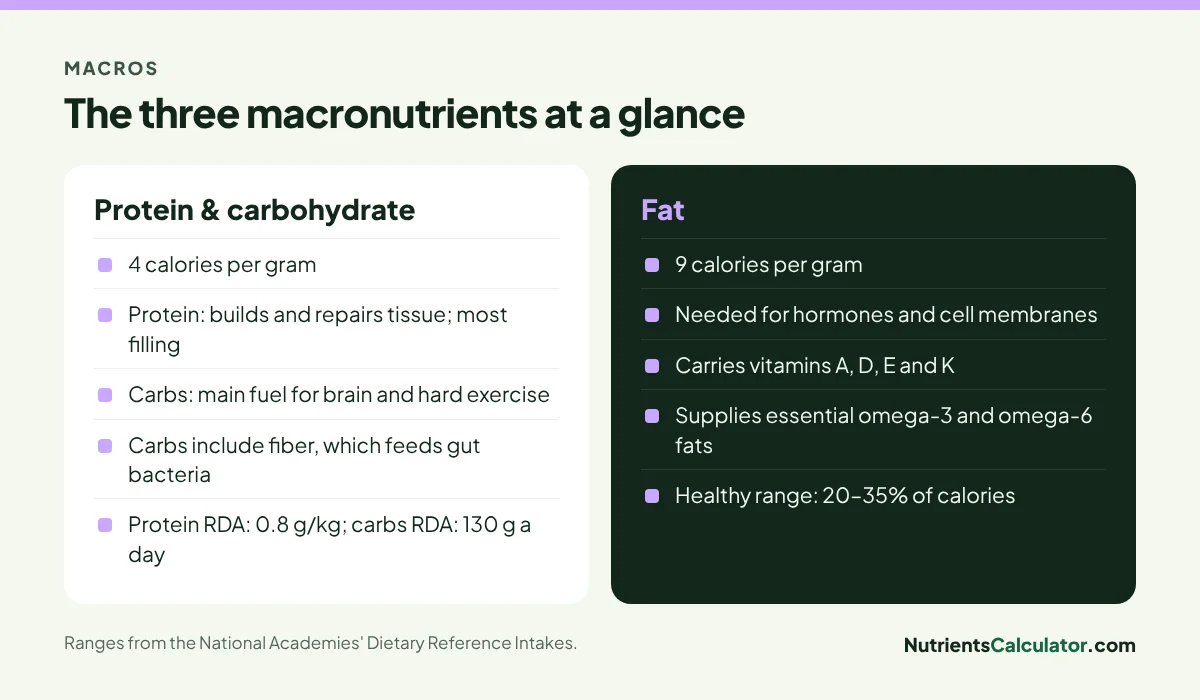
- Protein and carbs have 4 calories per gram; fat has 9.
- Each does a different job: protein builds, carbs fuel, fat supports hormones and vitamin absorption.
- Healthy ranges are wide: about 10–35% of calories from protein, 45–65% from carbs and 20–35% from fat.
Nutrition labels, fitness apps and diet plans all talk about “macros”. If you’ve ever wondered what macronutrients actually are, and why they matter more than just calories, this is the plain-English version. It covers what each macronutrient does, how many calories each provides, how much you need and which foods supply the best versions of each.
What are macronutrients, and how are they different from micronutrients?
Your body needs two kinds of nutrients:
- Macronutrients (protein, carbohydrate, fat) are needed in grams, often hundreds of grams a day. They supply energy (calories) and building materials.
- Micronutrients (vitamins and minerals) are needed in milligrams or micrograms. They don’t supply energy but are essential for nearly every process in the body.
So when someone says they’re “counting macros”, they’re tracking grams of protein, carbs and fat.

Etekcity Food Scale
0.1g accuracy — the perfect companion for exact portions.
Protein

What it does: Protein is made of amino acids, the building blocks of muscle, skin, enzymes, hormones and immune cells. Nine amino acids are essential, meaning you must get them from food. Protein is also the most filling macronutrient, which is why higher-protein meals help with appetite control.
How much: The RDA is 0.8 g per kg of body weight to prevent deficiency. The current Dietary Guidelines describe 1.2–1.6 g/kg as beneficial for many adults, especially older and active people (summary). Our guide to how much protein you need a day turns that into grams.
Good sources (USDA values):
- Chicken breast, 3 oz cooked: 26 g
- Lentils, 1 cup cooked: 18 g
- Plain nonfat Greek yogurt, 6 oz: 17 g
- Firm tofu, ½ cup: 22 g
- Large egg: 6 g
Carbohydrate

What it does: Carbohydrates are your body’s main fuel, and the preferred fuel for your brain and for intense exercise. They come in three main forms:
- Sugars, found naturally in fruit and milk, and added to many processed foods.
- Starches, in grains, potatoes, beans and corn.
- Fiber, which you can’t fully digest but which feeds gut bacteria, slows digestion and helps with fullness, blood sugar and cholesterol.
How much: The RDA is 130 g a day, the amount needed to fuel the brain. The healthy range is 45–65% of calories, which on a 2,000-calorie diet is 225–325 g. Fiber has its own target: about 14 g per 1,000 calories, or 28 g on 2,000 (National Academies). See how many carbs a day for more.
Good sources: oats, brown rice, quinoa, beans, lentils, potatoes, fruit, vegetables and whole-grain bread. A cup of cooked black beans gives about 41 g of carbs, 15 g of them fiber.
Fat

What it does: Fat stores energy, forms cell membranes, helps make hormones and carries the fat-soluble vitamins A, D, E and K. Two types, omega-3 and omega-6 fats, are essential because your body can’t make them.
Types of fat:
- Unsaturated fats (olive oil, nuts, seeds, avocado, fatty fish) are linked to better heart health.
- Saturated fats (butter, fatty meat, cheese, coconut oil) are best kept under about 10% of calories, a limit the 2025–2030 Dietary Guidelines kept.
- Trans fats from partially hydrogenated oils have largely been removed from the US food supply.
How much: 20–35% of calories, which on a 2,000-calorie diet is about 44–78 g. Read more in how much fat per day.
Good sources: olive oil (1 tbsp: 13.5 g fat), almonds (1 oz: 14 g), avocado, salmon and chia seeds.
Calories per gram, and why it matters
| Macro | Calories per gram |
|---|---|
| Protein | 4 |
| Carbohydrate | 4 |
| Fat | 9 |
| Alcohol (not a nutrient) | 7 |
Because fat has more than twice the calories per gram, fatty foods are calorie-dense: a tablespoon of olive oil (119 calories) has almost as many calories as a 3 oz chicken breast (140). That doesn’t make fat bad; it just means portions matter more.
Do you need to balance them?
You don’t need a perfect ratio. Most healthy eating patterns, from Mediterranean to higher-protein to vegetarian, fall within the healthy ranges and work well. For weight loss, research shows total calories and protein matter more than the exact split of carbs and fat; see the best macro ratio for weight loss.
A simple way to build balanced meals without counting: fill half your plate with vegetables, a quarter with a protein food and a quarter with a whole-grain or starchy food, plus a little healthy fat.
How to see your own macros
Most people have no idea how their day splits until they log it. Snap a meal with our free analyzer to see its protein, carbs and fat in seconds, or learn the full method in how to count macros.
The bottom line
What are macronutrients? Protein, carbohydrate and fat: the three nutrients that supply your calories and the raw materials your body runs on. Protein builds and fills you up, carbs fuel you (and include fiber), and fat supports hormones and vitamin absorption. You need all three, and a wide range of balances can be healthy, as long as protein is adequate and most carbs and fats come from whole foods.
Frequently asked questions
What are the 3 macronutrients?
Protein, carbohydrate and fat. They're called macronutrients because your body needs them in large amounts (grams), unlike vitamins and minerals, which you need in milligrams or micrograms.
Is water a macronutrient?
Some textbooks include water because you need it in large amounts, but it doesn't supply energy. In nutrition tracking, "macros" almost always means protein, carbs and fat.
Is alcohol a macronutrient?
Alcohol supplies energy (about 7 calories per gram), but it isn't a nutrient because your body doesn't need it. Trackers usually count it within calories rather than as a macro.
Which macronutrient is most important?
You need all three. For people trying to lose weight or stay strong as they age, protein deserves special attention because it's the one most often eaten in too-small amounts at some meals.
Sources
- National Academies: Dietary Reference Intakes for Energy, Carbohydrate, Fiber, Fat, Fatty Acids, Cholesterol, Protein, and Amino Acids
- USDA FoodData Central
- 2025–2030 Dietary Guidelines for Americans: key changes (Perkins Coie summary)
This article is for general information and isn’t medical advice. Talk to your doctor or a registered dietitian about your own needs, especially if you have a health condition, are pregnant or take medication.