Key takeaways
- Knowing how to count macros means tracking protein, carbohydrate and fat in grams, not just total calories.
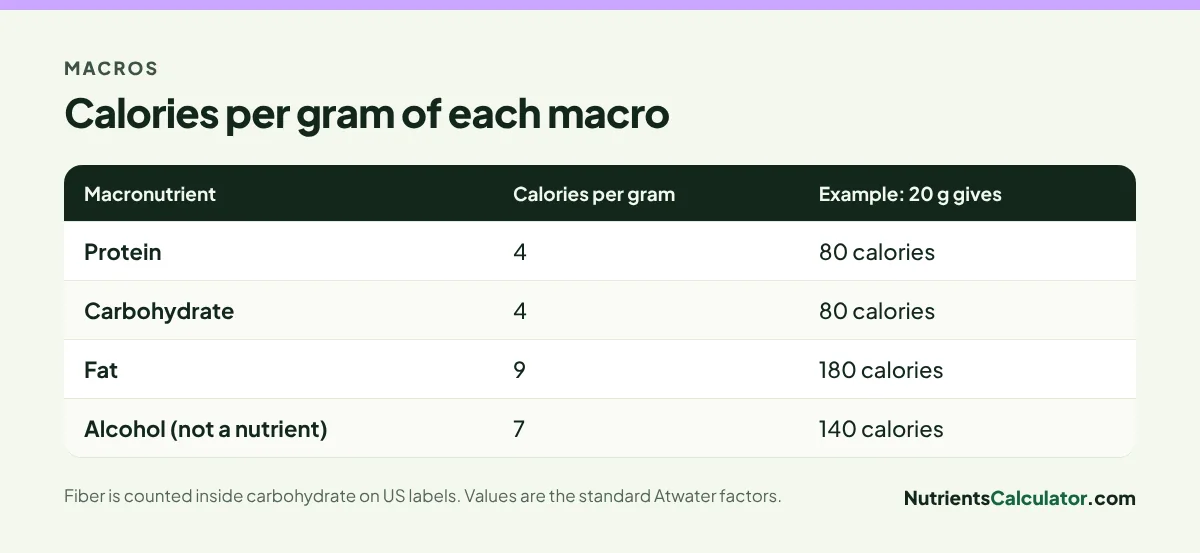
- Protein and carbs give 4 calories per gram; fat gives 9.
- Set calories first, choose a split (for example 30% protein, 40% carbs, 30% fat), then convert percentages to grams.
- Hit protein every day; let carbs and fat flex. Close is good enough.
Calories tell you how much energy you eat. Macros tell you what that energy is made of. Two days with the same 1,800 calories can feel completely different: one with 130 g of protein and plenty of fiber keeps you full and protects muscle, the other built on pastries and crisps leaves you hungry by mid-afternoon. Learning how to count macros fixes that blind spot. This guide walks through it in five steps, with real numbers from USDA FoodData Central.
What “macros” are

Macronutrients are the three nutrients your body needs in large amounts, measured in grams:
- Protein builds and repairs tissue, including muscle, and is the most filling nutrient.
- Carbohydrate is the body’s main fuel, especially for the brain and hard exercise. Fiber is a type of carbohydrate.
- Fat is needed for hormones, cell membranes and absorbing vitamins A, D, E and K.
Each macro also supplies energy, which is how calories and macros connect. For a closer look at each one, see what macronutrients are and what they do.

Etekcity Food Scale
0.1g accuracy — the perfect companion for exact portions.
Step 1: Set your calorie target
Macros are slices of a calorie budget, so start there. Use your maintenance calories if you want to stay the same weight, about 300–500 fewer if you want to lose fat, or a little more if you’re trying to gain. Our guide to creating a calorie deficit explains how to find these numbers, and our calculator can do it for you.
Step 2: Choose a macro split
The National Academies set healthy ranges called Acceptable Macronutrient Distribution Ranges (DRI report):
| Macro | Healthy range (% of calories) |
|---|---|
| Protein | 10–35% |
| Carbohydrate | 45–65% |
| Fat | 20–35% |
Most practical splits sit near the edges of these ranges. A balanced starting point that works for many people is 30% protein, 40% carbs, 30% fat. People who train hard often prefer more carbs; people who find carbs less filling sometimes prefer a bit more fat. For weight loss specifically, the best split is the one you can keep, as we explain in the best macro ratio for weight loss.
Step 3: Convert percentages to grams
Multiply your calories by each percentage, then divide by the calories per gram. For a 1,800-calorie target at 30/40/30:
- Protein: 1,800 × 0.30 = 540 calories ÷ 4 = 135 g
- Carbs: 1,800 × 0.40 = 720 calories ÷ 4 = 180 g
- Fat: 1,800 × 0.30 = 540 calories ÷ 9 = 60 g
Check: 135 × 4 + 180 × 4 + 60 × 9 = 540 + 720 + 540 = 1,800. If 135 g of protein feels high, you can also set protein from body weight instead. The current Dietary Guidelines describe 1.2–1.6 g per kg as a useful range for many adults (summary); our guide to daily protein needs has a chart. Then split the remaining calories between carbs and fat.
Step 4: Learn to read macros on labels and foods

Every Nutrition Facts label lists total fat, total carbohydrate and protein per serving. You can check that they add up. A 6 oz pot of plain nonfat Greek yogurt has about 17.3 g protein, 6.1 g carbs and 0.7 g fat:
17.3 × 4 + 6.1 × 4 + 0.7 × 9 = about 100 calories, which matches the label.
For foods without labels, a few USDA reference values cover a lot of meals:
| Food | Portion | Protein | Carbs | Fat | Calories |
|---|---|---|---|---|---|
| Chicken breast, roasted | 3 oz | 26 g | 0 g | 3 g | 140 |
| Salmon, farmed, cooked | 3 oz | 19 g | 0 g | 10.5 g | 175 |
| Large egg, hard-boiled | 1 egg | 6 g | 0.6 g | 5 g | 78 |
| Lentils, cooked | 1 cup | 18 g | 40 g | 1 g | 230 |
| Brown rice, cooked | 1 cup | 5 g | 50 g | 2 g | 240 |
| Rolled oats, dry | ½ cup (40 g) | 5 g | 27 g | 2.6 g | 152 |
| Banana | 1 medium | 1.3 g | 27 g | 0.4 g | 105 |
| Almonds | 1 oz | 6 g | 6 g | 14 g | 162 |
| Olive oil | 1 tbsp | 0 g | 0 g | 13.5 g | 119 |
Notice how quickly fat adds calories: one tablespoon of oil has about as many calories as a 3 oz chicken breast.
Step 5: Track for a week, then simplify

Log everything for seven days. You’ll quickly see patterns, such as breakfast being low in protein or most fat coming from cooking oil. After that, many people switch to a lighter routine:
- Track protein every day. It’s the macro most people undershoot.
- Track calories roughly (or weigh in weekly and adjust).
- Let carbs and fat flex. A higher-carb day and a higher-fat day balance out.
If precise logging starts to feel stressful, step back. Our guide to tracking food without obsessing has lighter methods that still work.
A day that hits 135 g protein, 180 g carbs, 60 g fat
Here’s one way to land close to the 1,800-calorie, 30/40/30 example:
- Breakfast: 1 cup Greek yogurt, ½ cup blueberries, ¼ cup oats, a few almonds.
- Lunch: 4 oz chicken breast, ½ cup brown rice, ½ cup black beans, tomatoes and a little avocado.
- Snack: an apple and 2 tbsp peanut butter.
- Dinner: 4 oz salmon, 1 cup potatoes, 1 cup broccoli, cooked in 1 tbsp olive oil.
- Evening: 1 cup 2% milk.
By USDA values that’s about 1,800 calories, 124 g protein, 175 g carbs and 73 g fat: a little under on protein and over on fat. Swapping the peanut butter for a cup of 2% cottage cheese brings it to about 140 g protein and 62 g fat, right next to target. That kind of small swap is all “hitting your macros” usually takes. Our 1,800-calorie meal plan has two more days.
Common mistakes when learning how to count macros
- Forgetting cooking fat and sauces. They’re the most common reason fat comes in high.
- Counting dry vs cooked weights inconsistently. 40 g of dry oats and 40 g of cooked oats are very different. Pick one and stick with it.
- Chasing perfect numbers. Within 5–10 g is excellent.
- Ignoring fiber. Fiber sits inside your carb number; aim for 25–35 g a day so carbs come mostly from plants (see how to get 28 grams of fiber a day).
The bottom line
Counting macros is calorie counting with more detail. Set a calorie target, choose a split inside the healthy ranges, convert it to grams, and track for a week to learn your patterns. After that, focus on protein and let the rest flex. The other posts in this series cover each macro, carbs vs net carbs, and the right split for weight loss.
Frequently asked questions
Is counting macros better than counting calories?
Macros include calories, so counting them gives you more information: you see whether your calories come with enough protein and fiber. For weight loss, total calories still matter most; macros help with fullness, muscle and energy.
What macro split should a beginner use?
Start inside the ranges health authorities consider healthy: about 10–35% of calories from protein, 45–65% from carbs and 20–35% from fat. Many people do well with a split near 30% protein, 40% carbs and 30% fat, then adjust to taste.
Do I need to hit my macros exactly?
No. Being within about 5–10 g of your protein target and roughly on target for calories is plenty. Carbs and fat can trade places from day to day without much effect.
How do I count macros when eating out?
Use posted nutrition information when it exists. Otherwise, estimate the protein portion with your palm and the starch with your fist, and assume extra fat from cooking oil and sauces.
Sources
- National Academies: Dietary Reference Intakes for Energy, Carbohydrate, Fiber, Fat, Fatty Acids, Cholesterol, Protein, and Amino Acids
- USDA FoodData Central
- 2025–2030 Dietary Guidelines for Americans: key changes (Perkins Coie summary)
This article is for general information and isn’t medical advice. Talk to your doctor or a registered dietitian about your own needs, especially if you have a health condition, are pregnant or take medication.