Part of our guide: How to Build a Food Tracking Habit That Actually Sticks
Key takeaways
- To track food without obsessing, treat it as a tool for noticing patterns, not a test you pass or fail.
- Warning signs it’s becoming unhealthy: guilt, anxiety, rigid rules, skipping meals, avoiding social eating.
- Lighter options work well: photo-only logs, tracking one nutrient, hand portions, or weekly check-ins.
- If food or numbers feel out of control, step back and talk to a professional. Support is available.
Food logging helps many people. Research consistently links self-monitoring to better results for weight management (Burke et al., 2011), and plenty of people enjoy learning how their meals add up. But for some, tracking can tip into stress, guilt or rigid rules. The goal of this article is to help you keep the benefits and drop the downsides. It’s the final step in our guide to building a food tracking habit that sticks.
Why tracking can become stressful
- Numbers feel like judgment. A total over your target can feel like failure, even though daily numbers naturally vary.
- Precision anxiety. Estimates are always approximate, which can be frustrating if you want certainty.
- All-or-nothing thinking. One “bad” meal turns into “the day is ruined”.
- Losing touch with hunger. Eating by numbers rather than by appetite can make hunger cues harder to notice.
Etekcity Food Scale
0.1g accuracy — the perfect companion for exact portions.
Signs it’s time to step back

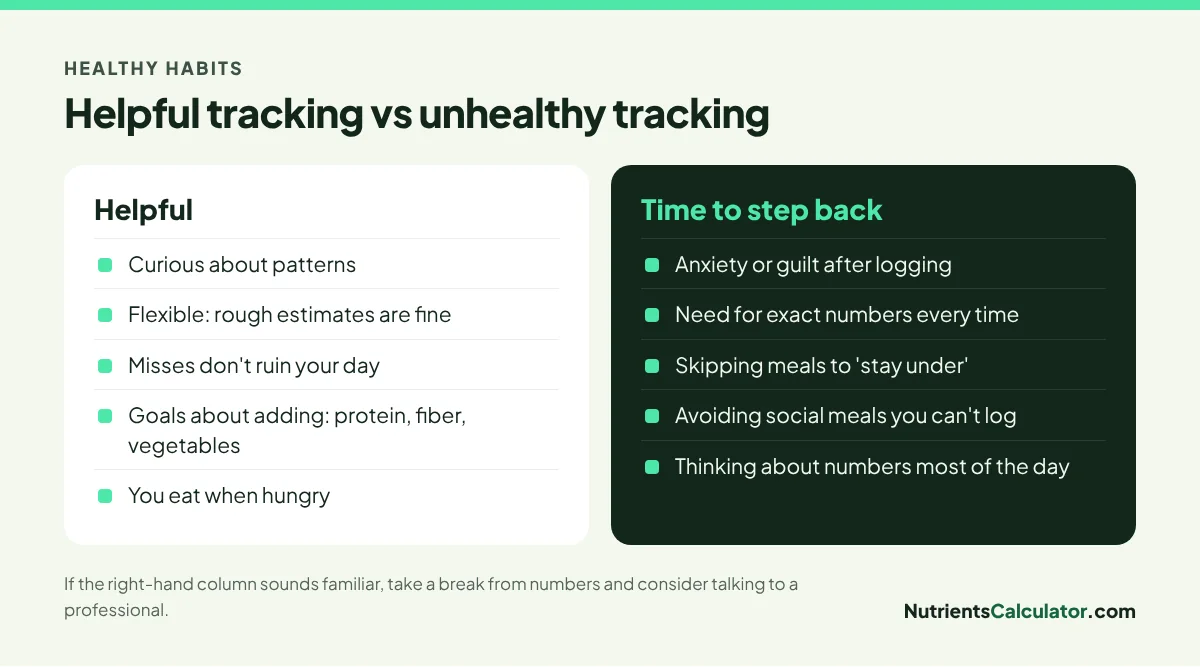
Take a break from detailed tracking, and consider talking to your doctor or a registered dietitian, if you notice:
- Anxiety or guilt before or after logging
- Feeling you must know the exact number for everything you eat
- Skipping meals or restricting heavily to “stay under”
- Avoiding restaurants, parties or family meals because you can’t log them precisely
- Thinking about food, calories or your weight most of the day
- Exercising to “cancel out” food
These aren’t character flaws. They’re signals that the tool isn’t serving you right now.
Five ways to track food without obsessing

1. Photo-only logging
Take a photo of each meal but hide or ignore the numbers. At the end of the week, scroll through the photos. You’ll still see patterns (how often vegetables appear, how big portions are, when you snack) without daily totals.
2. Track one thing
Instead of every calorie, track a single goal that’s about adding something good:
- Protein at each meal (see protein per meal)
- Servings of vegetables or fruit
- Fiber, or bean days per week
- Glasses of water
3. Use hand portions
Build meals with a palm of protein, a fist of vegetables, a cupped hand of carbs and a thumb of fat, without writing anything down. Our hand portion guide explains how.
4. Hunger and energy journal
Instead of numbers, note how hungry you were before and after a meal (1–10) and how your energy felt a few hours later. This rebuilds trust in your body’s signals.
5. Weekly check-ins only
Log normally for one week a month, or do a 10-minute weekly review without daily tracking. You still get a useful picture without daily scrutiny.
Healthier ways to set goals
- Focus on adding, not cutting: “eat beans three times this week” instead of “no carbs”.
- Use ranges, not exact numbers: “1,800–2,000 calories” or “25–35 g protein at breakfast”.
- Judge by weekly averages, not single days.
- Include non-food goals: sleep, steps, how your clothes fit, how you feel.
- Allow flexibility: birthdays, holidays and dinners out are part of a healthy life, not a lapse.
How to set up a tracking app so it feels supportive
- Turn off daily “over budget” warnings if they upset you.
- Use streaks for showing up, like “logged one meal”, not for restrictive goals.
- Choose positive daily missions: hit protein, drink water, eat a vegetable.
- Allow streak misses (“never miss twice”); see why streaks work.
- Use fun features (a daily game, challenges with a friend) to keep the experience light.
When to stop tracking entirely
If you have a history of an eating disorder, are currently struggling with food, or find that every lighter method above still causes distress, it may be best not to track numbers at all, at least for now. That’s a valid choice. Many people eat well using routines, balanced plates and listening to hunger, with no app.
Where to find support

If food, weight or numbers feel out of control:
- Talk to your doctor, who can refer you to a therapist or registered dietitian who specializes in eating concerns.
- National Alliance for Eating Disorders helpline (US): 866-662-1235, Monday to Friday, 9 AM to 7 PM Eastern. Free, confidential guidance and referrals (allianceforeatingdisorders.com).
- In an emergency, call 911. If you’re having thoughts of harming yourself, call or text 988 (the Suicide & Crisis Lifeline in the US).
The bottom line
Food tracking should make you more informed and more relaxed about eating, not less. Keep it flexible, focus on adding healthy foods, judge by weekly patterns, and choose a lighter method if numbers start to feel stressful. If tracking causes guilt, anxiety or restrictive behavior, step back and reach out for support. Your wellbeing matters more than any number.
Frequently asked questions
Is calorie counting bad for mental health?
For many people it's a neutral or helpful tool. For some, especially those with a history of disordered eating, it can increase anxiety or rigid behaviors. If tracking makes you feel worse, switch to a lighter method or stop.
How can I track food without counting calories?
Log photos without looking at numbers, track one nutrient (like protein or vegetables), use hand portions, or keep a simple hunger and energy journal. Each gives you useful patterns without exact numbers.
How do I know if I have an unhealthy relationship with food?
Warning signs include persistent guilt or anxiety around eating, rigid rules, skipping meals to compensate, avoiding social meals, and thinking about food or numbers most of the day. A doctor, therapist or registered dietitian can help you sort it out.
Where can I get help for disordered eating?
In the US, the National Alliance for Eating Disorders runs a free helpline at 866-662-1235 (weekdays 9 AM to 7 PM Eastern). You can also start with your doctor.
Sources
- National Alliance for Eating Disorders
- Find a Helpline: National Alliance for Eating Disorders
- Burke LE et al. Self-monitoring in weight loss: a systematic review. J Am Diet Assoc, 2011
This article is for general information and isn’t medical advice. Talk to your doctor or a registered dietitian about your own needs, especially if you have a health condition, are pregnant or take medication.