Part of our guide: How to Build a Food Tracking Habit That Actually Sticks
Key takeaways
- An accountability partner makes a measurable difference. In a classic study, people recruited with friends who got social-support training were much more likely to finish a weight-loss program and keep the weight off.
- The best partner is consistent and kind, not necessarily someone with the same goal.
- Share behaviors (logged today, hit protein, completed a challenge day) rather than weight.
- Short, regular check-ins beat long, occasional ones.
Most people try to change how they eat alone, quietly, and give up quietly too. Adding one other person changes the dynamic: there’s someone who notices, someone to report to, and someone who’s going through the same thing. This post is part of our guide to building a food tracking habit that sticks.
What the research says
The best-known study on this was published in 1999 by Rena Wing and Robert Jeffery. They recruited 166 adults into a behavioral weight-loss program either alone or with three friends or family members, and gave half of each group a standard program and half extra social-support training (Wing & Jeffery, 1999).
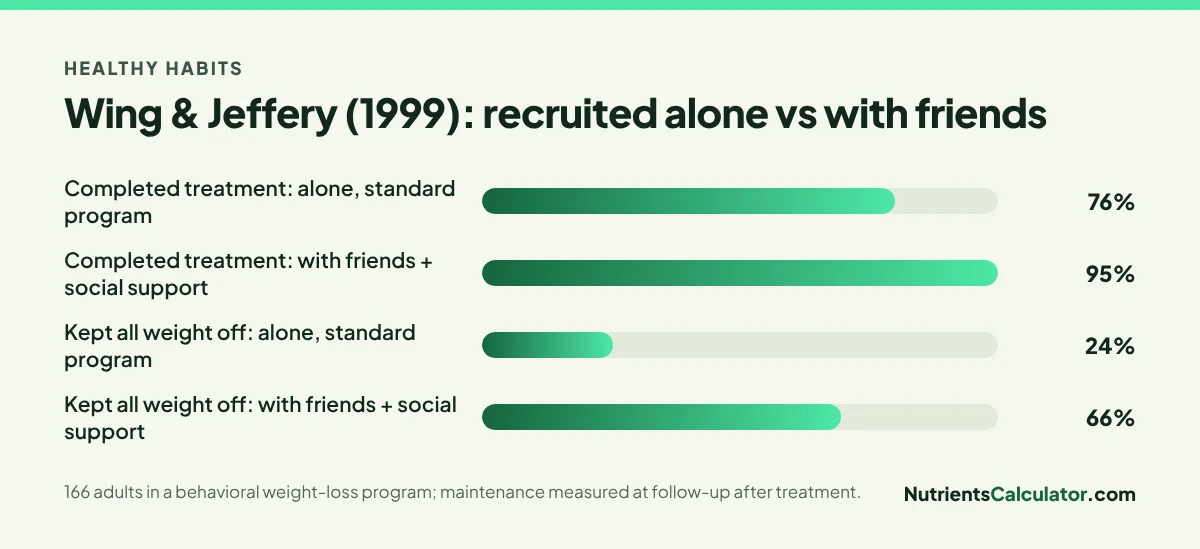
- Completion: 95% of people recruited with friends who received social-support training completed the program, compared with 76% of those recruited alone in the standard program.
- Keeping the weight off: 66% of the friends-plus-support group maintained their full weight loss at follow-up, compared with 24% of the alone-standard group.
It’s one study and the program was intensive, but the direction matches a broad body of research: people do better with support.

Etekcity Food Scale
0.1g accuracy — the perfect companion for exact portions.
Why a buddy helps

- Accountability. Knowing someone will ask “did you log today?” makes logging more likely.
- Modeling. Seeing a friend choose the salad or log their dinner makes it feel normal.
- Encouragement on bad days. A quick “you’ve got this” can stop one missed meal from becoming a missed week.
- Shared problem-solving. “What do you eat for a high-protein breakfast?” is easier to answer together.
- Fun. Friendly competition and shared wins make the process more enjoyable, which helps it last.
How to choose the right partner
The ideal accountability partner is:
- Consistent: someone who’ll actually check in, most days.
- Kind: encouraging rather than critical. You want a teammate, not a food police officer.
- Comparable in commitment: they don’t need the same goal, but they should care about theirs.
- Reachable: a friend you text daily is better than a perfect partner you see once a month.
Partners can be a friend, a spouse, a coworker, a family member far away or someone you meet in an online community.
What to share (and what not to)
Share behaviors: – “Logged all my meals today” – “Hit my protein goal” – “Day 9 of 21 done” – “Tried a new bean recipe”
Optional, by agreement: – Weekly averages (calories, protein, steps) – Weight trends
Many people feel uncomfortable sharing weight or calorie totals, and behaviors are what you can control day to day anyway. Behavior-based goals also keep the partnership positive.
Check-in routines that work

Daily (30 seconds)
A quick message or a glance at each other’s progress in an app: did you log today? A thumbs-up is enough.
Weekly (10 minutes)
Share one win and one thing to change next week. Our 10-minute weekly nutrition review gives you a structure to bring to the conversation.
Monthly
Look back at the month together: longest streak, favorite new meal, what got easier. Celebrate something.
Turn it into a challenge
Shared challenges give partnerships a clear structure: a start date, a daily target, and a finish line. Examples:
- 21 days of logging at least one meal
- 14 days hitting a protein goal
- 7 days of drinking 8 glasses of water
Choose challenges where progress counts automatically from what you already log, so nobody has to “check in” manually. And allow for misses: a challenge that requires 18 of 21 days is more forgiving, and more realistic, than 21 of 21. That matches what habit research shows about occasional misses not derailing progress (Lally et al., 2010). We cover the psychology in why streaks work.
When your partner falls off track
It will happen, to both of you. A good response:
- Notice without judging: “Haven’t seen you log in a couple of days. Everything OK?”
- Offer an easy restart: “Want to just log dinner tonight?”
- Keep your own routine going. Don’t let their pause become yours.
- Use a nudge, not a lecture. Many apps let you send a one-tap nudge, which is often all it takes.
Buddy systems for families

Households often eat together, so changes stick better when everyone’s involved. Plan meals together, cook a batch of high-protein breakfasts on Sunday, and let each person pick one vegetable or new recipe for the week. Keep the focus on foods to add, not foods to cut, especially around children.
The bottom line
An accountability partner raises your odds of sticking with healthy eating, especially if you pick someone consistent and kind, share behaviors rather than weight, check in briefly every day, and give your partnership a structure like a shared 21-day challenge. Invite one person this week. It’s one of the simplest changes with real evidence behind it.
Frequently asked questions
Does having an accountability partner help you lose weight?
Research suggests social support helps. In one well-known study, people who joined a weight-loss program with friends and received social-support training were more likely to complete the program and keep their weight off than those who joined alone.
What should I share with an accountability partner?
Share behaviors, not just numbers: whether you logged today, hit a protein goal or completed a challenge day. Many people prefer not to share weight or calorie totals, and that's fine.
What if my partner falls off track?
Check in without judgment, suggest restarting with the next meal, and keep your own routine going. A good buddy system survives one person having a bad week.
Can an online buddy work as well as a friend?
Yes, especially if you check in regularly. Shared progress in an app, a group chat or a joint challenge can provide much of the same accountability.
Sources
- Wing RR, Jeffery RW. Benefits of recruiting participants with friends and increasing social support for weight loss and maintenance. J Consult Clin Psychol, 1999
- Burke LE et al. Self-monitoring in weight loss: a systematic review. J Am Diet Assoc, 2011
- Lally P et al. How are habits formed. Eur J Soc Psychol, 2010
This article is for general information and isn’t medical advice. Talk to your doctor or a registered dietitian about your own needs, especially if you have a health condition, are pregnant or take medication.