Key takeaways
- A consistent food tracking habit is one of the strongest predictors of weight-loss success, and consistency beats precision.
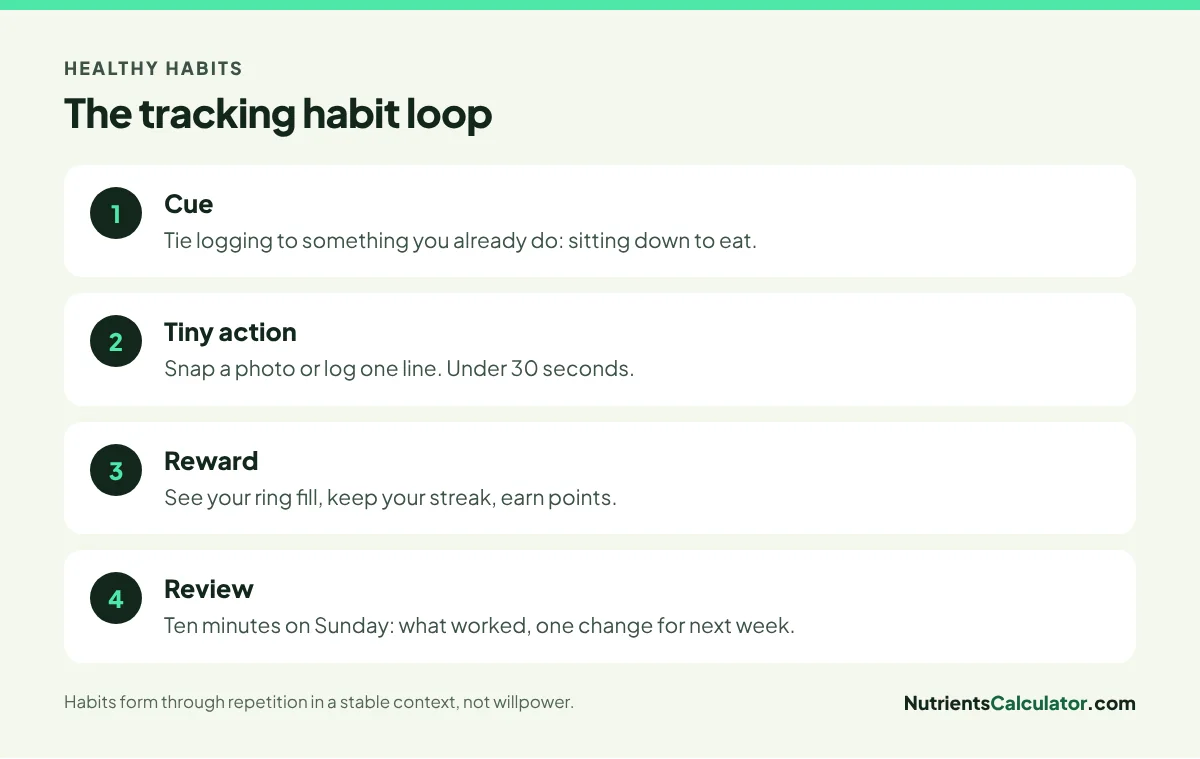
- Make each entry tiny (a photo or one line) and tie it to a cue you already have: sitting down to eat.
- Expect it to take weeks, not days. A median of 66 days in one study, with a wide range.
- Streaks, a buddy and a short weekly review keep the habit alive after the novelty fades.
Food logging works. A systematic review of self-monitoring studies found a consistent link between tracking what you eat and losing weight (Burke et al., 2011). The problem is that most people stop. The first week feels motivating; by week three, entries get skipped, then whole days, then the app is forgotten.
The difference between people who keep going and people who don’t is rarely willpower. It’s design: how easy logging is, when it happens, and what keeps it rewarding. Here’s how to set it up so it lasts.
Why most people quit tracking
- It takes too long. Searching a database for every ingredient of a homemade stew is tedious.
- It feels like judgment. Seeing a big number after a big dinner can make people avoid logging altogether.
- There’s no fixed moment for it. “I’ll log it later” usually means never.
- The payoff is slow. Weight and energy change over weeks; logging costs effort today.
Each of these has a fix.

Etekcity Food Scale
0.1g accuracy — the perfect companion for exact portions.
Step 1: Make every entry tiny

The smaller the action, the more likely you’ll repeat it. Aim for under 30 seconds per meal:
- Snap a photo of the plate and let the app estimate it.
- Save meals you eat often (your usual breakfast) and re-log them with one tap.
- Use rough estimates. Our guide to estimating calories without a scale shows how to be close enough without weighing anything.
Research supports this: in one study, the people who lost the most weight logged often, and the time they spent per day fell as they got faster, from about 23 minutes a day in month one to under 15 by month six (Harvey et al., 2019).
Step 2: Attach logging to a cue
Habits form when the same action follows the same cue in the same context, over and over (Lally et al., 2010). The best cue for food logging is the meal itself: when the plate is in front of you, before the first bite, take the photo. It’s the same moment every time, and the food is right there.
Other cues that work: putting your phone next to your plate, logging breakfast while the kettle boils, or logging snacks the moment you open the package.
Step 3: Expect weeks, not days
The famous “21 days to form a habit” isn’t supported by research. In the study above, it took a median of 66 days for a simple daily action to become automatic, and the range ran from 18 to 254 days. That’s not a reason to give up; it’s a reason to stop judging yourself at day 10. We look at what the research really says in how long it takes to form a habit.
Step 4: Use a streak, gently
A visible streak is one of the most effective motivators in habit apps, because people don’t like to lose something they’ve built. Seeing “12 days in a row” makes logging today feel worth it.
Streaks have a dark side too: break one and some people quit entirely. The fix is a rule like “never miss twice”: one missed day is normal, two in a row is the thing to avoid. We cover why streaks work and how to use them without the all-or-nothing trap in the psychology of streaks.
Step 5: Find a buddy
Social support makes a measurable difference. In a classic study, people who joined a weight-loss program with friends and got extra social support were far more likely to finish the program and keep the weight off than people who joined alone (Wing & Jeffery, 1999). A partner who logs at the same time, or who notices when you’ve gone quiet, is a strong reason to keep going. More on choosing and working with one in accountability partners for healthy eating.
Step 6: Make it rewarding today, not just in three months
Logging needs a small reward right away. Options that work:
- Seeing your daily calorie ring or protein bar fill up.
- Earning points or levels for logging.
- Ticking off a daily mission (“log three meals”, “hit your protein goal”).
- A short, fun daily activity in the same app, so opening it is something you look forward to.
Step 7: Review once a week

Daily numbers are noisy. Once a week, spend 10 minutes looking at the bigger picture: How many days did you log? What was your average? Which nutrient was lowest? What’s one thing to change next week? This turns data into decisions. Our 10-minute weekly nutrition review gives you the exact questions.
Step 8: Keep it healthy
Tracking should make eating easier and more informed, not more stressful. If logging starts to make you anxious, feel guilty, or leads you to skip meals, step back. You can track less (only protein, only weekdays, only photos without numbers) or take a break. Our guide on how to track food without obsessing covers warning signs and lighter ways to track.
A 4-week plan to start your food tracking habit
| Week | Focus | Goal |
|---|---|---|
| 1 | Just log | Log at least one meal every day, any way you like |
| 2 | Log all meals | Photo every meal and snack; don’t change what you eat |
| 3 | One improvement | Pick one change from your data (more protein at breakfast, for example) |
| 4 | Review and adjust | Do your first weekly review; set a target for next week |
Notice what’s missing from week one: calorie targets. Building the habit first and optimizing second is what makes the habit stick.
What to track (and what you can skip)
You don’t have to track everything to benefit. Choose the level that fits your goal:
| Goal | Track this | Can skip |
|---|---|---|
| General awareness | Photo of every meal | Exact numbers |
| Weight loss | Calories and protein | Micronutrients day to day |
| Muscle gain | Protein per meal, total calories | Fiber details |
| Better nutrition | Fiber, vegetables, weekly nutrient gaps | Daily calories |
| Budget | Meals planned vs eaten, grocery cost | Macros |
Start with the lightest level that answers your question. You can always add detail later; it’s much harder to keep up a heavy system you started on day one.
Tools that make it easier
- Photo logging for plates (fastest).
- Barcode scanning for packaged food (most accurate).
- Saved meals for things you eat often.
- A meal planner, so logging becomes “ate as planned” with one tap.
- Weekly summaries that do the averaging for you.
The bottom line
Food tracking works when it’s quick, tied to a cue, and rewarding in the moment. Keep entries tiny, log at the moment the plate arrives, protect your streak without letting one miss end it, bring a friend, and review once a week. Give it six to ten weeks before you decide whether it’s working, and judge it by consistency, not perfection.
Frequently asked questions
How long does it take to make food tracking a habit?
In a well-known study, simple daily habits took a median of 66 days to become automatic, with a range of 18 to 254 days. Food logging often feels easier after three to six weeks, especially if you log at the same moment each day.
Does tracking food really help with weight loss?
Yes. Reviews of the research find that consistent self-monitoring of diet is one of the strongest predictors of weight loss success. The benefit comes from consistency rather than perfect accuracy.
How much time does food tracking take?
In one study of successful dieters, time spent logging dropped from about 23 minutes a day in the first month to under 15 minutes by month six. Photo logging and saved meals cut it further.
What if I miss a day of tracking?
Log the next meal and carry on. Missing a single day did not meaningfully slow habit formation in research. What matters is not letting one missed day turn into a missed week.
Sources
- Burke LE et al. Self-monitoring in weight loss: a systematic review. J Am Diet Assoc, 2011
- Harvey J et al. Log often, lose more: electronic dietary self-monitoring for weight loss. Obesity, 2019
- Lally P et al. How are habits formed: modelling habit formation in the real world. Eur J Soc Psychol, 2010
- Wing RR, Jeffery RW. Benefits of recruiting participants with friends and increasing social support for weight loss and maintenance. J Consult Clin Psychol, 1999
This article is for general information and isn’t medical advice. Talk to your doctor or a registered dietitian about your own needs, especially if you have a health condition, are pregnant or take medication.