Key takeaways
- You can estimate calories without a food scale well enough to reach your goals: aim for “close and consistent”, not perfect.
- The five tools are your hand, your plate, nutrition labels, reference foods you already know, and a photo of the meal.
- The biggest errors come from fats and sauces, not vegetables. Check those first.
- Small errors cancel out over a week. Logging every day matters more than logging precisely.
A kitchen scale is the most precise way to measure food, but most meals don’t happen next to one. You eat at work, at a friend’s house, at a restaurant, or straight from a pan. The good news: research on food tracking consistently finds that the habit of recording what you eat predicts results better than how precise each entry is (Burke et al., 2011). A reasonable estimate you actually log beats a perfect number you never write down.
This guide walks through five methods, how accurate each one tends to be, and a simple routine for combining them. Each method has its own deep-dive post in this series, linked as you go.
Why “close enough” really is enough
Suppose your daily target is 1,900 calories and your estimates are off by 15% on any given meal. Some meals you’ll guess high, some low. Over a week, those errors partly cancel. What doesn’t cancel is a systematic error, like always forgetting the tablespoon of olive oil (about 120 calories) or never counting the latte.
So the goal of estimating isn’t precision on every bite. It’s:
- Being in the right range for each meal.
- Not leaving out whole categories of food.
- Being consistent, so your weekly trend tells you something real.
If your weight or energy isn’t moving the way you expect after two or three weeks of consistent logging, adjust your target by 100–200 calories and keep going. That feedback loop works even when individual entries are rough.
Etekcity Food Scale
0.1g accuracy — the perfect companion for exact portions.
Method 1: Use your hand as a measuring tool
Your hand goes everywhere you go, and it scales roughly with your body size. The common conversions:
| Hand portion | Roughly equals | Use it for |
|---|---|---|
| Palm (thickness and width) | 3–4 oz cooked meat or fish | Chicken, salmon, tofu, steak |
| Fist | About 1 cup | Rice, pasta, cereal, chopped fruit |
| Cupped hand | About ½ cup | Beans, oats, berries |
| Thumb (tip to base) | About 1 tablespoon | Nut butter, oil, mayo, cheese sauce |
| Fingertip (to first knuckle) | About 1 teaspoon | Butter, oil drizzle |
A palm of cooked chicken breast is roughly 140–190 calories. A fist of cooked white rice is about 205 calories (USDA). A thumb of peanut butter is about 95 calories, which is why two “quick scoops” from the jar add up fast.
The hand method works best for plates you serve yourself. It’s covered step by step, including how to calibrate your own hand, in our visual guide to hand portions.
Method 2: Read the label, but know its limits
On packaged foods, the nutrition label is your best starting point. Two things to watch:
- Serving size. The calories listed are per serving, and many packages hold two or more. A “single” bag of chips or a bottle of juice is often 2–2.5 servings.
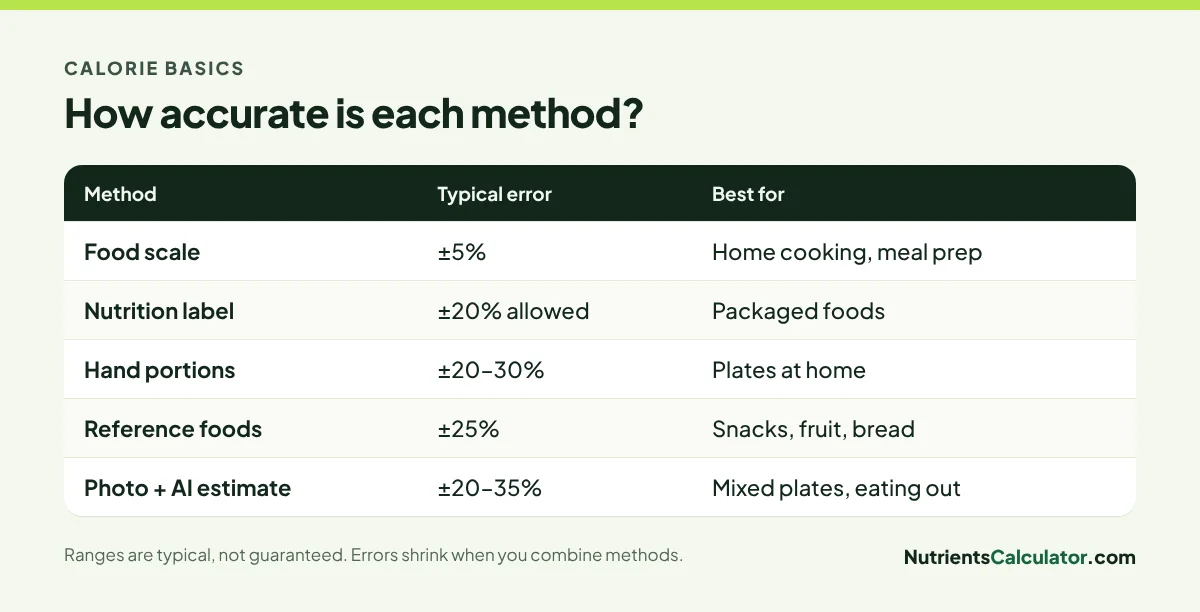
- Accuracy. US labeling rules allow the actual calorie content to be up to 20% higher than the label and still be in compliance (21 CFR 101.9). In practice most products are close, but a few run consistently high.
That 20% figure sounds alarming, but for most people it changes little: a 250-calorie snack bar might really be 270. The bigger problem is serving size. We break down what the rule means and when it matters in are calorie counts on food labels accurate?
Method 3: Learn a few reference foods
Some foods come in natural units. Once you know a handful of them, you can estimate many other foods by comparison. A few anchors from USDA data:
- 1 medium banana: about 105 calories
- 1 medium apple: about 95 calories
- 1 large egg: about 72 calories
- 1 slice of white sandwich bread: about 77 calories
- 1 medium bagel: about 277 calories (roughly 3.5 slices of bread)
- 1 tablespoon of olive oil: about 119 calories
Reference foods also reveal the surprises. A medium croissant is about 231 calories; a glazed doughnut about 269; a 16 oz whole-milk latte about 223. If any of those numbers surprised you, read 12 everyday foods with more calories than you think.
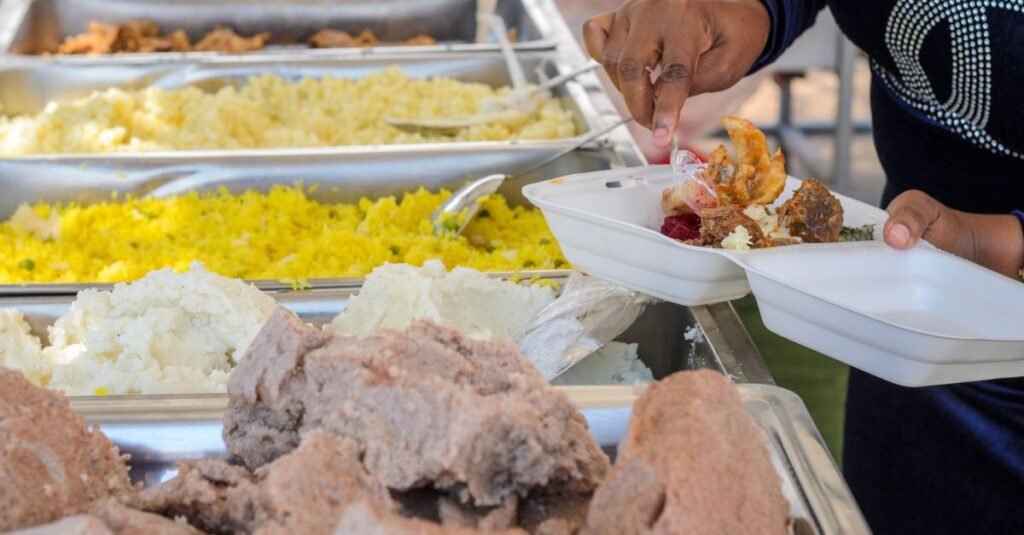
Method 4: Divide the plate

For mixed meals, don’t try to guess the whole plate at once. Break it into parts:
- Protein: use your palm.
- Starch (rice, pasta, potatoes, bread): use your fist.
- Vegetables: estimate quickly; plain vegetables are low in calories, so errors here barely matter.
- Fats and sauces: use your thumb, and count anything shiny. Oil in the pan, dressing, butter on the bread, cheese on top.
Add the parts. A typical home dinner of a palm of salmon (about 175 calories for 3 oz), a fist of rice (205), a cup of broccoli (55) and a thumb of oil (119) lands near 550 calories. Notice that the oil, which is easy to forget, is worth more than double the broccoli.
The same divide-the-plate approach is what makes eating out manageable. Restaurant dishes tend to carry more fat than home cooking. In a study of 269 restaurant foods, stated calories were accurate on average, but about one in five items had at least 100 calories more than listed (Urban et al., 2011). Our guide to estimating calories when eating out has dish-by-dish rules of thumb.
Method 5: Take a photo and let AI estimate it
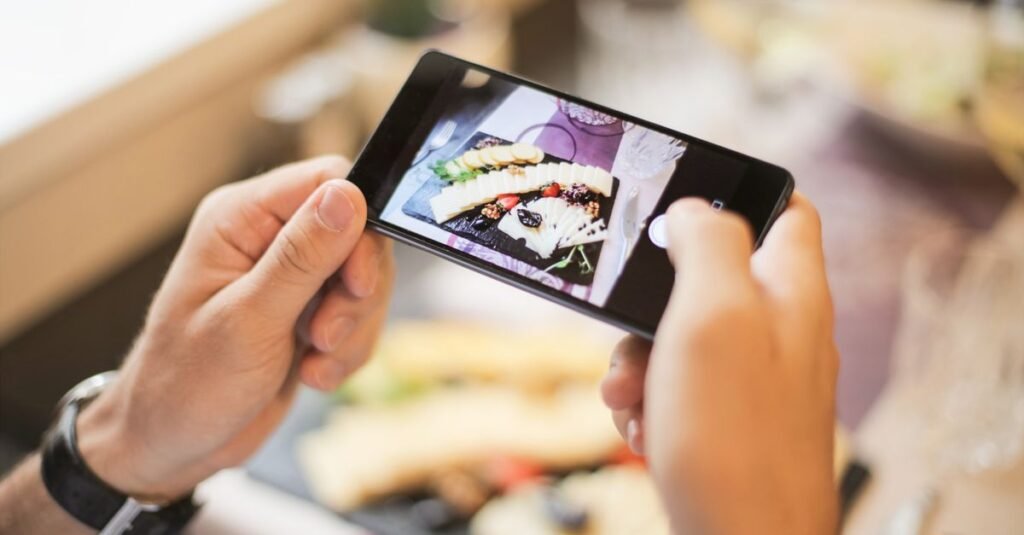
Photo-based estimation has improved quickly. You snap the plate, the app identifies the foods, estimates the portion of each, and looks up nutrition values. It’s fastest for mixed plates where splitting the food by hand would be tedious.
Photo estimates have predictable weak spots: hidden oils and butter, foods stacked on top of each other, very deep bowls, and drinks. The trick is to treat the result as a starting draft and correct it, such as adding the dressing you know is on the salad. We explain how it works under the hood and how to get better results in can you count calories from a photo?
How to estimate calories without a food scale: which method when?
You don’t need to pick one. Most people end up using all five in a normal day:
- Breakfast at home: labels (oats, yogurt) plus reference foods (banana, egg).
- Lunch from a café: photo estimate, then add the dressing or spread by hand.
- Snack: label or reference food.
- Dinner at home: hand portions and divide-the-plate.
- Eating out: photo plus restaurant rules of thumb, rounding up for sauces.
A simple daily routine
- Log as you eat, not at night. Memory fades fast and snacks disappear from it first.
- Round up on fats. If in doubt, add a thumb of oil to anything sautéed or roasted.
- Check one “anchor” a week. Once a week, measure a food you eat often (your usual bowl of cereal or pour of olive oil) with a measuring cup or spoon. This recalibrates your eye.
- Watch the weekly average, not single days. Daily numbers bounce; the seven-day average shows the real direction.
Train your eye in two minutes a day
Estimating is a skill, and like any skill it improves with quick, frequent practice and instant feedback. That’s the idea behind our free daily game: you see five foods with a serving size, guess the calories, and see the USDA answer straight away. A week of playing noticeably sharpens your sense of what a “normal” portion of bagel, cheese or granola is worth.
Common mistakes to avoid
- Forgetting drinks. Juice, sodas, sweetened coffee and alcohol are easy to leave out. A 12 oz cola is about 155 calories; a 5 oz glass of red wine about 125.
- Underestimating “healthy” fats. Avocado, nuts, olive oil and nut butters are nutritious and calorie-dense. A whole avocado is about 320 calories.
- Using the package serving as your serving. Measure what you actually ate.
- Skipping the “bites”. Tasting while cooking, finishing a child’s plate and office snacks can add 100–300 calories a day.
The bottom line
You can estimate calories well without a scale by combining your hand, labels, reference foods, a divide-the-plate habit and photo estimates. Aim to be close and consistent, round up on fats and sauces, and judge your progress by weekly averages. The rest of this series goes deeper into each method, so pick the one that matches the meals you eat most and start there.
Frequently asked questions
How accurate is estimating calories by eye?
Most people underestimate large portions and overestimate small ones. With a reference method such as hand portions, typical errors fall to roughly 20–30% per meal, and many of those errors cancel out over a week.
Do I need a food scale to lose weight?
No. A scale is the most precise tool, but consistency matters more than precision. Logging every meal with a reasonable estimate beats weighing food for three days and then stopping.
What is the easiest way to estimate calories in a mixed meal?
Split the plate into parts (protein, starch, vegetables, fats and sauces), estimate each part with your hand or a reference food, then add them. Sauces and cooking oil are the parts people most often forget.
Which foods are hardest to estimate?
Calorie-dense foods with hidden fat: nut butters, oils, cheese, granola, pastries and restaurant sauces. A small misjudgment on these adds far more calories than the same mistake on vegetables.
Sources
- USDA FoodData Central
- 21 CFR 101.9: Nutrition labeling of food (FDA rule on label accuracy)
- Urban LE et al. Accuracy of stated energy contents of restaurant foods. JAMA, 2011
- Burke LE et al. Self-monitoring in weight loss: a systematic review. J Am Diet Assoc, 2011
This article is for general information and isn’t medical advice. Talk to your doctor or a registered dietitian about your own needs, especially if you have a health condition, are pregnant or take medication.