Part of our guide: How to Estimate Calories Without a Food Scale: 5 Methods That Work
Key takeaways
- Calorie counts on food labels have built-in tolerance: under FDA rules, the true calorie content of a packaged food can be up to 20% above the label and still comply.
- Labels are also rounded: to the nearest 5 calories up to 50, and the nearest 10 above that.
- Most products are close to their label. The bigger errors come from serving sizes and how much you actually eat.
- For practical tracking, labels are good enough. Round up slightly on snacks you eat often.
Every Nutrition Facts label looks precise: 150 calories, 7 g fat, 210 mg sodium. But food is natural and variable, and testing every batch is impossible, so the rules build in tolerance. Understanding how much tolerance, and where the real errors come from, helps you use labels well. This is part of our guide to estimating calories without a food scale.
The 20% rule

US labeling regulations (21 CFR 101.9) group nutrients by whether they’re “good” or “bad” to have more of:
- For nutrients people want more of (protein, fiber, vitamins, minerals), the actual amount must be at least 80% of what’s declared for naturally occurring nutrients, and at least 100% for added ones.
- For nutrients people want less of (calories, total sugars, added sugars, total fat, saturated fat, cholesterol, sodium), a product is misbranded if the actual amount is more than 20% above the declared value.
In other words, a snack bar labeled 200 calories is legally fine at anything up to 240. It can also be below 200; the rule only limits overstatement in the unhelpful direction.
Etekcity Food Scale
0.1g accuracy — the perfect companion for exact portions.
Rounding adds a little more
Labels also round, which is helpful for reading but adds small gaps:
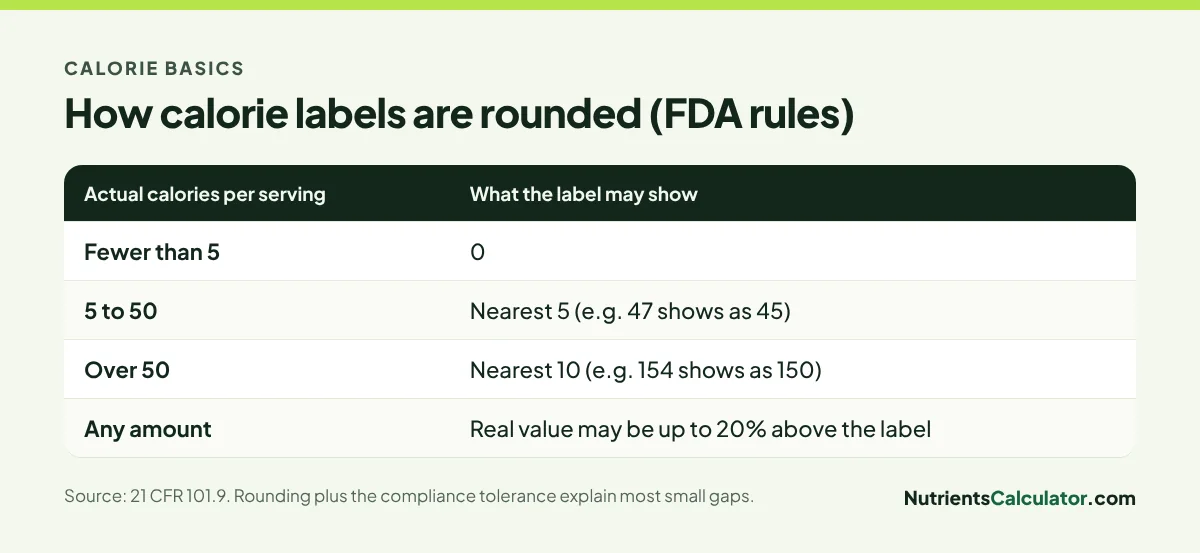
A product with 154 calories per serving is labeled 150. One with 4 calories per serving is labeled 0, which is why “zero-calorie” sprays and sweeteners aren’t truly zero when you use several servings.
How accurate are calorie counts on food labels in practice?
Studies that have measured foods in the lab generally find labels are close on average, with some outliers:
- In a study of reduced-calorie packaged and restaurant foods, supermarket frozen meals had on average about 8% more calories than stated, and restaurant foods about 18% more (Urban et al., 2010).
- In a larger study of 269 restaurant foods, stated values were accurate on average, but about 19% of items contained at least 100 calories more than listed (Urban et al., 2011).
So labels are a good guide, restaurant figures less so. For eating out, our restaurant estimating guide suggests rounding up.
The bigger problem: serving size

For most people, label tolerance matters much less than the gap between the serving size and what they actually eat:
- Multi-serving packages. A 20 oz bottle of soda, a large bag of chips or a pint of ice cream often contains 2–4 servings. Since 2020, many packages that can reasonably be eaten in one sitting must show the whole package, but plenty of products still list per serving.
- Small “official” servings. Cereal servings are often ¾ to 1 cup; most bowls hold 1½ to 2 cups.
- Spoon versus serving. A “tablespoon” of peanut butter in real life is often 1.5 tablespoons.
A 30% mistake on serving size easily outweighs a 5–10% label variance.
When label accuracy actually matters
For most people, it doesn’t change outcomes. It matters more if:
- You eat the same packaged snack every day. A consistent 15% overage on a 250-calorie bar is about 38 extra calories a day, or around 260 a week.
- You rely heavily on “low-calorie” or “diet” products, where a small absolute error is a big percentage.
- You’re in a small calorie deficit and stalled. Then it’s worth checking your most frequent foods.
How to use labels well
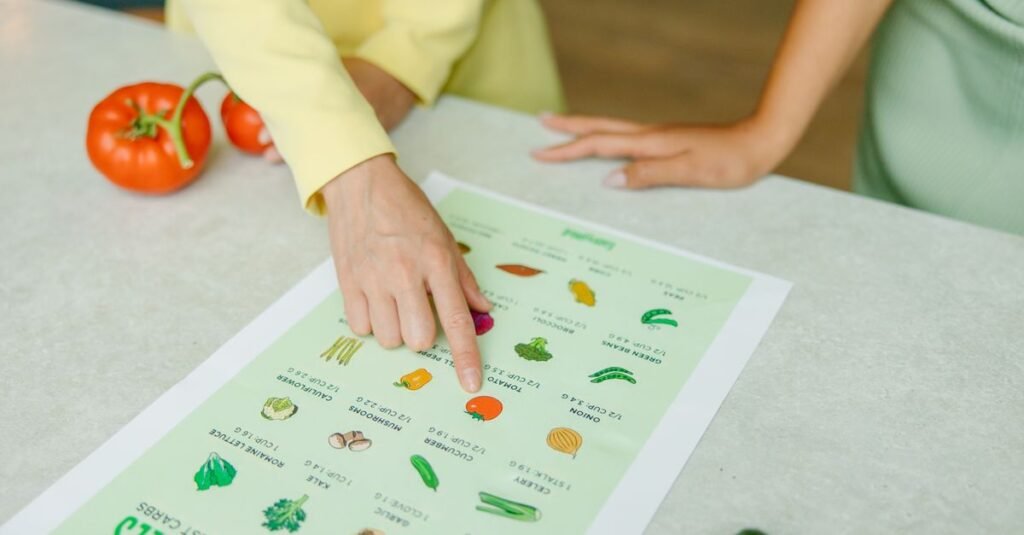
- Read the serving size first. Then decide how many servings you actually ate.
- Measure your usual portions once with measuring cups or a spoon, especially cereal, granola, nut butter, oil and ice cream.
- Round up on frequent snacks by 10% if you’re stuck.
- Look past the calories: protein, fiber, added sugars and sodium tell you more about how filling and nutritious a food is.
- Use weekly averages to judge progress rather than single-day totals.
What about calorie apps and databases?
Databases built on USDA FoodData Central are reliable for whole foods: a banana or a cup of cooked rice varies little. User-submitted entries in some apps vary more. When you can, choose entries that match the label of the product in your hand, or verified USDA entries for whole foods. Photo-based estimates have their own error patterns, covered in counting calories from a photo.
Test your eye
Want to know how well you judge calories without a label? Our free daily game gives you five foods with serving sizes. You guess the calories and see the USDA value straight away. It’s a quick way to learn where your instincts are off.
The bottom line
Calorie labels are allowed to understate calories by up to 20%, and they’re rounded, but in practice most packaged foods are close. The much bigger source of error is serving size. Read it first, measure your usual portions now and then, round up on snacks you eat daily, and judge progress by weekly trends.
Frequently asked questions
Can food labels be off by 20 percent?
For calories, sugars, total fat, saturated fat, cholesterol and sodium, FDA rules treat a product as misbranded if the actual amount is more than 20% above the declared value. Products can also come in below the label. Most products are close, but the rule leaves room.
Are restaurant calorie counts accurate?
On average, studies have found restaurant calorie counts are reasonably close, but individual items vary a lot. In one study, about one in five restaurant items had at least 100 more calories than stated.
Why does 'zero calories' sometimes have calories?
Products with fewer than 5 calories per serving can be labeled as 0. A spray of cooking oil or a serving of a sweetener packet may contain a few calories that add up if you use a lot.
Should I still trust nutrition labels?
Yes. Labels are the best information available for packaged foods. The bigger accuracy problem is usually how much people actually eat compared with the listed serving size.
Sources
- 21 CFR 101.9: Nutrition labeling of food
- FDA: How to Understand and Use the Nutrition Facts Label
- Urban LE et al. Accuracy of stated energy contents of restaurant foods. JAMA, 2011
- Urban LE et al. The accuracy of stated energy contents of reduced-energy, commercially prepared foods. J Am Diet Assoc, 2010
This article is for general information and isn’t medical advice. Talk to your doctor or a registered dietitian about your own needs, especially if you have a health condition, are pregnant or take medication.