Part of our guide: How to Estimate Calories Without a Food Scale: 5 Methods That Work
Key takeaways
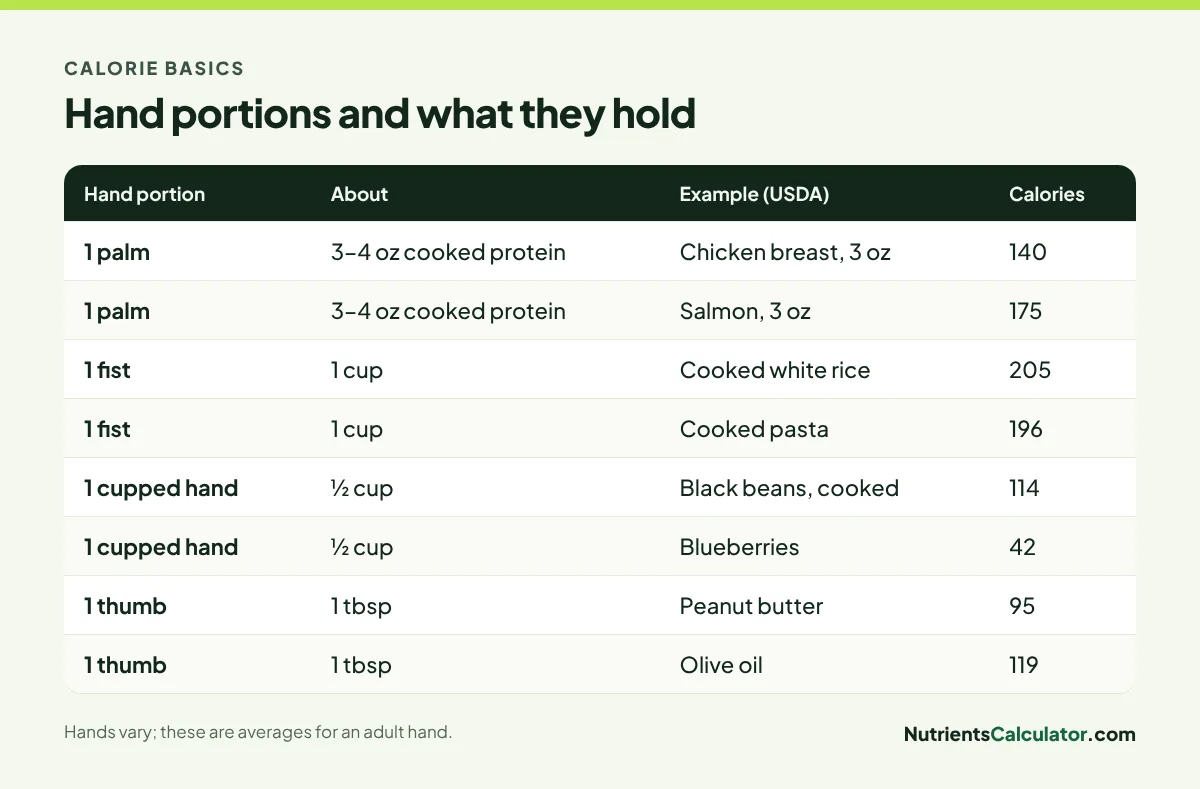
- The hand portion size guide in brief: Palm = protein (about 3–4 oz cooked). Fist = about 1 cup (vegetables, rice, pasta). Cupped hand = about ½ cup (beans, grains, fruit). Thumb = about 1 tablespoon (fats, nut butter, oil).
- The method is rough but portable, and it scales with your body size.
- Fats are where hand portions matter most: one extra thumb of oil is about 120 calories.
- Check your own hand once against a measuring cup and spoon to calibrate.
Measuring cups and scales are accurate, but they stay in the kitchen. Your hand comes to restaurants, work lunches and family dinners. The hand-portion method gives you a fast, consistent way to size portions anywhere. It’s the first of the five estimation tools in our pillar guide, how to estimate calories without a food scale.
Hand portion size guide: the four measures
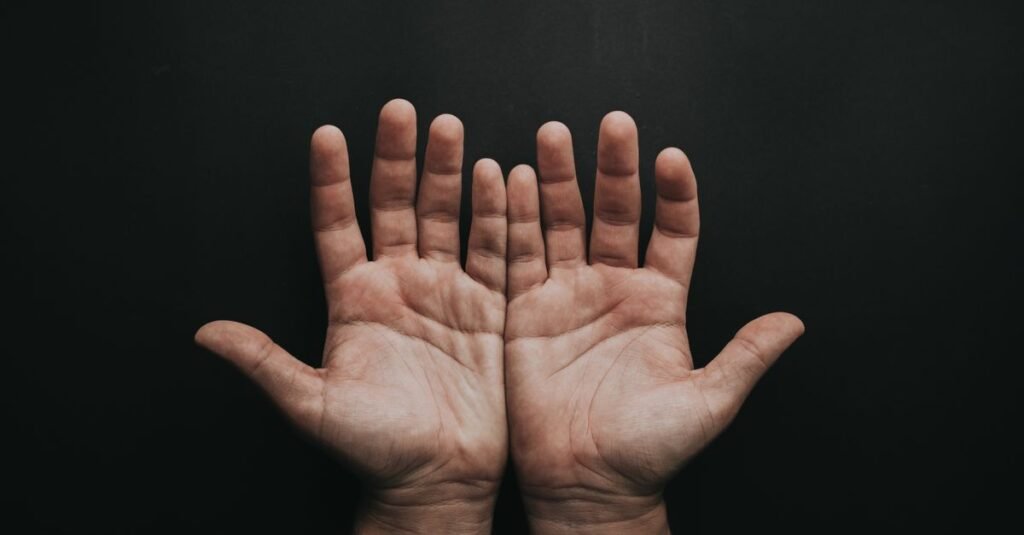
Palm: protein
The flat of your hand, its full size and thickness, without fingers. That’s about 3–4 ounces cooked of meat, fish, poultry, tofu or tempeh. Using USDA values:
- Chicken breast, roasted, 3 oz: about 140 calories, 26 g protein
- Salmon, farmed, cooked, 3 oz: about 175 calories, 19 g protein
- Ground beef 85/15, cooked, 3 oz: about 210 calories, 22 g protein
- Firm tofu, ½ cup: about 98 calories, 11 g protein
Fist: vegetables and big carbs
A clenched fist is about 1 cup. Use it for vegetables, salad greens, cooked rice and pasta, and cereal.
- Cooked white rice, 1 cup: about 205 calories
- Cooked spaghetti, 1 cup: about 196 calories
- Broccoli, cooked, 1 cup: about 55 calories
- Mixed salad greens, 1 cup: about 10 calories
Cupped hand: grains, beans and fruit
Your hand cupped as if holding water is about ½ cup. Use it for beans, oats, quinoa, berries, chopped fruit and nuts (though nuts are better sized by thumb).
- Black beans, cooked, ½ cup: about 114 calories, 7.5 g fiber
- Blueberries, ½ cup: about 42 calories
- Cooked oatmeal, ½ cup: about 80 calories
Thumb: fats
From the tip of your thumb to the base is about 1 tablespoon. Use it for oils, butter, nut butter, mayo, dressing, cheese sauce and seeds.
- Olive oil, 1 tbsp: about 119 calories
- Butter, 1 tbsp: about 102 calories
- Peanut butter, 1 tbsp: about 95 calories
A fingertip (to the first knuckle) is about 1 teaspoon.
Etekcity Food Scale
0.1g accuracy — the perfect companion for exact portions.
Build a balanced plate with your hands
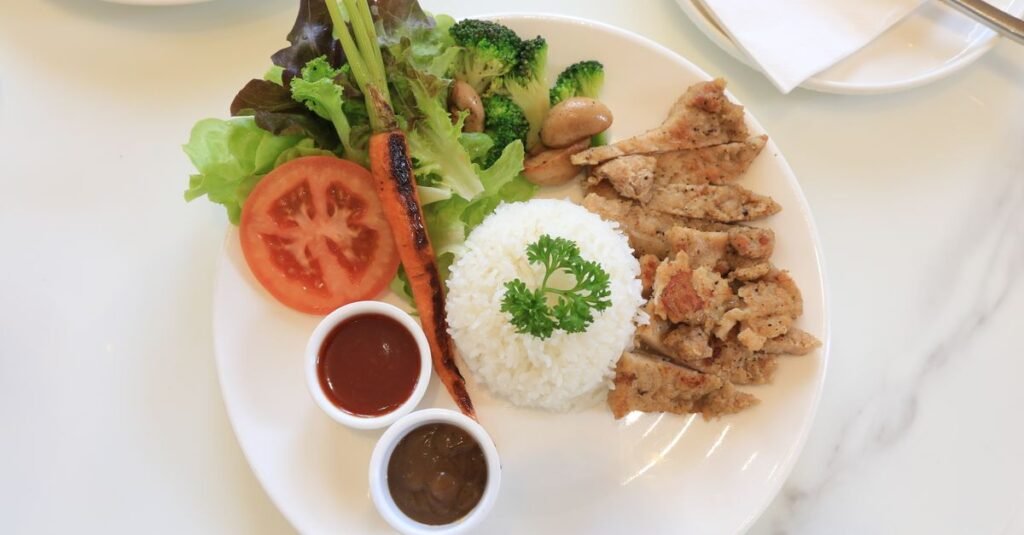
A simple starting point for each main meal:
| Women (typical) | Men (typical) | |
|---|---|---|
| Protein | 1 palm | 2 palms |
| Vegetables | 1 fist | 2 fists |
| Carbs | 1 cupped hand | 2 cupped hands |
| Fats | 1 thumb | 2 thumbs |
This lands near 400–600 calories per meal for women and 700–900 for men, depending on the foods. Adjust from there:
- More active or still hungry? Add a cupped hand of carbs or a thumb of fat.
- Losing weight slower than you’d like? Remove a thumb of fat or a cupped hand of carbs at one meal.
- Want more protein? Add half a palm. Our guide to protein per meal explains how much is useful at once.
Where the hand method goes wrong
- Thick versus thin. A palm-sized chicken breast that’s twice as thick as your hand is two palms.
- Piled versus flat. A heaped fist of rice is more like 1½ cups. Level it in your mind.
- Hidden fats. Restaurant vegetables and rice often have butter or oil already. Add a thumb you can’t see. See estimating calories when eating out.
- Calorie-dense foods. For nuts, granola, cheese and chocolate, a small misjudgment adds a lot. Use the thumb rule or measure occasionally.
Calibrate your hand in five minutes
Hands differ, so check yours once:
- Fill a 1-cup measure with rice or cereal and pour it onto a plate. Compare it to your fist.
- Fill a ½-cup measure and compare it to your cupped hand.
- Fill a tablespoon with peanut butter and compare it to your thumb.
- Next time you cook chicken, weigh a piece on a store scale or look at the package weight, and compare it to your palm.
Write down any adjustments (“my fist is about 1¼ cups”). From then on, the method is personal and more accurate.
Practice with real foods
The fastest way to get good at portion estimates is quick, repeated practice with instant feedback. Each day our free calorie game shows five foods with a serving size; you guess the calories and see the USDA answer. It trains the same intuition the hand method relies on.
Hand portions for snacks and drinks

- Nuts: a small cupped handful (about 1 oz) is 160–200 calories. Two thumbs is a better snack portion.
- Cheese: a portion the size of your two thumbs together is about 1 oz (about 114 calories for cheddar).
- Chips: a cupped hand is roughly 1 oz (about 150 calories).
- Drinks: hands don’t help here; use the cup size. A 12 oz soda is about 155 calories; a 5 oz glass of wine about 125.
The bottom line
Use your palm for protein, fist for vegetables and big carb servings, cupped hand for beans, grains and fruit, and thumb for fats. Calibrate once against measuring cups, watch thickness and hidden oils, and you’ll have a measuring system you can use at any meal, anywhere.
Frequently asked questions
How accurate is the hand portion method?
It's an approximation, typically within about 20–30% for a single portion. Because larger people tend to have larger hands, it also scales roughly to body size, and errors partly cancel across a day.
What does a palm-sized portion of protein weigh?
A palm the size and thickness of your hand, without fingers, is about 3–4 oz (85–115 g) of cooked meat, fish or tofu.
How many hand portions should I eat per meal?
A common starting point for women is 1 palm of protein, 1 fist of vegetables, 1 cupped hand of carbs and 1 thumb of fat per meal; for men, about double. Adjust based on hunger, activity and results.
Is a fist really one cup?
For most adults a clenched fist is roughly the volume of a cup, give or take a quarter cup. Check yours once with a measuring cup.
Sources
This article is for general information and isn’t medical advice. Talk to your doctor or a registered dietitian about your own needs, especially if you have a health condition, are pregnant or take medication.