Part of our guide: How to Build a Food Tracking Habit That Actually Sticks
Key takeaways
- How long does it take to form a habit? Not 21 days: that rule is a myth. It came from a 1960s self-help book, not a study.
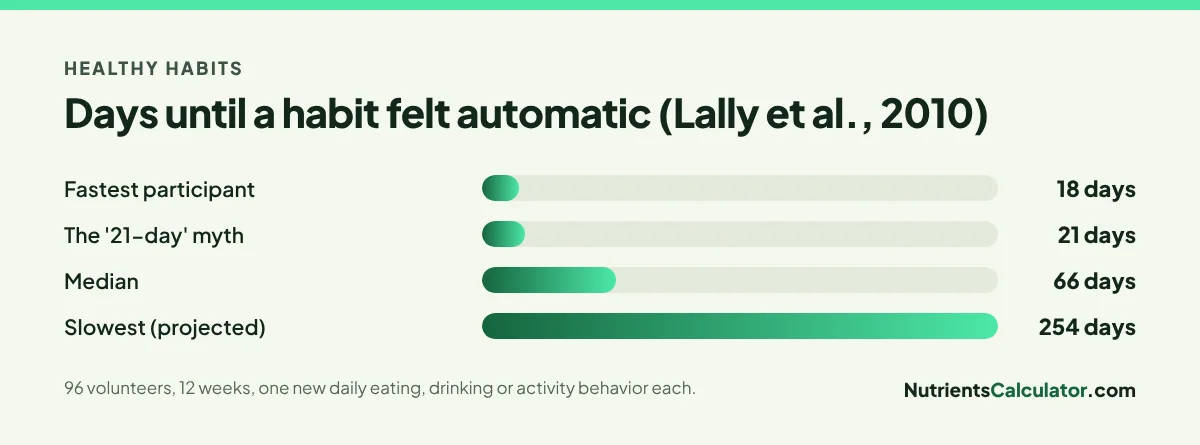
- In the best-known real-world study, a daily behavior took a median of 66 days to feel automatic, with a range of 18 to 254 days.
- Missing one day didn’t meaningfully set people back. Missing many did.
- Simple actions tied to a clear cue become automatic fastest. Make healthy eating habits small and specific.
If you’ve ever started a new eating habit on a Monday, felt great for two weeks and then wondered why it still felt like effort, you’re not doing it wrong. You’ve probably been told habits form in 21 days. The research says otherwise, and knowing the real timeline makes it much easier to stick with things. This post is part of our guide to building a food tracking habit that sticks.
Where the 21-day idea came from
In 1960, plastic surgeon Maxwell Maltz wrote in Psycho-Cybernetics that patients seemed to take “a minimum of about 21 days” to get used to a change, such as a new face in the mirror. Over decades of retelling, “a minimum of about 21 days to adjust” became “it takes 21 days to form a habit”. It was never tested as a rule for building habits.

Etekcity Food Scale
0.1g accuracy — the perfect companion for exact portions.
How long does it take to form a habit? What the research found
In 2010, researchers at University College London published the most-cited real-world study of habit formation (Lally et al., 2010). They asked 96 volunteers to pick one new daily behavior linked to a cue, such as “eat a piece of fruit with lunch”, “drink a bottle of water after breakfast” or “run for 15 minutes before dinner”. Every day for 12 weeks, participants rated how automatic the behavior felt.
The results:
- The median time to reach automaticity was 66 days.
- The range was 18 to 254 days (some participants’ curves were projected beyond the 12 weeks).
- Automaticity grew fastest at the start and then leveled off, following a smooth curve rather than flipping like a switch.
- Missing a single day had no meaningful effect on the habit’s progress.
- Simpler behaviors became automatic faster. Eating and drinking habits generally formed faster than exercise habits.
What “automatic” really means
A habit isn’t just something you do often. It’s something you do without having to decide because a cue triggers it. Brushing your teeth after breakfast is automatic; you don’t negotiate with yourself about it. That’s the goal for healthy eating habits: you sit down to lunch and take the photo, you open the fridge and reach for the yogurt, you start dinner by putting vegetables on the plate.
Psychologists describe habit formation as repetition of an action in a consistent context until the context alone prompts the action (Gardner et al., 2012). That’s why the cue matters as much as the behavior.
What this means for your eating habits

1. Judge your habit at week 10, not week 3
At three weeks you’re on the steep, effortful part of the curve. Feeling that it’s still hard is normal and not a sign of failure. Give a new habit about two to three months before deciding it “didn’t work”.
2. Make the behavior small
“Eat healthier” can’t become automatic because it isn’t a specific action. “Add a vegetable to dinner”, “eat 25 g of protein at breakfast” or “log my lunch with a photo” can. If you’re building a breakfast habit, our high-protein breakfast ideas give you specific defaults to repeat.
3. Tie it to a stable cue
Good cues happen every day, at the same time or place:
- “When I sit down to eat, I take a photo of my plate.”
- “When I pour my morning coffee, I put Greek yogurt in a bowl.”
- “When I unpack groceries, I wash and cut the vegetables.”
4. Don’t panic over a missed day
Because one miss doesn’t erase progress, the biggest risk isn’t the miss itself but the “what the hell” reaction: deciding the habit is ruined and quitting. A simple rule helps: never miss twice in a row. We explore this further in why streaks work, and when to let one go.
5. Make it rewarding now
The research also points to the value of immediate rewards. The payoff of a healthy habit (weight change, more energy) arrives weeks later, so add something rewarding today: a visible streak, ticking off a daily mission, a quick game, or simply noticing that you did it.
A realistic timeline for a new eating habit
| Weeks | What it usually feels like | What helps |
|---|---|---|
| 1–2 | Motivating but effortful | Keep it tiny; set reminders |
| 3–5 | The dip: novelty gone, not yet automatic | Streaks, a buddy, track misses kindly |
| 6–9 | Getting easier on most days | Keep the cue identical; avoid adding new rules |
| 10+ | Mostly automatic | Build the next habit on top of this one |
Stacking habits

Once a habit feels automatic, it becomes a reliable cue for the next one. For example:
- Weeks 1–10: photo-log every meal.
- Weeks 11–20: when you log breakfast, check it has 25 g of protein.
- Weeks 21–30: when you review your week on Sunday, plan two bean-based dinners.
That’s three meaningful habits in about seven months, each built on the previous one, instead of six habits started on the same Monday and abandoned by February. A short weekly nutrition review is a natural place to plan the next stack.
The bottom line
Habits take longer than 21 days, typically around two months and sometimes much longer. That’s normal. Keep the action small and specific, tie it to a cue you already have, don’t let a single miss become a quit, and judge your progress at week ten. By then most people find the habit is doing more of the work than their willpower.
Frequently asked questions
Does it take 21 days to form a habit?
No. The 21-day idea comes from a 1960 self-help book's observation about adjusting to change, not from a study of habits. Research by Lally and colleagues found a median of 66 days for a daily behavior to become automatic, with a range of 18 to 254 days.
Does missing a day ruin a habit?
In the same study, missing a single opportunity did not materially affect how automatic the habit became. Missing many days in a row did slow progress.
Why do some habits form faster than others?
Simpler actions (drinking a glass of water) became automatic faster than more complex ones (doing 50 sit-ups). A clear, stable cue and an easy action speed things up.
How can I make a healthy eating habit stick faster?
Make the action small, tie it to an existing routine (a cue), do it in the same place and time each day, and make it rewarding right away.
Sources
- Lally P et al. How are habits formed: modelling habit formation in the real world. Eur J Soc Psychol, 2010
- Gardner B, Lally P, Wardle J. Making health habitual: the psychology of 'habit-formation' and general practice. Br J Gen Pract, 2012
This article is for general information and isn’t medical advice. Talk to your doctor or a registered dietitian about your own needs, especially if you have a health condition, are pregnant or take medication.