Part of our guide: How to Build a Food Tracking Habit That Actually Sticks
Key takeaways
- A weekly nutrition review beats daily checking: daily food numbers are noisy; weekly averages show the real pattern.
- A 10-minute review with five questions turns your logs into decisions.
- End every review with one specific change, written as “When X, I will Y”.
- Review even bad weeks, especially bad weeks. That’s where the useful lessons are.
Logging your meals collects data. Reviewing it once a week is what turns that data into progress. Without a review, many people track faithfully for weeks and then wonder why nothing is changing. With one, every week ends with a clear, small adjustment. It’s step seven in our guide to building a food tracking habit that sticks.
Why weekly beats daily
Daily calorie and weight numbers bounce around: a restaurant dinner, a salty meal, a hard workout or a poor night’s sleep can all swing them. Reacting to every daily number leads to frustration and over-correction. Weekly averages smooth out the noise and show the true direction.
Research on food tracking supports the idea that consistent self-monitoring is linked to better results (Burke et al., 2011). The weekly review is how you get value from that monitoring.

Etekcity Food Scale
0.1g accuracy — the perfect companion for exact portions.
When and where to do it

Pick a fixed time: Sunday evening works for many people because it sets up the week ahead, but any day works. Tie it to something you already do, like your Sunday grocery list or a cup of tea after dinner. You’ll need your food log or a weekly summary, and somewhere to write two lines.
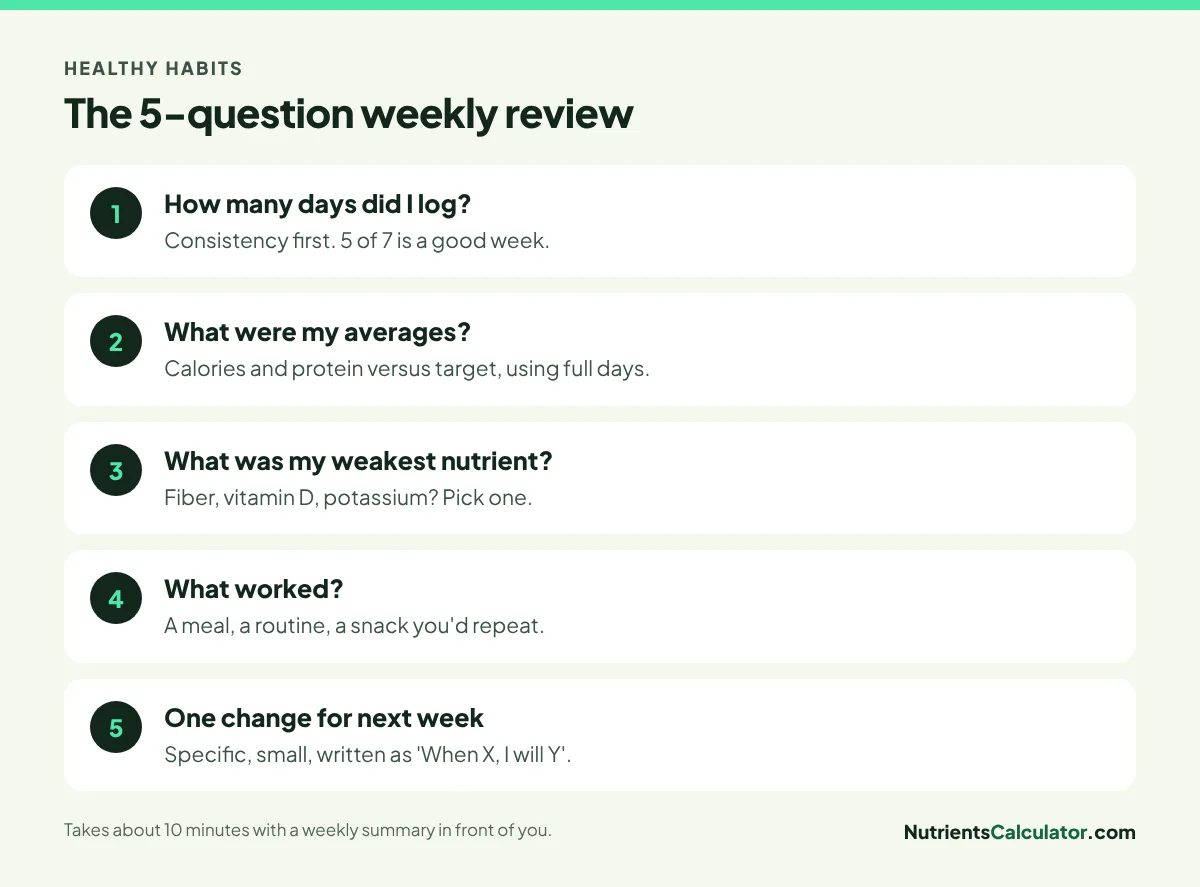
The five questions

1. How many days did I log?
Consistency is the foundation. If you logged 3 of 7 days, the most valuable change next week may simply be logging more, not changing what you eat.
2. What were my averages?
Look at average calories and protein on days you logged fully (two or more meals). Compare them to your targets. Are you close? Consistently over or under? How many days did you hit your protein goal?
3. What was my weakest nutrient?
If your app estimates micronutrients, check which one is lowest compared with the Daily Value. Common answers are fiber, vitamin D, potassium and calcium (see common nutrient gaps). Remember that partly logged days read low.
4. What worked?
Name one meal, routine or snack that went well and that you want to repeat. Positive patterns are as useful as problems, and reviewing them makes the process more motivating.
5. What’s my one change for next week?
Pick one small, specific change based on questions 1–4. Write it as an if-then plan: “When I pack lunch on Sunday, I’ll add a cup of beans.” Research on these “implementation intentions” shows that linking a specific action to a specific situation makes people far more likely to follow through (Gollwitzer, 1999).
A worked example
Maya’s week: – Logged 6 of 7 days – Average 1,780 calories on full days (target 1,900) – Hit protein goal (110 g) on 2 of 6 days; breakfast averaged 14 g – Lowest nutrient: vitamin D at about 25% of the Daily Value – What worked: Sunday batch of lentil soup made lunches easy
One change: “When I make breakfast, I’ll have Greek yogurt instead of toast,” aiming for 25 g of protein. (She might pick canned salmon for the vitamin D next week, one change at a time.)
That’s the whole review: ten minutes, one decision.
Plan the week while you’re at it

The review is the natural moment to plan the next week:
- Plan three to five dinners that support your one change.
- Write the shopping list from those dinners. Our cheap healthy grocery list can help.
- Schedule a prep session if batch cooking helps you. See meal prep for beginners.
Make the review automatic
You can do this review with a notebook, but it’s easier with a summary in front of you. Our free account dashboard creates a weekly report card every Sunday: days logged, average calories versus your target, protein-goal days, your average meal score and the nutrients you ran lowest on, with a grade and a short coach note. It’s emailed to you on Sunday evening, so your review starts with the numbers already done.
Common review mistakes
- Judging instead of learning. “I was terrible” isn’t useful. “I skipped breakfast on busy days and overate at 4 PM” is.
- Too many changes. Five resolutions on Sunday become zero by Wednesday. One is enough.
- Only reviewing good weeks. Bad weeks hold the most useful information.
- Ignoring context. A week with travel, illness or a deadline will look different. Note it and move on.
- Focusing only on calories. Protein, fiber, vegetables and consistency often matter more for how you feel.
A review template you can copy
Copy these lines into your notes app and fill them in each Sunday:
- Week of:
- Days logged: __ / 7
- Average calories (full days): _ vs target _
- Protein goal hit: __ days
- Lowest nutrient: __ (food to add: __)
- What worked:
- What got in the way:
- One change, as if-then: When __, I will __.
- Dinners planned: 1. _ 2. _ 3. ____
After four weeks, read back through your notes. You’ll see which changes stuck, which didn’t, and what your next habit should be. That’s far more useful than any single day’s total.
The bottom line
Spend ten minutes each week answering five questions: how many days you logged, your averages, your weakest nutrient, what worked, and one change for next week. Write the change as an if-then plan, plan your meals around it, and repeat next Sunday. It’s the habit that makes every other habit work better.
Frequently asked questions
Why review weekly instead of daily?
Daily numbers swing with restaurant meals, social events and water weight. Weekly averages smooth those swings and show the real direction, which makes decisions better and less emotional.
What should I look at in a weekly nutrition review?
How many days you logged, average calories and protein on fully logged days, how often you hit your protein goal, your lowest nutrient compared with the Daily Value, and what went well.
How many changes should I make each week?
One. Small, specific changes are easier to turn into habits than several at once. Stack the next change on top once the first feels easy.
What if my week was bad?
Review it anyway, without judgment. Look for the cause (a busy schedule, no plan for lunches) and choose one change that addresses it. A bad week with a review is more useful than a good week without one.
Sources
- Burke LE et al. Self-monitoring in weight loss: a systematic review. J Am Diet Assoc, 2011
- Gollwitzer PM. Implementation intentions: strong effects of simple plans. American Psychologist, 1999
- Harvey J et al. Log often, lose more. Obesity, 2019
This article is for general information and isn’t medical advice. Talk to your doctor or a registered dietitian about your own needs, especially if you have a health condition, are pregnant or take medication.