Part of our guide: How to Build a Food Tracking Habit That Actually Sticks
Key takeaways
- Why streaks work: they make progress visible and give you something to lose.
- The longer a streak gets, the stronger the pull to protect it, which helps on low-motivation days.
- The risk is the all-or-nothing reaction when a streak breaks. Use the “never miss twice” rule.
- Count a small, healthy action (like logging one meal) rather than something extreme.
Language apps, fitness trackers and food logs all use streaks, and for good reason: few features keep people coming back as reliably. But streaks can also backfire, turning one missed day into a week off. Understanding why they work helps you get the benefit without the trap. This is part of our guide to building a food tracking habit that sticks.
Why streaks work: four forces behind them

1. Loss aversion
People feel losses more strongly than equivalent gains, one of the best-established findings in behavioral science (Kahneman & Tversky, 1979). On day one, a streak is worth little. On day 30, it’s something you’ve built, and losing it feels like a real cost. That’s why logging your dinner at 10 PM to “keep the streak” feels worth the effort when the meal itself wouldn’t.
2. The goal-gradient effect
People speed up as they get closer to a goal. In a study of coffee-shop loyalty cards, customers bought coffee more often as they got nearer to their free drink (Kivetz et al., 2006). Streaks with milestones (7 days, 30 days, 100 days) create this pull repeatedly.
3. Visible progress
A number that goes up every day is a small, immediate reward. Most health benefits of eating well arrive slowly; a streak gives you something to see today.
4. Identity
After a few weeks, a streak becomes part of how you see yourself: “I’m someone who logs every day”. Identity-based motivation tends to last longer than goal-based motivation.

Etekcity Food Scale
0.1g accuracy — the perfect companion for exact portions.
The dark side: when streaks backfire

The “what the hell” effect
Researchers studying dieting described how a small slip (eating a cookie on a diet) can lead people to abandon their rules entirely for the rest of the day: “I’ve already blown it, so what the hell” (Polivy & Herman, 1985). Broken streaks can trigger the same reaction: “My 40-day streak is gone, why bother?”
Gaming the number
If the streak matters more than the behavior, people do the minimum to keep it: logging one item to save the count while ignoring the rest of the day. That’s not always bad (a minimal log is better than none), but watch for it.
Pressure and guilt
For some people, streaks create stress. If a streak makes you anxious or pushes you toward rigid eating, it’s not helping. Read how to track food without obsessing for lighter options.
How to use streaks well

Choose the right behavior to count
Good streak behaviors are small, positive and possible on your worst day:
- Log at least one meal
- Eat a vegetable with dinner
- Hit 25 g of protein at breakfast
- Drink a glass of water with each meal
Avoid counting restrictive behaviors (“days without sugar”, “days under 1,200 calories”). They encourage all-or-nothing thinking and can be unhealthy.
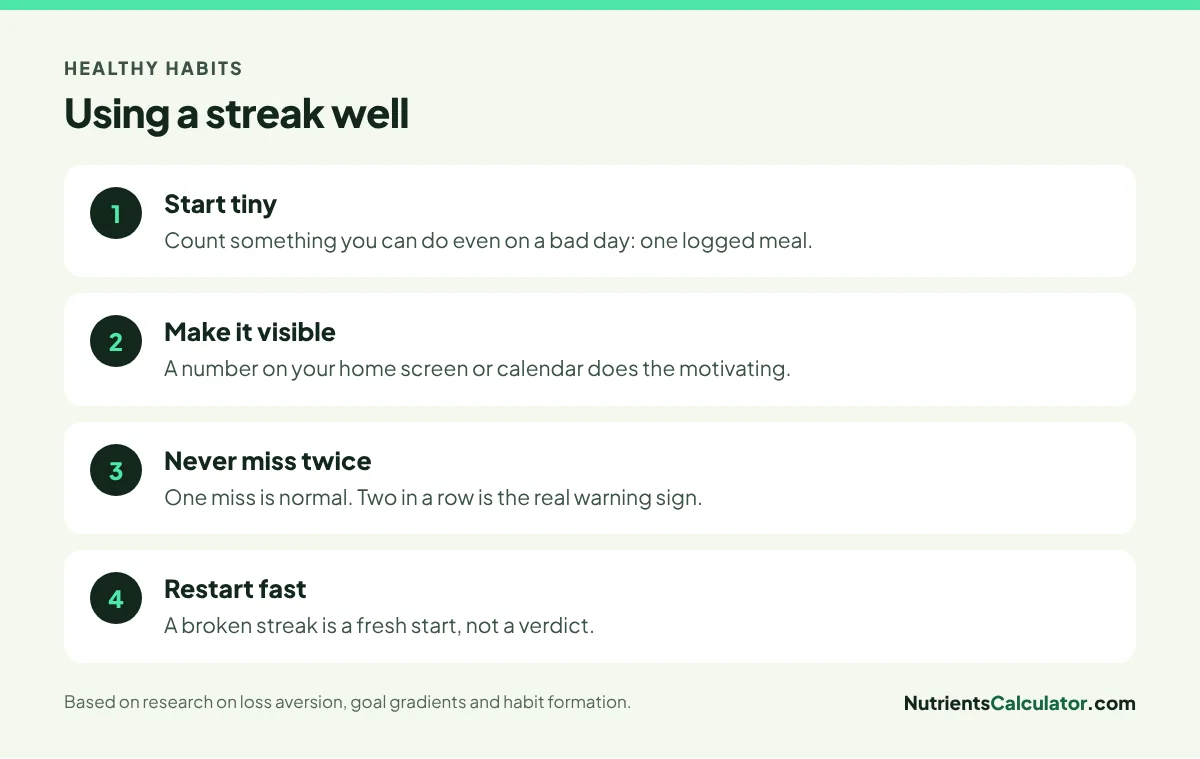
Use “never miss twice”
Habit research found that missing a single opportunity didn’t meaningfully affect how a habit develops (Lally et al., 2010). So plan for misses: one missed day is normal life; two in a row is the signal to act. Some apps build this in with “streak freezes” or by counting your best streak alongside your current one.
Treat a break as a fresh start
People are more likely to start or restart goals at “temporal landmarks” like Mondays, the first of the month or birthdays (Dai et al., 2014). You can create your own: the day after a broken streak is a fresh start, and it can come with a new target.
Celebrate your longest streak, not just your current one
Showing “best: 21 days” next to “current: 3 days” turns a reset into a challenge to beat your record, rather than a loss.
Combine streaks with a buddy
A shared streak, or a friend who sees your progress, adds social accountability on top of loss aversion. We look at the research on partners in accountability partners for healthy eating.
What a healthy streak setup looks like
- Streak behavior: log at least one meal a day.
- Daily missions on top: optional extras like hitting protein or water goals, with points but no streak pressure.
- Weekly review: looking at the bigger picture, not just whether the chain is unbroken. See the 10-minute weekly nutrition review.
- A fun daily reason to open the app: a short game or a new challenge makes keeping the streak feel like play, not homework.
The bottom line
Streaks work because they make progress visible and give you something you don’t want to lose. Use them for a small, positive action, plan for the occasional miss with “never miss twice”, celebrate your longest streak, and restart immediately when one breaks. Used that way, a streak carries you through the low-motivation days that otherwise end most new habits.
Frequently asked questions
Why are streaks so motivating?
Streaks make progress visible and give you something to lose. People feel losses more strongly than equal gains, so protecting a streak becomes a reason to act on days when motivation is low.
What should I do when I break a streak?
Start again with the very next meal or day. Research on habit formation found that missing a single day didn't meaningfully slow progress. The danger is giving up entirely after one miss.
Can streaks be bad for you?
They can encourage all-or-nothing thinking or doing the behavior just to keep the number alive. Choose a small, healthy action to count, and allow yourself occasional misses.
What's a good streak for healthy eating?
Logging at least one meal a day, eating a vegetable with dinner or hitting a protein goal are good streak behaviors: small, positive and achievable on busy days.
Sources
- Kahneman D, Tversky A. Prospect theory: an analysis of decision under risk. Econometrica, 1979
- Kivetz R, Urminsky O, Zheng Y. The goal-gradient hypothesis resurrected. J Marketing Research, 2006
- Dai H, Milkman KL, Riis J. The fresh start effect. Management Science, 2014
- Lally P et al. How are habits formed. Eur J Soc Psychol, 2010
- Polivy J, Herman CP. Dieting and binging: a causal analysis. American Psychologist, 1985
This article is for general information and isn’t medical advice. Talk to your doctor or a registered dietitian about your own needs, especially if you have a health condition, are pregnant or take medication.