Key takeaways
- A calorie deficit means eating fewer calories than your body uses. It’s the only way to lose body fat, whatever diet style you choose.
- Start with a gap of about 300–500 calories a day below maintenance. It’s big enough to see progress and small enough to live with.
- Protein, fiber and high-volume foods make the same calories feel like more food.
- Judge progress by your weekly average weight over two to three weeks, then adjust in small steps.
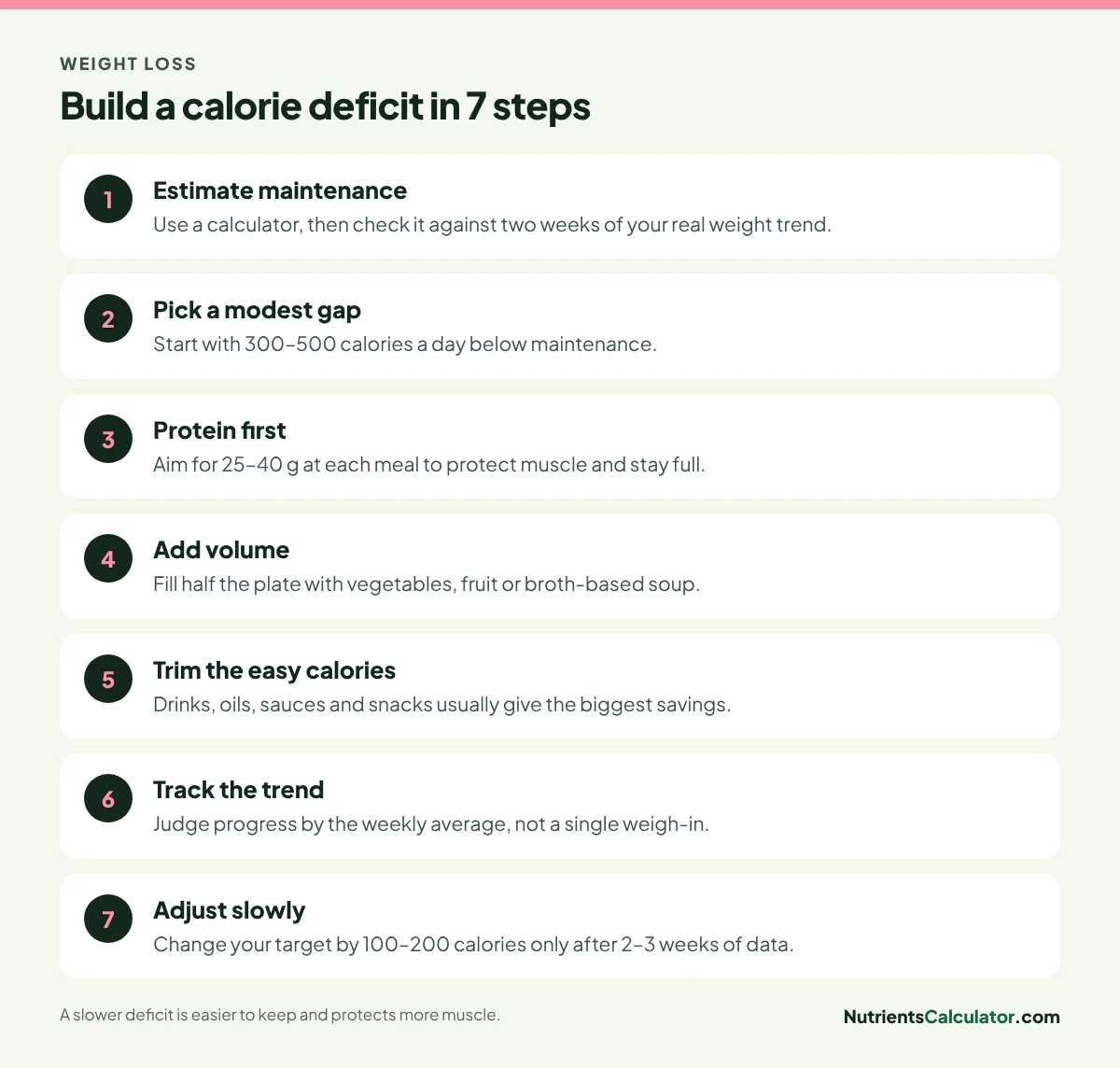
Every weight-loss plan, from low-carb to intermittent fasting, works the same way underneath: it creates a calorie deficit. You eat a little less energy than your body burns, and your body makes up the difference from its stored fat. What differs between plans is how easy that gap feels to keep. This guide shows how to size a calorie deficit for your body, build it into normal meals, and stay with it long enough to see results.
What a calorie deficit actually is
Your body spends energy all day: keeping you alive at rest (your basal metabolic rate), digesting food, and moving, from workouts to walking to the car. Add those up and you get your maintenance calories, the amount that keeps your weight stable. Eat below that number and you’re in a deficit.
You’ll often hear that a 3,500-calorie deficit equals one pound of fat. It’s a useful rough guide for the first few weeks, but it overestimates long-term loss because your body burns less as it gets smaller. Researchers at the NIH built a better model: a lasting change of about 10 calories a day moves body weight by roughly one pound eventually, with about half of that change showing up in the first year (Hall et al., 2011). The NIH’s free Body Weight Planner uses that model if you want a precise projection.

Etekcity Food Scale
0.1g accuracy — the perfect companion for exact portions.
Step 1: Estimate your maintenance calories
Calculators use your sex, age, height, weight and activity level. Two worked examples using the widely used Mifflin-St Jeor equation:
| Person | Resting burn | Activity factor | Maintenance |
|---|---|---|---|
| Woman, 35, 5’5″ (165 cm), 165 lb (75 kg), lightly active | about 1,445 | × 1.375 | about 1,990 |
| Man, 40, 5’10” (178 cm), 198 lb (90 kg), moderately active | about 1,820 | × 1.55 | about 2,820 |
Treat the result as a starting estimate, not a fact. Equations can be off by a couple of hundred calories for any individual. The real test is your own data: if you log your food for two weeks and your weight stays flat, your average intake is your maintenance.
Step 2: Choose a deficit you can keep
Subtract 300–500 calories from maintenance. For the woman above, that’s a target of about 1,490–1,690 calories; for the man, 2,320–2,520. Bigger gaps feel exciting in week one, but they increase hunger, make workouts harder and cost more muscle, which is why most people who crash-diet regain the weight. If you want to know what pace is realistic for you, see how fast you should lose weight.
For a target based on your own numbers, our free calculator does the maths in under a minute.
Step 3: Put protein first

Protein is the most filling nutrient, and eating enough of it while in a calorie deficit helps you keep muscle. Aim for roughly 25–40 g at each meal. A palm-sized chicken breast (4 oz, cooked) gives about 35 g; a 6 oz pot of plain nonfat Greek yogurt about 17 g. Our guide to how much protein you need a day shows how to set a daily number.
Step 4: Eat more volume for the same calories

Foods with lots of water and fiber let you eat a bigger portion for fewer calories, and research on energy density consistently finds that people eat less overall when meals are built around them (Rolls, 2017). From USDA data:
- 1 cup of strawberries: about 49 calories.
- 1 cup of cooked broccoli: about 55 calories.
- 1 cup of chicken noodle soup (canned, prepared): about 60 calories.
- 1 oz of almonds, about a small handful: about 162 calories.
Nuts are healthy, but you can see why half a plate of vegetables does more for hunger in a deficit. We list the best options in low-calorie foods that keep you full.
Step 5: Trim the easiest calories first
You don’t need to overhaul every meal. The biggest, least painful savings usually come from:
- Drinks. A 12 oz can of regular cola is about 155 calories; switching to sparkling water saves that every day. See how many calories are in sugary drinks.
- Cooking fat. A tablespoon of olive oil is about 119 calories. Measuring it instead of pouring often saves 100+ calories a meal.
- Alcohol. A 5 oz glass of red wine is about 125 calories, and drinking tends to loosen food choices too. More in alcohol and weight loss.
- Grazing. Bites while cooking and leftovers from kids’ plates add up quietly.
Step 6: Track the trend, not the day
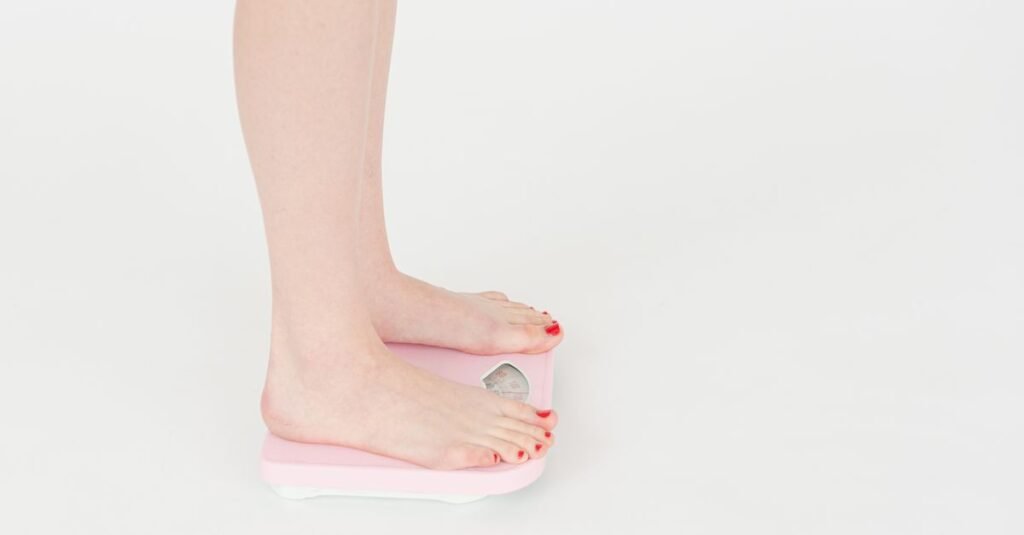
Daily weight swings of 1–3 pounds are normal and mostly water, salt and food in your gut. Weigh yourself under the same conditions (morning, after the bathroom) a few times a week and compare weekly averages. Our guide to daily weight fluctuations explains what’s behind the jumps.
Logging food helps too, even roughly. If you don’t have a scale, our pillar guide on estimating calories without a food scale shows five practical methods.
Step 7: Adjust slowly
After two or three weeks, look at the trend:
- Losing about 0.5–1% of body weight a week? Keep going.
- No change at all? Check your logging first (weekends and drinks are the usual gaps), then lower your target by 100–200 calories.
- Losing faster than 1% a week and feeling drained? Eat a little more.
As you lose weight your maintenance level drops too, so expect to make small adjustments every month or two. When progress stalls for several weeks, read why weight loss plateaus and what to do.
A sample calorie-deficit day (about 1,800 calories)
Here’s what a 1,800-calorie day can look like, using USDA values. It has about 124 g of protein and 33 g of fiber:
- Breakfast: 1 cup Greek yogurt with ½ cup blueberries, ¼ cup oats and a few almonds (about 330 calories).
- Lunch: 4 oz chicken breast, ½ cup brown rice, ½ cup black beans, tomatoes and a little avocado (about 515).
- Snack: an apple with 2 tbsp peanut butter (about 285).
- Dinner: 4 oz salmon, 1 cup of boiled potatoes, 1 cup broccoli and a tablespoon of olive oil (about 545).
- Evening: a glass of 2% milk (about 120).
Three full days at this level are in our 1,800-calorie meal plan.
Common mistakes
- Cutting too hard. If you’re constantly hungry, irritable or sleeping badly, the deficit is too big.
- Saving calories for the weekend. Two heavy days can cancel five careful ones.
- Dropping protein. Low-protein diets lose more muscle.
- Expecting a straight line. Fat loss is steady; the scale isn’t.
The bottom line
A calorie deficit doesn’t need to be extreme to work. Find your maintenance calories, eat about 300–500 below them, build meals around protein and high-volume foods, and judge your progress by two- to three-week trends. Small, steady changes are the ones that last, and the rest of this series shows how to make each step easier.
Frequently asked questions
How big should my calorie deficit be?
A deficit of about 300–500 calories a day below your maintenance level suits most people. It typically leads to steady loss without extreme hunger. Larger deficits work faster at first but are harder to sustain and cost more muscle.
Is 1,200 calories a day a safe deficit?
For many adults, especially men and active women, 1,200 calories is well below what they need and can make it hard to get enough protein and nutrients. Very low-calorie diets should be supervised by a doctor. Base your target on your own maintenance needs instead.
Why am I not losing weight in a calorie deficit?
Usually the deficit is smaller than you think (untracked drinks, oils or weekends), or water retention is hiding fat loss. Give it two to three weeks, check your logging, and look at your weekly average weight rather than daily numbers.
Can I create a calorie deficit with exercise alone?
You can, but it's harder than it sounds: a 30-minute brisk walk burns roughly 100–200 calories depending on your size. Most people find a mix of slightly smaller portions and more daily movement easier than relying on workouts alone.
Sources
- Hall KD et al. Quantification of the effect of energy imbalance on bodyweight. The Lancet, 2011
- NIDDK Body Weight Planner
- Hall KD, Kahan S. Maintenance of lost weight and long-term management of obesity. Med Clin North Am, 2018
- Rolls BJ. Dietary energy density: applying behavioural science to weight management. Nutrition Bulletin, 2017
- USDA FoodData Central
This article is for general information and isn’t medical advice. Talk to your doctor or a registered dietitian about your own needs, especially if you have a health condition, are pregnant or take medication.