Part of our guide: How to Create a Calorie Deficit Without Feeling Starved
Key takeaways
- The number of calories to lose weight depends on your maintenance calories, which depend on your size, age, sex and activity.
- A practical target is 300–500 calories below maintenance.
- Calculators are a starting estimate. Your weight trend over two to three weeks is the real answer.
- Avoid going below about 1,200 (women) or 1,500 (men) calories a day without medical supervision.
Search “how many calories to lose weight” and you’ll find answers from 1,200 to 2,500, all stated with confidence. They can’t all be right because they’re answering different people. The calories to lose weight depend on how many you burn, and that varies by hundreds of calories between two people of the same weight. Here’s a realistic four-step way to find your own number.
Step 1: Estimate your maintenance calories
Maintenance is the number of calories that keeps your weight stable. Most calculators estimate it in two parts:
- Resting burn (BMR), from your sex, age, height and weight. The Mifflin-St Jeor equation is one of the most accurate for most adults (Mifflin et al., 1990):
- Women: 10 × weight (kg) + 6.25 × height (cm) − 5 × age − 161
- Men: 10 × weight (kg) + 6.25 × height (cm) − 5 × age + 5
- Activity factor, multiplied in:
- Sedentary (desk job, little exercise): × 1.2
- Lightly active (exercise 1–3 days a week): × 1.375
- Moderately active (3–5 days): × 1.55
- Very active (6–7 days of hard exercise): × 1.725
Most people overestimate their activity. If you’re unsure, choose the lower level.

Etekcity Food Scale
0.1g accuracy — the perfect companion for exact portions.
Step 2: Subtract 300–500 calories to lose weight
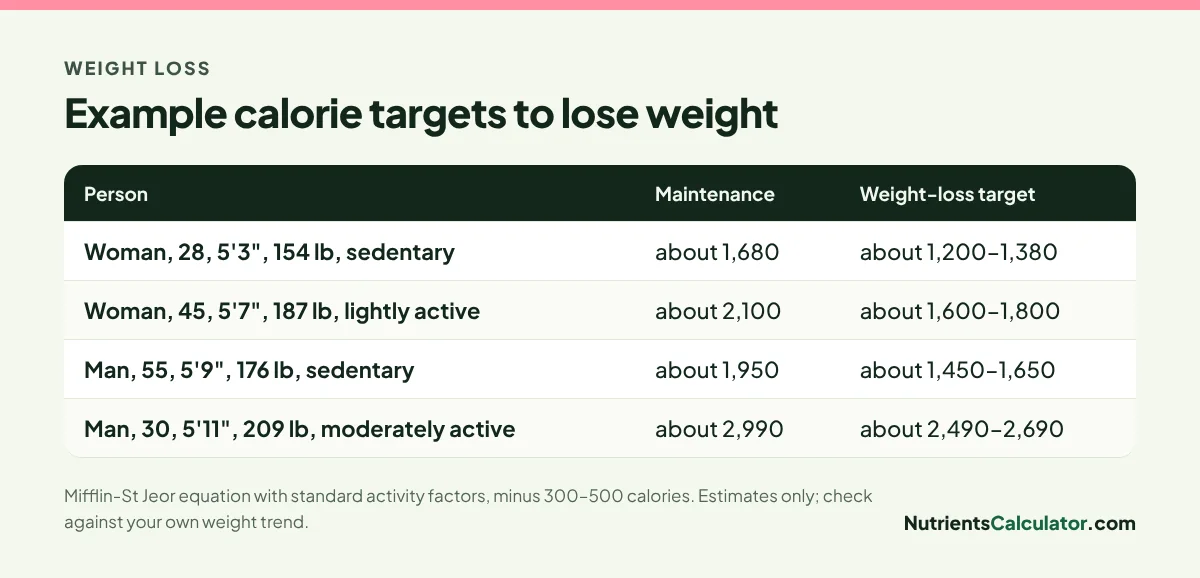
A deficit of 300–500 calories a day leads to steady loss that most people can sustain. The examples in the table above show how different the results are. A 28-year-old woman who sits most of the day has a maintenance of only about 1,680 calories. Her target bottoms out near 1,200, which is why very small, sedentary people often lose weight slowly and benefit most from adding daily movement. A 30-year-old active man can lose weight eating nearly 2,700.
If you’d rather not do the maths, our calculator works out maintenance and a weight-loss target from your details.
Step 3: Check it against reality
Equations are averages. Your real maintenance could be 200 calories higher or lower. So treat the number as a hypothesis:
- Eat at your target and log your food as accurately as you reasonably can for two to three weeks.
- Weigh yourself a few mornings a week and compare weekly averages, not single days (daily swings of 1–3 lb are normal; see why your weight fluctuates).
- Look at the trend:
- Losing about 0.5–1% of body weight a week: your target is working.
- No change after three weeks: your maintenance is lower than estimated, or some intake isn’t being logged. Check drinks, oils and weekends, then reduce by 100–200 calories.
- Losing faster than about 1% a week: you can eat a little more, especially if you’re hungry or tired.
Step 4: Recalculate as you lose
As your weight drops, so does your maintenance. With the Mifflin equation, every kilogram lost lowers resting burn by 10 calories. Lose 20 lb (about 9 kg) and your daily needs fall by roughly 90 calories at rest, or about 125 a day once activity is included. Your body may also adapt and burn a little less than the equation predicts. That’s why the old “500 calories a day = 1 lb a week forever” rule overpromises. The NIH’s research model shows loss slowing over time even when you stick to the same intake (Hall et al., 2011). Recalculate every 10 lb or so, or whenever progress stalls for several weeks (what to do about a plateau).
How low is too low?
A common guide is not to go below about 1,200 calories a day for women or 1,500 for men without medical supervision (Harvard Health). Below that it’s hard to get enough protein, fiber, vitamins and minerals, and hunger, fatigue and muscle loss become likely. If your calculation lands below these numbers, it usually means you’d benefit more from a smaller deficit plus more daily movement.
Make your calories go further

The same number of calories can feel like a feast or a snack depending on what you eat:
- Protein at every meal (25–40 g) for fullness and muscle. See how much protein you need a day.
- Vegetables, fruit and broth-based soups for volume (low-calorie filling foods).
- Fewer liquid calories: juice, soda, sweet coffee drinks and alcohol.
- Measured cooking fat: a tablespoon of oil is about 120 calories.
If you want to see how macros fit inside your calorie target, our guide to counting macros shows how.
Exercise calories: count them carefully

Watches and gym machines often overestimate calories burned. If your target already uses an activity factor that includes your usual workouts, don’t add exercise calories back on top. If you use a sedentary factor, eat back only about half of the tracker’s estimate.
The bottom line
The calories to lose weight are personal: estimate your maintenance, subtract 300–500, and let your two- to three-week weight trend tell you whether to adjust. Keep women above about 1,200 and men above about 1,500 calories unless a doctor is supervising, and recalculate as you lose. For the full method behind a sustainable deficit, see our guide to creating a calorie deficit.
Frequently asked questions
How many calories should I eat to lose 1 pound a week?
Roughly 500 calories a day below your maintenance level, at least at first. Loss slows over time because a smaller body uses fewer calories, so expect to adjust your target as you go.
What is the lowest number of calories I should eat?
A common guide is not to go below about 1,200 calories a day for women or 1,500 for men without medical supervision. Below those levels it's hard to get enough protein, vitamins and minerals.
Why do calorie calculators give different numbers?
They use different equations and activity multipliers, and none can measure your individual metabolism. Use any reputable calculator as a starting point, then adjust based on what your weight actually does over two to three weeks.
Should I eat back calories burned from exercise?
Fitness trackers often overestimate exercise calories. If you use them, eat back only part of them, or set your activity level to include your usual workouts and ignore daily exercise estimates.
Sources
- Mifflin MD et al. A new predictive equation for resting energy expenditure in healthy individuals. Am J Clin Nutr, 1990
- Hall KD et al. Quantification of the effect of energy imbalance on bodyweight. The Lancet, 2011
- Harvard Health Publishing: Calorie counting made easy
- NIDDK Body Weight Planner
This article is for general information and isn’t medical advice. Talk to your doctor or a registered dietitian about your own needs, especially if you have a health condition, are pregnant or take medication.