
Couscous is a staple grain across North Africa and the Middle East, where it’s served at nearly every meal—from simple breakfasts to elaborate dinner spreads. It’s increasingly popular in Western cuisines as a quick, versatile side dish or base for salads and grain bowls. People choose couscous for convenience (it cooks in minutes), mild flavor, and its reputation as a lighter alternative to rice or pasta, especially among those watching their weight.
But understanding the actual calorie content of couscous is crucial for accurate meal planning, whether you’re tracking intake for weight loss, muscle building, or managing blood sugar. How many calories are in couscous? The answer depends on whether you’re measuring it dry or cooked, and we’ll break down the exact nutrition facts, portion strategies, and practical eating tips.
Calories in Couscous (Quick Answer)
A standard serving of couscous varies in calories based on preparation:
- 1 cup cooked couscous — 176 calories
- 1/2 cup uncooked couscous — 351 calories
- 100g cooked couscous — 112 calories
Calorie counts can shift slightly based on the brand, whether it’s whole wheat or regular white couscous, and how much liquid it absorbs during cooking.
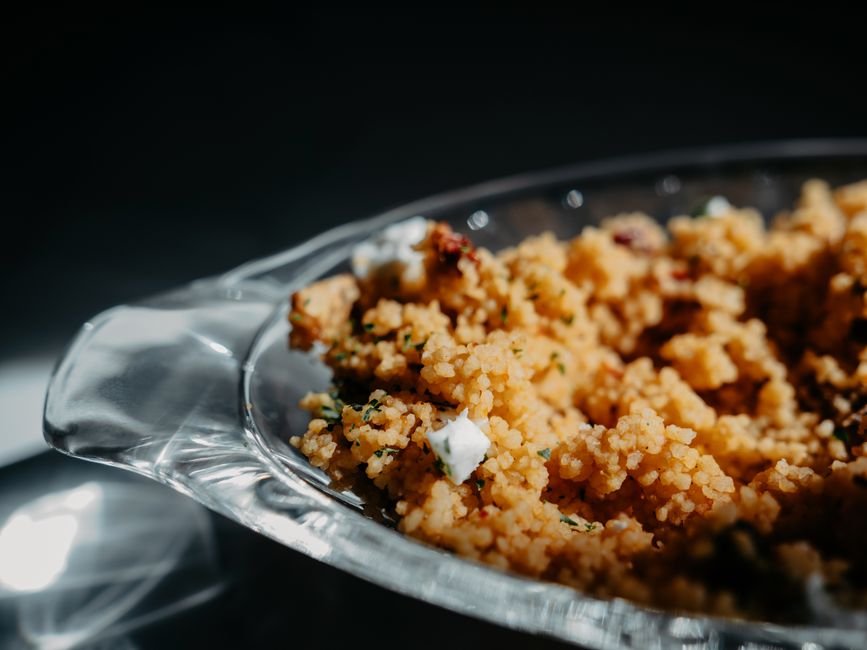
Full Nutrition Facts for 1 Cup Cooked Couscous
Here’s the complete nutritional breakdown of a standard 157g serving of cooked couscous:
| Nutrient | Amount | % Daily Value |
|---|---|---|
| Calories | 176 | — |
| Total Fat | 0.3g | <1% |
| Saturated Fat | 0.1g | <1% |
| Cholesterol | 0mg | 0% |
| Sodium | 8mg | <1% |
| Total Carbohydrate | 36g | 13% |
| Dietary Fiber | 2.2g | 8% |
| Total Sugars | 0.7g | — |
| Protein | 5.9g | 12% |
| Iron | 0.3mg | 2% |
| Magnesium | 19mg | 5% |
| Selenium | 52mcg | 95% |
*Percent Daily Values are based on a 2,000-calorie diet. Source: USDA FoodData Central.
Key insight: Couscous is remarkably lean—virtually fat-free—and delivers a surprising 5.9g of protein per cup of cooked serving. Its selenium content (95% DV) supports thyroid function and antioxidant defense, making it nutritionally denser than many people realize. The relatively low sodium is also notable for those monitoring salt intake.

Etekcity Food Scale
0.1g accuracy — the perfect companion for exact portions.
Couscous: Uncooked vs. Cooked
Uncooked (Dry) Couscous
- 351 calories per 1/2 cup (about 85g)
- Absorbs water during cooking, nearly doubling weight
- Higher calorie density—easy to overestimate portions by volume
Cooked Couscous
- 176 calories per 1 cup (157g after cooking)
- Lighter, fluffier texture with absorbed water
- Easier to portion accurately and visually reasonable serving sizes
Practical takeaway: Always measure couscous before cooking to avoid accidentally eating double the intended calories. A small 1/4 cup uncooked portion becomes a satisfying full cup when cooked. If cooking in bulk, weigh the dry grain first, then portion the cooked result for consistent tracking.
Is Couscous Good for Weight Loss?
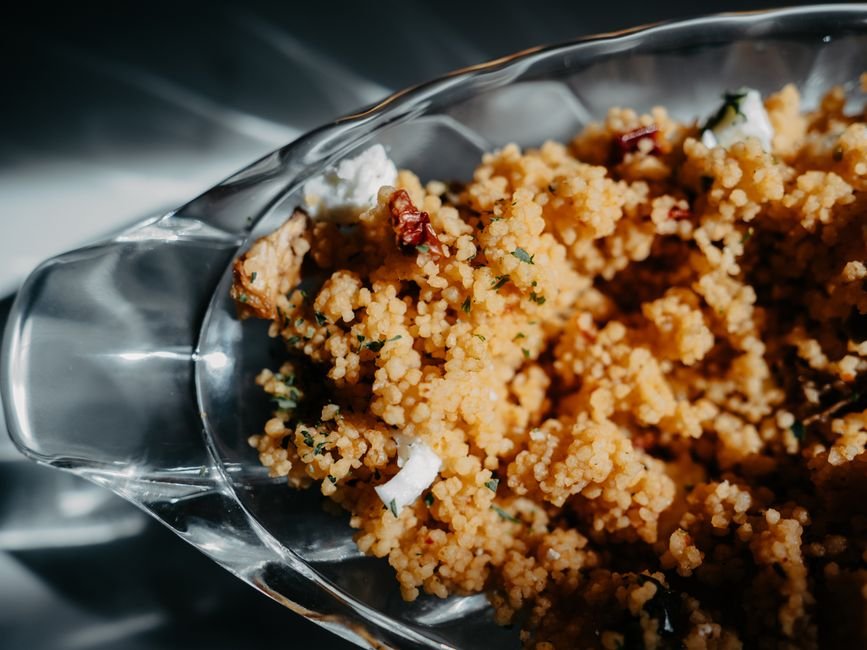
Couscous can fit into a weight-loss diet when portioned carefully. At 176 calories per cup cooked, it’s reasonable for side dishes, but it’s not particularly satiating on its own. Because couscous is primarily carbohydrate with modest protein (5.9g per serving), pairing it with lean protein and vegetables maximizes fullness and prevents overeating. The lack of fiber (only 2.2g per cup) means it won’t keep you satisfied as long as a whole grain like barley or farro would.
Tips to Eat Couscous Without Gaining Weight:
- Measure before cooking: Use a kitchen scale or measured cup of dry couscous; eyeballing can lead to 2–3× the intended portion.
- Bulk with vegetables: Mix cooked couscous 50/50 with sautéed zucchini, tomatoes, or leafy greens to keep portions smaller while maintaining plate fullness.
- Add protein: Pair with grilled chicken, fish, legumes, or tofu to increase satiety and balance macronutrients.
- Watch oil additions: Restaurant and recipe couscous often includes butter or olive oil; make yours with broth or water to save 50–100 calories per serving.
When treated as a vehicle for lean proteins and vegetables rather than a main event, couscous remains a sensible choice for weight-conscious eaters.
How Portion Size Affects Calories
Couscous’s calorie density changes dramatically depending on whether you measure it raw or cooked. Raw couscous is highly concentrated—1/4 cup uncooked (about 43g) contains 175 calories. Once water is added during cooking, that same 1/4 cup of dry couscous becomes 2 cups cooked, making the actual calorie cost deceptively low per visually obvious serving.
Example:
- Small portion (1/2 cup cooked): 88 calories—reasonable as a side
- Large portion (2 cups cooked): 352 calories—equivalent to a light meal on its own
Knowing how much dry couscous you start with prevents the common mistake of eating what feels like a modest amount, only to realize you’ve consumed 400+ calories.
Best Way to Measure Couscous Accurately
The most reliable method is to measure couscous before cooking, not after. Cooked grains absorb varying amounts of liquid depending on brand, humidity, and cooking method, making post-cooking measurements unreliable for calorie tracking. A kitchen scale is ideal for precision, but standard measuring cups work adequately for most people.
Options:
- Digital kitchen scale: Weigh 85g of dry couscous (1/2 cup, roughly 351 calories) for perfect consistency.
- Measuring cup: Use a standard 1/2-cup dry measuring cup, level to the top; multiply servings as needed.
- Couscous boxes: Most packaged couscous lists serving sizes on the label (commonly 1/4 cup dry = 170 calories); use the package guidance for quick reference.
Calculate Your Exact Calorie Intake
If couscous is a regular part of your diet, tracking becomes easier when you know the exact calorie contribution of every portion. But manually calculating couscous calories alongside vegetables, proteins, oils, and dressings is tedious and error-prone.
Our free AI nutrients calculator handles couscous and hundreds of other foods instantly, showing you total calories, macronutrients, and micronutrients for any meal or recipe. Simply input your ingredients and portions, and get a complete breakdown—ideal for meal planning, weight loss, or athletic performance.
- Track multiple ingredients in one calculation
- Adjust portion sizes in real time to hit your macros
- No signup required—use the calculator now
Common Mistakes When Eating Couscous
Even health-conscious eaters often stumble with couscous. Here are the mistakes to avoid:
❌ Eyeballing dry couscous portions. It looks small in a measuring cup, but 1/2 cup is easy to overpour by 50%, adding 175 hidden calories.
❌ Adding butter or oil during cooking. Traditional recipes call for fat to “fluff” the grains; even 1 tablespoon of butter adds 100 calories you might not realize you’re eating.
❌ Treating it as a protein source. Couscous contains only 5–6g protein per cup; relying on it as your main protein leaves meals unbalanced and less satisfying.
❌ Ignoring restaurant portions. Restaurant couscous is often cooked with stock, oil, and added ingredients; a single bowl can contain 400–600 calories or more.
Being aware of these pitfalls helps you stay on track with your nutrition goals.
FAQ
How many calories are in 100g of couscous?
100g of cooked couscous contains approximately 112 calories. If measuring uncooked, 100g (roughly 1 cup dry) contains about 375 calories.
Is couscous fattening?
Couscous itself is fat-free and moderate in calories, so it’s not inherently fattening. However, it’s easy to overeat because dry portions look small, and restaurant versions often include added fats. Portion control and pairing with protein and vegetables are key.
Can I eat couscous on a low-carb diet?
No. Couscous is 80% carbohydrate (36g per cooked cup), making it unsuitable for strict low-carb or keto diets. Those following lower-carb approaches should choose cauliflower rice or shirataki noodles instead.
Is whole wheat couscous more nutritious than white couscous?
Whole wheat couscous has slightly more fiber (around 6g per cup cooked vs. 2g in white) and retains more micronutrients, but calorie counts are nearly identical (roughly 174 calories per cooked cup). Both are reasonable grains; whole wheat offers a mild digestive advantage.
Conclusion
Couscous is a quick-cooking, low-fat grain that delivers 176 calories and 5.9g of protein per cooked cup, along with excellent selenium content. Its neutral flavor and light texture make it a versatile side dish, but its modest fiber and protein content mean it’s best paired with vegetables and lean protein rather than eaten alone. For weight loss or blood-sugar management, portion control is essential—always measure dry couscous before cooking to avoid consuming double the intended amount.
Understanding couscous’s true calorie content and macronutrient profile empowers you to make it work for your goals. Whether you’re building balanced meals or tracking intake for a specific diet, measuring carefully and using a reliable nutrients calculator takes the guesswork out of portion planning and ensures you hit your targets consistently.
