585 calories in 4 oz of pork belly (113 g)
- 11 g protein
- 0 g carbs
- 60 g fat
Source: USDA FoodData Central · 518 kcal per 100 g
A 4 oz serving of raw pork belly contains 585 calories, with fat accounting for 93% of them. Pork belly is one of the fattiest cuts of pork—roughly 53 g fat per 100 g—so it’s calorie-dense and carries minimal protein and zero carbohydrates.
What matters most here is the fat profile: over half of that fat is saturated, and pork belly provides almost no fiber, vitamins or minerals in meaningful amounts. It’s a cut built for flavor and richness in cooked dishes, not nutritional density.

Calories in Pork Belly by Serving Size
| Serving | Calories | Protein | Carbs | Fat |
|---|---|---|---|---|
| 4 oz | 585 | 11 g | 0 g | 60 g |
| 1 lb (454 g) | 2350 | 42 g | 0 g | 240 g |
| 100 g | 518 | 9.3 g | 0 g | 53 g |
| 1 oz | 147 | 2.6 g | 0 g | 15 g |
Pork Belly Nutrition Facts
Per 4 oz (113 g):
| Nutrient | Amount | % Daily Value* |
|---|---|---|
| Calories | 585 kcal | |
| Protein | 11 g | 21% |
| Total Fat | 60 g | 77% |
| Saturated Fat | 22 g | 109% |
| Cholesterol | 81 mg | 27% |
| Sodium | 36 mg | 2% |
| Total Carbohydrate | 0 g | 0% |
| Dietary Fiber | 0 g | 0% |
| Total Sugars | 0 g | |
| Calcium | 5.7 mg | 0% |
| Iron | 0.6 mg | 3% |
| Potassium | 209 mg | 4% |
| Magnesium | 4.5 mg | 1% |
| Zinc | 1.2 mg | 10% |
| Phosphorus | 122 mg | 10% |
| Selenium | 9 mcg | 16% |
| Vitamin A (RAE) | 3.4 mcg | 0% |
| Vitamin C | 0.3 mg | 0% |
| Vitamin E | 0.4 mg | 3% |
| Thiamin (B1) | 0.4 mg | 37% |
| Riboflavin (B2) | 0.3 mg | 21% |
| Niacin (B3) | 5.3 mg | 33% |
| Vitamin B6 | 0.1 mg | 9% |
| Folate (DFE) | 1.1 mcg | 0% |
| Vitamin B12 | 0.9 mcg | 40% |
Where the calories come from: 93% fat · 7% protein · 0% carbs
*Percent Daily Values are based on a 2,000-calorie diet (FDA reference values). Source: USDA FoodData Central — Pork, fresh, belly, raw (FDC ID 167812, SR Legacy, published 4/1/2019). Values for other servings are calculated from the per-100 g data.
How Cooking Changes Pork Belly's Calories
The data here is for raw pork belly. Cooking methods—roasting, braising, pan-frying—will affect the final calorie count depending on how much fat renders out and what you add to the pan. Slow-roasted or braised pork belly loses some fat to the cooking liquid, which lowers calories per serving. Pan-fried or crisped belly absorbs little additional fat and often becomes more concentrated in calories as water evaporates.
If you drain off rendered fat after cooking, the cooked result will have fewer calories than the raw numbers suggest. Conversely, if you cook pork belly in oil or butter, or use the drippings in a sauce, the finished dish will be higher in calories than the raw cut alone.
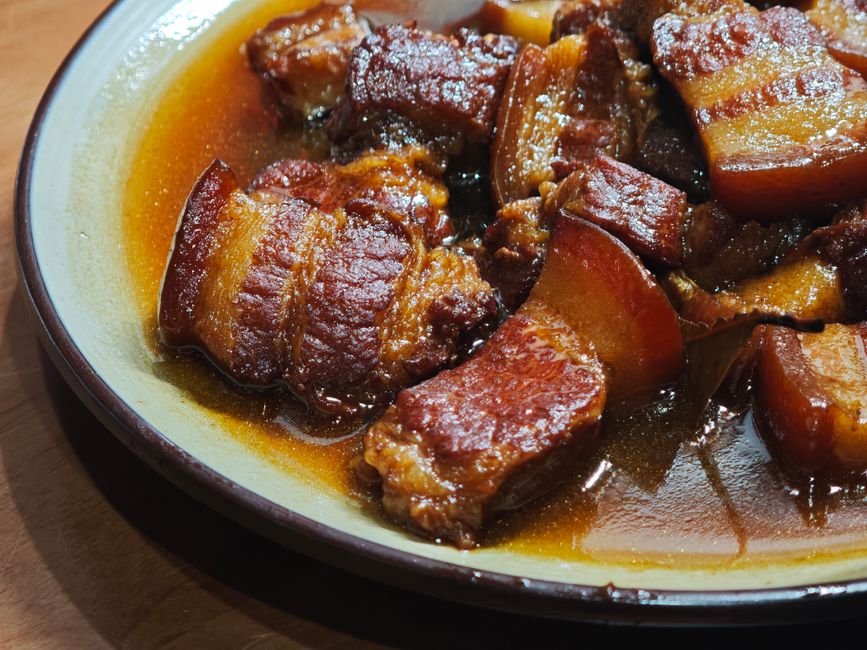
Pork Belly's Saturated Fat and Cholesterol Content
Both are high relative to serving size—saturated fat hits 109% of the daily value in a single portion.
Where Pork Belly Fits on a Low-Carb or Keto Diet
Pork belly has zero carbohydrates and zero sugar, making it compliant with strict low-carb, keto, or carnivore diets. The 11 g of protein per 4 oz is modest compared to leaner cuts, but the high fat content aligns with keto macros.
The trade-off is calorie density: because 93% of calories come from fat, a small visual portion can contain a large caloric load. A 4 oz serving—roughly the size of a deck of cards—delivers 585 calories. If you’re eating pork belly on a calorie-conscious version of keto or low-carb, weighing or measuring portions matters more than with leaner proteins.
Pork Belly Vs. Leaner Pork Cuts
Pork belly is fundamentally different from cuts like pork loin or pork tenderloin. Those leaner cuts are mostly protein and water, with far fewer calories and less fat per ounce. Pork belly’s value is in flavor and texture when braised or roasted slowly—the fat is the point—rather than as a practical protein source for high-protein, low-calorie goals.
Use pork belly where the fat and connective tissue contribute to the dish: braised dishes, slow-roasted preparations, rendered into lard, or crisped as a garnish. For straightforward lean protein, choose a different cut.
Micronutrient Highlights
Pork belly is not a significant source of most vitamins or minerals, but it does provide B vitamins reasonably well. A 4 oz serving supplies 37% of the daily value for thiamin (B1), 33% for niacin (B3), 21% for riboflavin (B2), and 40% for vitamin B12. It also provides 16% of the daily value for selenium.
Beyond those B vitamins and selenium, pork belly offers little else: calcium, magnesium, potassium and most other micronutrients are sparse.
How Pork Belly Compares
Per 100 g, next to similar foods in our database:
| Food (100 g) | Calories | Protein | Carbs | Fat |
|---|---|---|---|---|
| Pork Belly | 518 | 9.3 g | 0 g | 53 g |
| Cashews | 533 | 17 g | 36 g | 39 g |
| Swiss Cheese | 307 | 13 g | 1.6 g | 27 g |
| Feta Cheese Crumbles | 273 | 20 g | 5.6 g | 19 g |
| Chicken Thigh | 193 | 17 g | -0.2 g | 13 g |
| Ricotta Cheese | 157 | 7.8 g | 6.9 g | 11 g |
Pork Belly FAQ
How many calories are in cooked pork belly?
Cooked pork belly's calories depend on cooking method and fat loss. If significant fat renders out and drains away, the cooked result will have fewer calories than the raw 585 kcal per 4 oz. If you retain the drippings or add cooking fat, calories stay similar to or exceed the raw value.
Is pork belly all fat?
No—raw pork belly is 37% water and 9.3% protein by weight, with fat making up the rest. It has genuine nutritional structure, but fat is the dominant macronutrient by a large margin.
Can I eat pork belly if I'm trying to lose weight?
Yes, if portions are small and intentional. At 585 kcal per 4 oz, pork belly is calorie-dense, so a modest serving fits into a weight-loss plan only if you account for its caloric load and balance it against your total intake.
Does pork belly have any sugar or carbs?
No. Raw pork belly contains zero grams of carbohydrate and zero grams of sugar, regardless of portion size.
The Bottom Line
Pork belly is a fatty, calorie-dense cut—585 calories per 4 oz raw—best used for flavor in braised and slow-roasted dishes where the fat renders and enriches the dish. It fits low-carb diets but demands portion awareness on any calorie-conscious plan.