Part of our guide: How to Count Macros: A Simple Beginner’s Guide With Examples
Key takeaways
- How much fat per day? Most adults do well with 20–35% of calories from fat: about 44–78 g on 2,000 calories.
- Fat has 9 calories per gram, more than twice protein or carbs, so small portions add up quickly.
- Keep saturated fat under about 10% of calories (about 22 g on 2,000).
- Choose mostly unsaturated fats: olive oil, nuts, seeds, avocado and fish.
Fat went through decades of being the villain, then a few years of being the hero. The science sits in the middle: fat is essential, and some fats are clearly better than others, but because it’s so calorie-dense, the amount matters. Here’s how much fat per day you need, how to work it out in grams for your calorie level, and which fats to prioritize.
Why you need fat

Dietary fat:
- Supplies essential fatty acids (omega-3 and omega-6) that your body can’t make.
- Carries the fat-soluble vitamins A, D, E and K and helps you absorb them.
- Forms part of every cell membrane and is needed to make some hormones.
- Makes meals satisfying and slows digestion.
Very low-fat diets aren’t necessary for weight loss or health for most people.

Etekcity Food Scale
0.1g accuracy — the perfect companion for exact portions.
How much fat per day: the official range
The National Academies set an Acceptable Macronutrient Distribution Range of 20–35% of calories from fat for adults (National Academies). To convert that to grams:
Grams of fat = calories × percentage ÷ 9
On 2,000 calories: 2,000 × 0.20 ÷ 9 = 44 g, and 2,000 × 0.35 ÷ 9 = 78 g. The Daily Value used on food labels is 78 g, the top of that range (FDA).
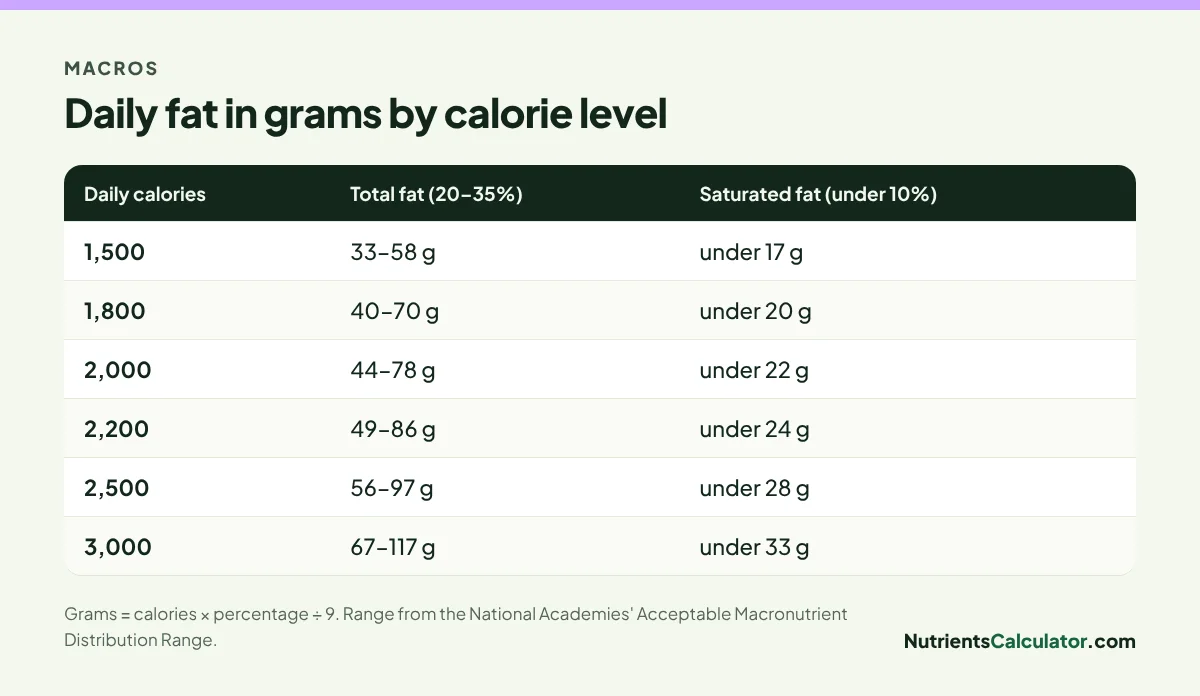
Where you land in the range is up to you. If you prefer more carbs (or train hard), sit near 20–25%. If you find fat more satisfying, 30–35% works fine. For weight loss, the split matters less than total calories; see the best macro ratio for weight loss.
Saturated fat: how much is OK?
Saturated fat, found mostly in butter, cheese, fatty meats, coconut oil and many baked goods, raises LDL cholesterol in many people. The guidance to keep it under about 10% of calories was kept in the 2025–2030 Dietary Guidelines (summary). That’s about 22 g on 2,000 calories; the label Daily Value is 20 g.
For context, from USDA data:
| Food | Portion | Total fat | Saturated fat |
|---|---|---|---|
| Butter | 1 tbsp | 11.4 g | 7.2 g |
| Coconut oil | 1 tbsp | 13.5 g | 11.2 g |
| Cheddar cheese | 1 oz | 9.3 g | 5.3 g |
| 85% lean ground beef, cooked | 3 oz | 13.1 g | 5.0 g |
| Whole milk | 1 cup | 7.9 g | 4.6 g |
| Olive oil | 1 tbsp | 13.5 g | 1.9 g |
| Almonds | 1 oz | 14.0 g | 1.1 g |
| Walnuts | 1 oz | 18.3 g | 1.7 g |
| Avocado | ½ large (100 g) | 14.7 g | 2.1 g |
| Salmon, farmed, cooked | 3 oz | 10.5 g | 2.0 g |
| Chia seeds | 1 oz | 8.6 g | 0.9 g |
| Egg, hard-boiled | 1 large | 5.3 g | 1.6 g |
Olive oil, nuts and avocado have similar total fat to butter but far less saturated fat.
The best fats to choose
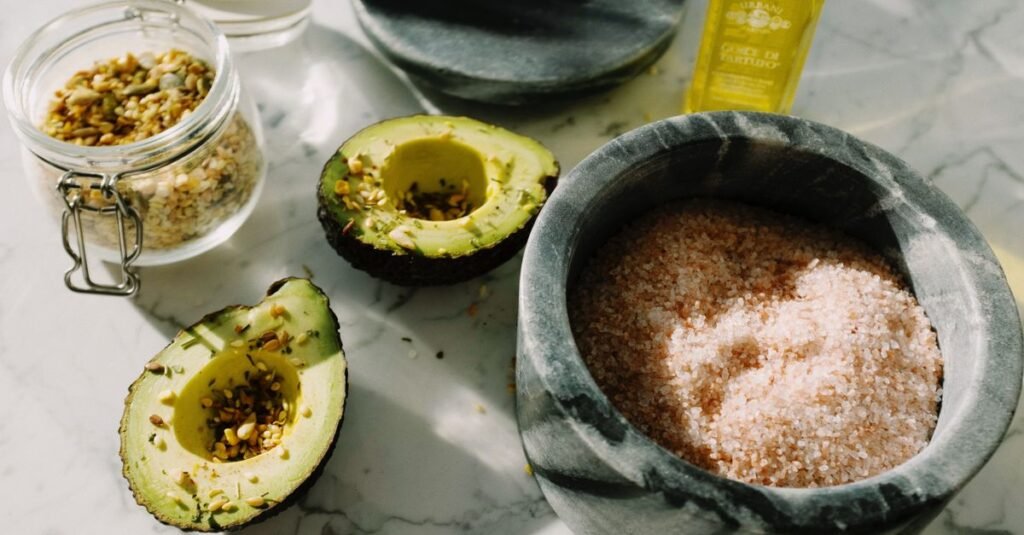
- Olive oil and canola oil for cooking and dressings.
- Nuts and seeds: almonds, walnuts, peanuts, chia, flax, pumpkin seeds.
- Avocado.
- Fatty fish such as salmon, trout and sardines, for omega-3s. Two servings a week is a common target.
Our guide to what macronutrients are explains the different types of fat in more detail.
Why fat is easy to overeat
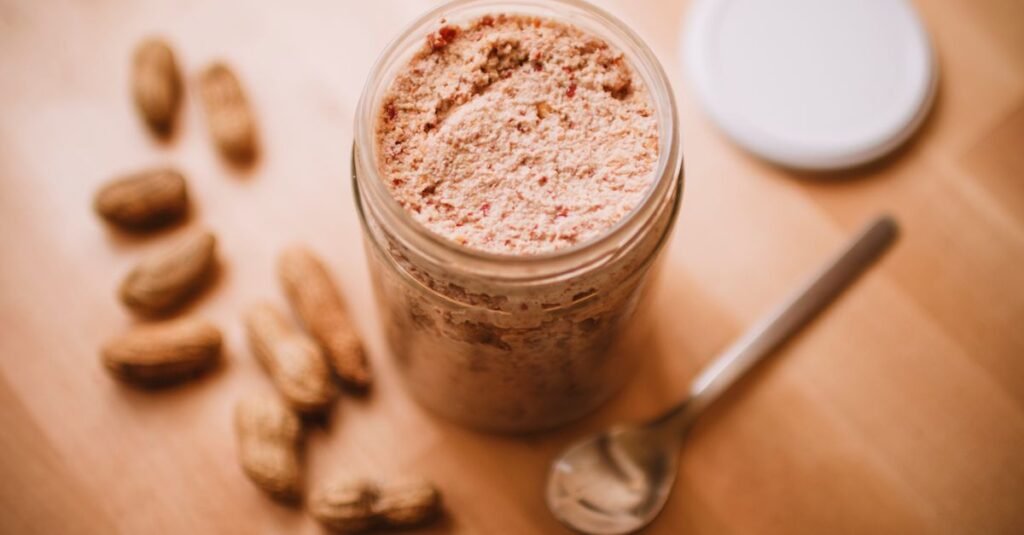
At 9 calories per gram, fat adds calories fast:
- 1 tbsp olive oil = 119 calories. Pouring “a glug” into a pan is often 2–3 tablespoons.
- 2 tbsp peanut butter = 191 calories and 16 g fat.
- A small handful of almonds (1 oz) = 162 calories.
None of these are unhealthy, but measuring them for a week is one of the quickest ways to find hidden calories. It’s the same lesson as in our guide to foods with more calories than you think.
Easy swaps to improve your fats
- Cook with olive oil instead of butter, and measure it.
- Swap processed meats for chicken, fish, beans or eggs a few times a week.
- Snack on nuts instead of chips or cookies.
- Choose lower-fat dairy if you eat a lot of it, or keep full-fat dairy and trim saturated fat elsewhere.
- Have fish twice a week: canned salmon or sardines count.
Fitting fat into your macros
If you count macros, set protein first, then decide how the remaining calories split between carbs and fat. Our calculator does the maths for any calorie target.
The bottom line
How much fat per day? About 20–35% of your calories, or 44–78 g on a 2,000-calorie diet, with saturated fat under about 10% of calories. Choose mostly olive oil, nuts, seeds, avocado and fish, measure the calorie-dense ones, and you’ll get the benefits of fat without overdoing the calories. For the full method of setting your numbers, see how to count macros.
Frequently asked questions
How many grams of fat should I eat a day to lose weight?
Stay within 20–35% of your calorie target. On 1,600 calories that's about 36–62 g. Going much lower can leave meals less satisfying and make it harder to absorb fat-soluble vitamins.
Is it bad to eat 100 grams of fat a day?
Not necessarily. On a 2,600-calorie diet, 100 g of fat is about 35% of calories, the top of the healthy range. On 1,800 calories it would be 50%, which leaves little room for protein and fiber-rich carbs.
How much saturated fat per day is OK?
Keep saturated fat under about 10% of calories, a limit kept in the 2025–2030 Dietary Guidelines. On 2,000 calories that's about 22 g. The Daily Value on food labels is 20 g.
What happens if you eat too little fat?
Very low-fat diets can fall short on essential fatty acids and make it harder to absorb vitamins A, D, E and K. Meals may also feel less filling. Below about 20% of calories is rarely necessary.
Sources
- National Academies: Dietary Reference Intakes for Energy, Carbohydrate, Fiber, Fat, Fatty Acids, Cholesterol, Protein, and Amino Acids
- 2025–2030 Dietary Guidelines for Americans: key changes (Perkins Coie summary)
- FDA: Daily Value on the Nutrition and Supplement Facts Labels
- USDA FoodData Central
This article is for general information and isn’t medical advice. Talk to your doctor or a registered dietitian about your own needs, especially if you have a health condition, are pregnant or take medication.