Part of our guide: How to Count Macros: A Simple Beginner’s Guide With Examples
Key takeaways
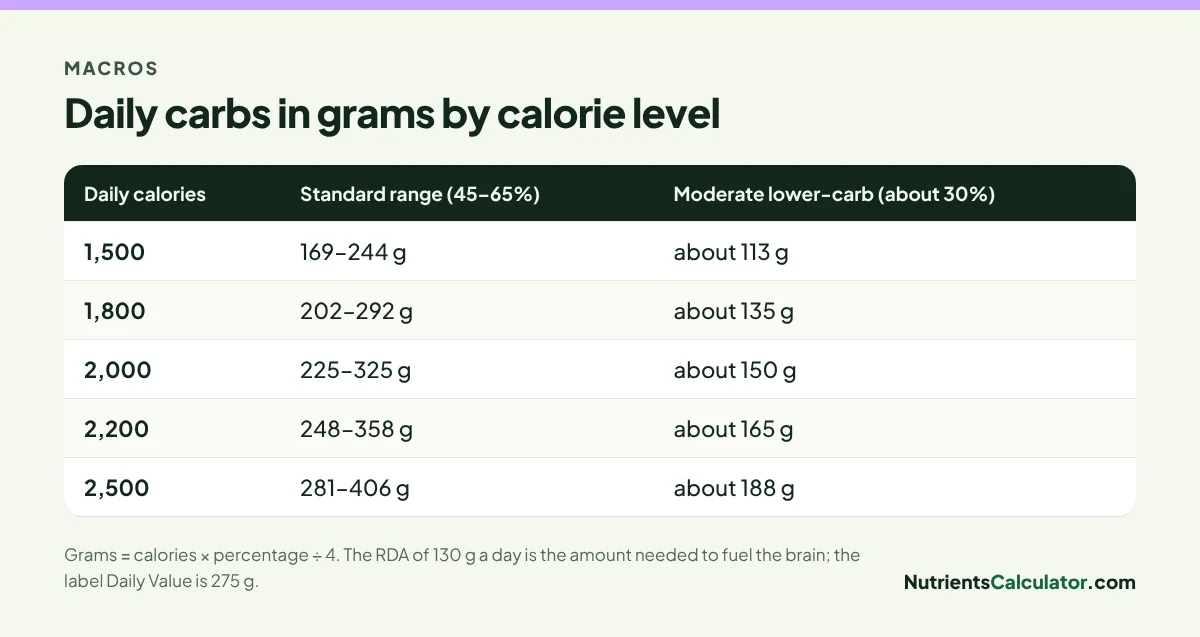
- How many carbs a day? The standard healthy range is 45–65% of calories, which is 225–325 g on 2,000 calories.
- The RDA is 130 g a day, the amount the brain needs. Below that is generally considered low-carb.
- The quality of carbs matters more than the exact number: choose foods with fiber and keep added sugar low.
- For weight loss, low-carb and higher-carb diets work about equally well when calories are matched.
Carbohydrates are the most debated macronutrient. Some plans cut them to almost nothing; official guidelines suggest they make up about half your calories. So how many carbs a day should you eat? It depends on your calories, activity and preferences, but there are clear reference points. Here’s how to set a number in grams, and how to make those grams count.
The reference points
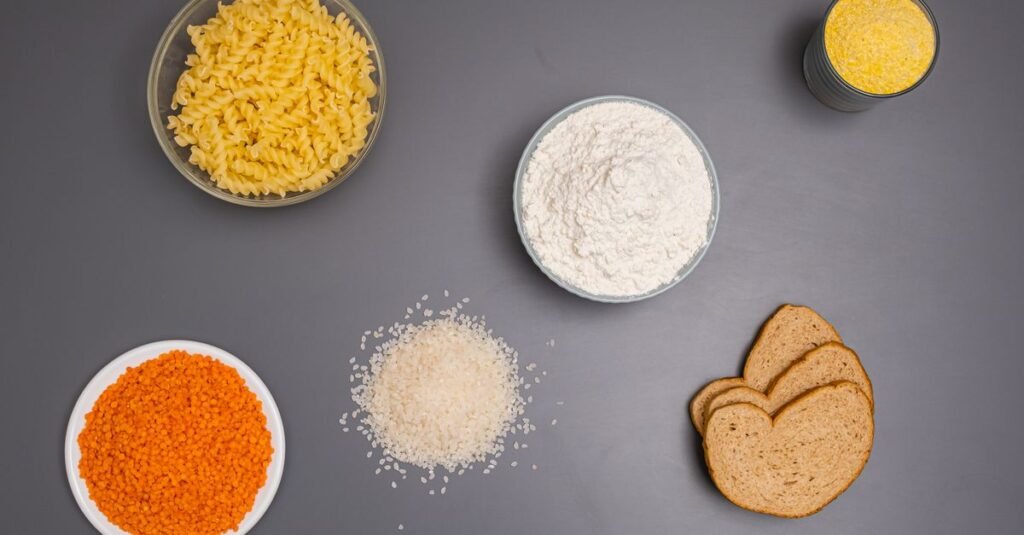
From the National Academies’ Dietary Reference Intakes (National Academies):
- RDA: 130 g a day for adults. This is the amount of carbohydrate needed to supply the brain with glucose. It’s a minimum reference, not a target.
- Healthy range: 45–65% of calories. On 2,000 calories, that’s 225–325 g.
- Fiber: about 14 g per 1,000 calories, or 28 g on 2,000.
The Daily Value on food labels is 275 g of total carbohydrate (FDA).

Etekcity Food Scale
0.1g accuracy — the perfect companion for exact portions.
How to set your carb target
- Start with your calorie target. See how to count macros if you haven’t set one.
- Set protein at about 1.2–1.6 g per kg of body weight.
- Choose your carb percentage based on activity and preference:
- Active, training hard, or prefer bread, rice and fruit: 45–55%.
- Moderately active, general health: 40–50%.
- Prefer fewer carbs, or find them less filling: 25–35%, with plenty of vegetables and legumes.
- Convert to grams: calories × percentage ÷ 4.
For example, 1,800 calories at 40% carbs: 1,800 × 0.40 ÷ 4 = 180 g.
How many carbs a day for weight loss?
Fat loss depends on total calories, not on carbs specifically. In the DIETFITS trial, people on a healthy low-carb diet and a healthy low-fat diet lost about the same amount of weight over a year (Gardner et al., 2018). Many people find a moderate approach, about 30–45% of calories from carbs, easiest while dieting: enough for energy and fiber, with more room for protein. See the best macro ratio for weight loss.
Low-carb diets often show a quick drop on the scale in the first week. That’s mostly water stored with glycogen, not fat.
Carbs in common foods

From USDA data:
| Food | Portion | Carbs | Fiber |
|---|---|---|---|
| Cooked white rice | 1 cup | 44.5 g | 0.6 g |
| Cooked brown rice | 1 cup | 50 g | 3.1 g |
| Cooked whole-wheat spaghetti | 1 cup | 35 g | 4.6 g |
| Rolled oats, dry | ½ cup (40 g) | 27 g | 4 g |
| Whole-wheat bread | 1 slice | 14 g | 1.9 g |
| Black beans, cooked | 1 cup | 41 g | 15 g |
| Lentils, cooked | 1 cup | 40 g | 15.6 g |
| Potato, boiled | 1 cup | 31 g | 2.8 g |
| Banana | 1 medium | 27 g | 3.1 g |
| Apple | 1 medium | 25 g | 4.4 g |
| Blueberries | 1 cup | 21 g | 3.6 g |
| Cauliflower, raw | 1 cup | 5 g | 2.1 g |
| Regular cola | 12 oz | 38 g | 0 g |
Notice how beans and lentils pack the most fiber, and how a can of cola matches a cup of rice in carbs with none of the fiber.
Choose quality carbs

- High-fiber carbs: beans, lentils, oats, whole grains, fruit, vegetables and potatoes with skin. Fiber slows digestion and keeps you full (how to get 28 g of fiber a day).
- Limit added sugars: the label Daily Value is 50 g, and the 2025–2030 Dietary Guidelines suggest keeping meals to about 10 g of added sugar (summary). Sugary drinks are the easiest place to cut (sugary drinks).
- Refined grains in moderation: white bread, white rice and pasta are fine as part of balanced meals, but whole-grain versions bring more fiber.
What about net carbs?
Low-carb product labels often promote “net carbs”, total carbs minus fiber (and sometimes sugar alcohols). It’s not an official term, and labels calculate it in different ways. We explain the difference in net carbs vs total carbs.
Signs your carb intake may be too low
- Low energy during workouts or a flat feeling in the afternoon.
- Constipation from too little fiber.
- Headaches or irritability in the first days of cutting carbs.
- Cravings that lead to bingeing.
If you notice these, add a portion of high-fiber carbs (oats, fruit, beans or potatoes) to one or two meals.
Work out your numbers
Our calculator sets calories, then splits them into protein, carbs and fat in grams for your goal.
The bottom line
How many carbs a day? For most adults, 45–65% of calories, or 225–325 g on 2,000 calories, with at least 130 g. Lower-carb approaches can work too, especially for weight loss, as long as calories, protein and fiber are right. Whatever your number, get most of your carbs from high-fiber foods and keep added sugar low.
Frequently asked questions
How many carbs should I eat a day to lose weight?
There's no single number. Weight loss depends on total calories. Many people do well with 30–45% of calories from carbs while losing weight, about 135–200 g on 1,800 calories, mostly from high-fiber foods.
What counts as a low-carb diet?
Definitions vary, but under about 130 g a day (or under 26% of calories) is often called low-carb, and under about 50 g is usually called very low-carb or ketogenic.
Is 100 grams of carbs a day low?
Yes, for most adults 100 g is a low-carb intake, below the 130 g RDA. It can work for some people but requires planning to get enough fiber and energy for exercise.
Do vegetables count as carbs?
Yes, but most non-starchy vegetables are very low in carbs: a cup of chopped raw cauliflower has about 5 g. Starchy vegetables like potatoes, corn and peas have more.
Sources
- National Academies: Dietary Reference Intakes for Energy, Carbohydrate, Fiber, Fat, Fatty Acids, Cholesterol, Protein, and Amino Acids
- FDA: Daily Value on the Nutrition and Supplement Facts Labels
- 2025–2030 Dietary Guidelines for Americans: key changes (Perkins Coie summary)
- Gardner CD et al. Effect of low-fat vs low-carbohydrate diet on 12-month weight loss (DIETFITS). JAMA, 2018
- USDA FoodData Central
This article is for general information and isn’t medical advice. Talk to your doctor or a registered dietitian about your own needs, especially if you have a health condition, are pregnant or take medication.