We independently choose the products in this guide. As an Amazon Associate we earn from qualifying purchases, at no extra cost to you. How we make money.
Key takeaways
- Fitness trackers are great for steps, heart rate and activity trends, but calorie burn is an estimate.
- In a Stanford study, no device measured energy expenditure within 20%.
- Best overall: Garmin Vivoactive 6. Best simple band: Fitbit Charge 6. Best for iPhone: Apple Watch SE 3.
- Use calorie numbers to compare days, and judge your plan by your weight trend.
Fitness trackers make your activity visible: steps, workouts, heart rate, sleep and an estimate of calories burned. That visibility is motivating, and more movement is good for nearly everyone. But if you use your tracker to decide how much to eat, it helps to know how accurate those calorie numbers are. Here are the best fitness trackers for counting calories burned, and how to use them well.
How accurate are fitness trackers at counting calories?
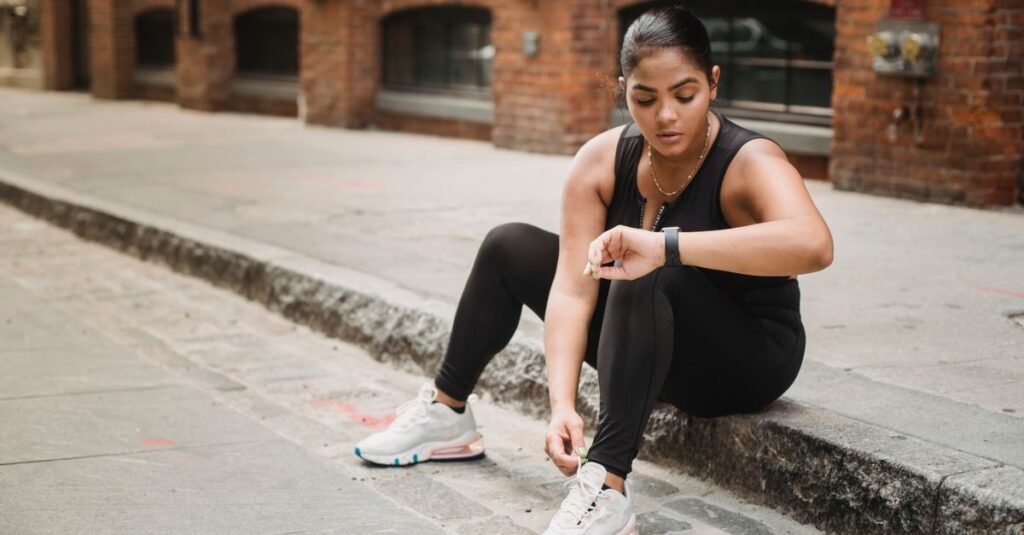
A widely cited Stanford study tested seven wrist-worn devices. Heart rate was reasonably accurate for most, but none estimated energy expenditure within 20%, and even the best had a median error of about 27%. Errors were larger for some activities and body types. In practice:
- Treat calories burned as a rough guide, not a precise number.
- Compare day to day with the same device, which is more useful than absolute numbers.
- Don’t “eat back” every exercise calorie. See how to create a calorie deficit.
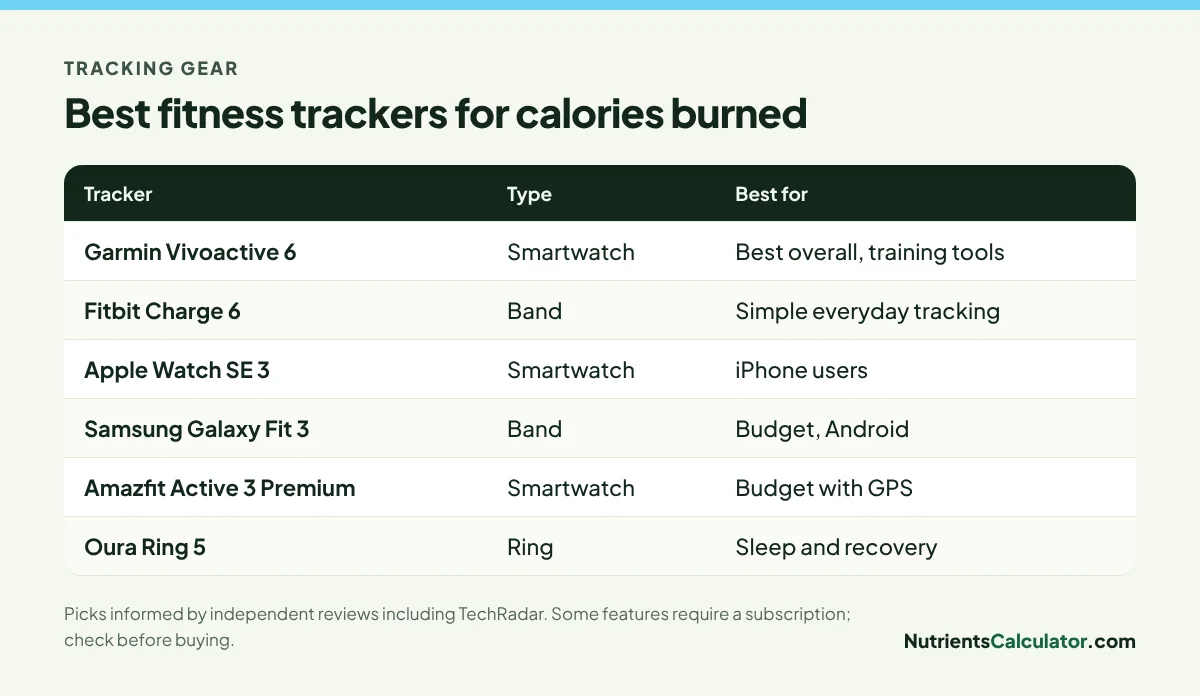
| Tracker | Type | Best for |
|---|---|---|
| Garmin Vivoactive 6 | Smartwatch | Best overall, training tools |
| Fitbit Charge 6 | Band | Simple everyday tracking |
| Apple Watch SE 3 | Smartwatch | iPhone users |
| Samsung Galaxy Fit 3 | Band | Budget, Android |
| Amazfit Active 3 Premium | Smartwatch | Budget with GPS |
| Oura Ring 5 | Ring | Sleep and recovery |
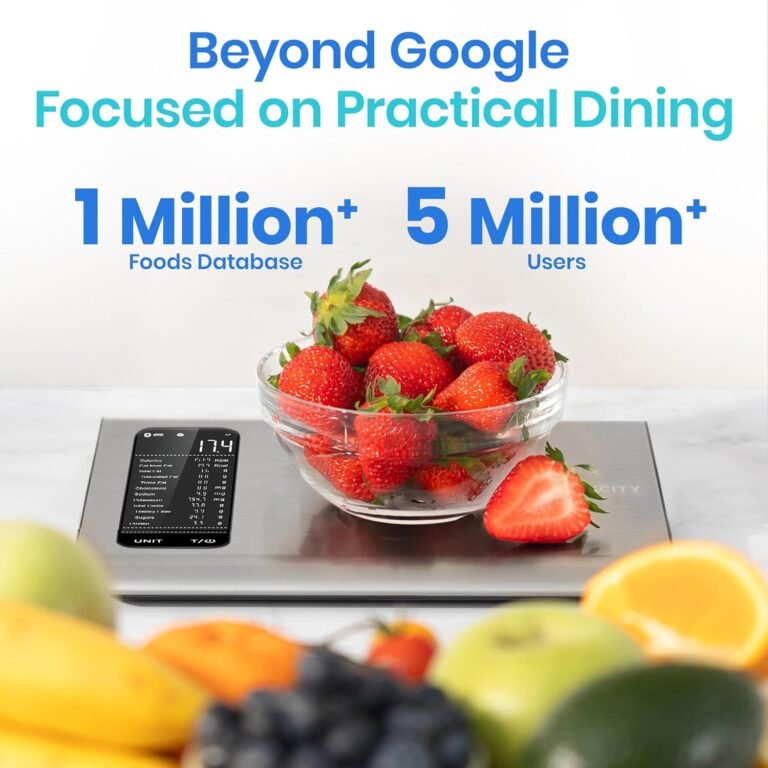
Etekcity Food Scale
0.1g accuracy — the perfect companion for exact portions.
What to look for in fitness trackers
- Heart rate sensor for better estimates during exercise.
- Built-in GPS for runs, walks and rides.
- Battery life you can live with.
- Comfort for wearing all day and night.
- App quality and whether key features need a subscription.
The best fitness trackers for calories burned
1. Garmin Vivoactive 6: best overall
Garmin’s Vivoactive line combines strong training tools, GPS and long battery life in a slim, comfortable watch, with no subscription needed for core features.
Check price on Amazon Garmin Vivoactive 6
2. Fitbit Charge 6: best simple band
The Charge 6 is a slim band with heart rate, built-in GPS and Google’s Fitbit app for steps, sleep and workouts. Some advanced insights need a Fitbit Premium subscription.
Check price on Amazon Fitbit Charge 6
3. Apple Watch SE 3: best for iPhone users
A full smartwatch with strong GPS, workout tracking and Apple’s Activity rings, at a lower price than the flagship models.
Check price on Amazon Apple Watch SE 3
4. Samsung Galaxy Fit 3: best budget band
A low-cost band with a bright screen and accurate heart rate, though without GPS. Best for Android users.
Check price on Amazon Samsung Galaxy Fit 3
5. Amazfit Active 3 Premium: best budget smartwatch
Built-in GPS and detailed running metrics at a budget price.
Check price on Amazon Amazfit Active 3 Premium
6. Oura Ring 5: best for sleep and recovery
A discreet smart ring focused on sleep, recovery and daily activity. It requires a subscription for full features.
Check price on Amazon Oura Ring 5
How to use fitness trackers for weight goals

- Set your calorie target with our goals calculator, using your usual activity level.
- Use steps as your main activity goal. They’re one of the more reliable tracker measures.
- Watch your 2–4 week weight trend. If it’s not moving as planned, adjust food by 100–200 calories. A smart scale makes this automatic.
- Pair with food tracking: a food scale or our AI analyzer.
U.S. guidelines recommend at least 150 minutes of moderate activity a week plus strength training twice a week. A tracker makes those minutes easy to see. If progress stalls, read weight-loss plateaus.
Why fitness trackers misjudge calories burned
Fitness trackers estimate calories burned from heart rate, movement and your profile (age, sex, height and weight). Several things throw that off:
- Wrist movement doesn’t always match effort, for example cycling or pushing a stroller.
- Strength training raises heart rate in bursts that algorithms read poorly.
- Fit and skin contact affect heart rate readings.
- Individual differences in metabolism aren’t captured by a formula.
That’s why two trackers on the same wrist can show very different numbers.
Fitness trackers: the most useful numbers
- Steps: simple, reliable enough, and strongly linked to health.
- Active minutes: a clear way to see if you’re meeting 150 minutes a week.
- Resting heart rate trend: a lower resting heart rate over months often reflects better fitness.
- Sleep duration: helpful for spotting short nights.
- Workout history: keeps you consistent.
Calories burned is useful for comparing your own days, such as a rest day vs a long hike, but less useful as an exact number to eat back.
How to choose fitness trackers
- Band, watch or ring? Bands are light and cheap, watches add GPS and apps, rings are discreet and sleep-focused.
- Phone compatibility: Apple Watch needs an iPhone; most others work with both.
- Subscriptions: check what’s free and what needs a monthly fee.
- Battery: days or weeks for bands and Garmin watches; about a day or two for many smartwatches.
- Comfort: if you won’t wear it to bed, sleep tracking won’t help.
A simple plan using your tracker
- Set a step goal a little above your current average and raise it by 500 to 1,000 every couple of weeks.
- Schedule two strength sessions a week.
- Use weekly averages for steps and weight, not daily swings.
- Track food with a food scale or photos and adjust your calorie target using your weight trend.
For more on the numbers, read how to create a calorie deficit and how many calories to lose weight.
The bottom line
Fitness trackers are excellent for motivation, steps, heart rate and sleep, but calorie burn is only an estimate. The Garmin Vivoactive 6 is our top pick, the Fitbit Charge 6 is the best simple band, and the Apple Watch SE 3 suits iPhone users. Use the numbers to spot trends, not to fine-tune every meal, and let your weight trend guide your plan.
Frequently asked questions
How accurate are fitness trackers for calories burned?
Not very. A Stanford study of seven popular wrist devices found heart rate was fairly accurate, but none measured energy expenditure with an error under 20%, and the best had a median error of about 27%. Use calorie burn as a rough guide and to compare days.
Should I eat back the calories my tracker says I burned?
Be cautious. Because trackers often overestimate, many people eat back only part of exercise calories, or set a fixed target and watch their weight trend for a few weeks instead.
Which is more accurate, a watch or a ring?
Both use similar sensors and both estimate calories. Accuracy depends more on the activity, fit and your body than on the form factor. Watches with GPS track outdoor workouts better.
Is a fitness tracker worth it for weight loss?
It can help by making activity visible and motivating more movement, especially steps. It works best alongside food tracking and realistic goals.
Do fitness trackers count calories burned at rest?
Yes. Most show total daily calories, which include your resting metabolism plus activity. The 'active calories' number is the part from movement.
Is a chest strap more accurate than a wrist tracker?
For heart rate during intense exercise, chest straps are usually more accurate. Many fitness trackers can pair with a chest strap for workouts.
Do fitness trackers count steps accurately?
Steps are one of the more reliable measures, especially during walking and running, though counts can be off during activities like cycling or pushing a cart.
Should I wear my fitness tracker to bed?
Only if you want sleep data and find it comfortable. Many people charge it during the evening or morning instead.
Do fitness trackers help you lose weight?
They can boost motivation and activity, but weight loss depends mostly on food intake. Use the tracker alongside food tracking.
Are cheap fitness trackers worth it?
Budget trackers count steps and heart rate reasonably well. You mainly pay more for GPS, better screens, longer battery life and app features.
Can a fitness tracker detect health problems?
Some can flag irregular heart rhythms or unusual trends, but they aren't medical devices. See a doctor about any symptoms or concerns.
Do fitness trackers work for swimming?
Many do. Check that the tracker is rated for swimming and has a swim tracking mode if you want laps and strokes.
Sources
- Shcherbina A et al. Accuracy in Wrist-Worn, Sensor-Based Measurements of Heart Rate and Energy Expenditure in a Diverse Cohort. J Pers Med, 2017
- TechRadar: The best fitness trackers
- CDC: Physical Activity Guidelines for Adults
This article is for general information and isn’t medical advice. Talk to your doctor or a registered dietitian about your own needs, especially if you have a health condition, are pregnant or take medication.