Part of our guide: How to Create a Calorie Deficit Without Feeling Starved
Key takeaways
- A weight loss plateau is normal. As you lose weight, you burn fewer calories and your appetite rises, so the same plan stops working.
- A stall of a week or two is often water. A real plateau means your weekly average hasn’t moved for 3+ weeks.
- The most common fixes: tighten logging, recalculate your target for your new weight, raise protein and add daily movement.
- Cheat days don’t reset metabolism; planned maintenance breaks can help.
You’ve been consistent for weeks, the scale has been moving, and then it stops. A weight loss plateau is one of the most frustrating parts of losing weight, and one of the most predictable. It isn’t a sign that you’ve failed or that your metabolism is broken. It’s your body adjusting to being smaller. Here’s what’s going on, how to tell a real plateau from a temporary stall, and what to change.
Why plateaus happen

Several things change as you lose weight:
- You burn fewer calories. A smaller body needs less energy to run and to move around. Losing 20 lb lowers daily needs by roughly 125 calories, so a 500-calorie deficit becomes a 375-calorie one without you changing anything.
- Your body adapts. Resting burn often drops a little more than body size alone predicts, a response sometimes called adaptive thermogenesis (Hall & Kahan, 2018).
- Appetite increases. The same review describes appetite rising by about 100 calories a day for every kilogram lost. This, more than metabolism, is why many people drift back toward their old intake.
- Habits loosen. Portions creep up, weekends get looser and logging gets lazier as the novelty wears off.
The NIH’s research model shows that even with perfect adherence, weight loss naturally slows and levels off over months (Hall et al., 2011). Plateaus are built into the process.

Etekcity Food Scale
0.1g accuracy — the perfect companion for exact portions.
Is it a real plateau?

Before changing anything, make sure it’s real. Daily weight swings of 1–3 lb are normal and mostly water, salt and food in your gut. People also tend to weigh more after weekends and less by Friday (Orsama et al., 2014). Starting a new exercise routine or a salty meal out can mask fat loss for a week or two.
A real plateau means your weekly average weight hasn’t changed for three weeks or more, under similar conditions (same scale, mornings, after the bathroom). If it’s only been a week, wait. Our guide to daily weight fluctuations explains what moves the scale day to day.
Other signs fat loss is still happening: your waist measurement is shrinking, clothes fit better, or strength in the gym is rising.
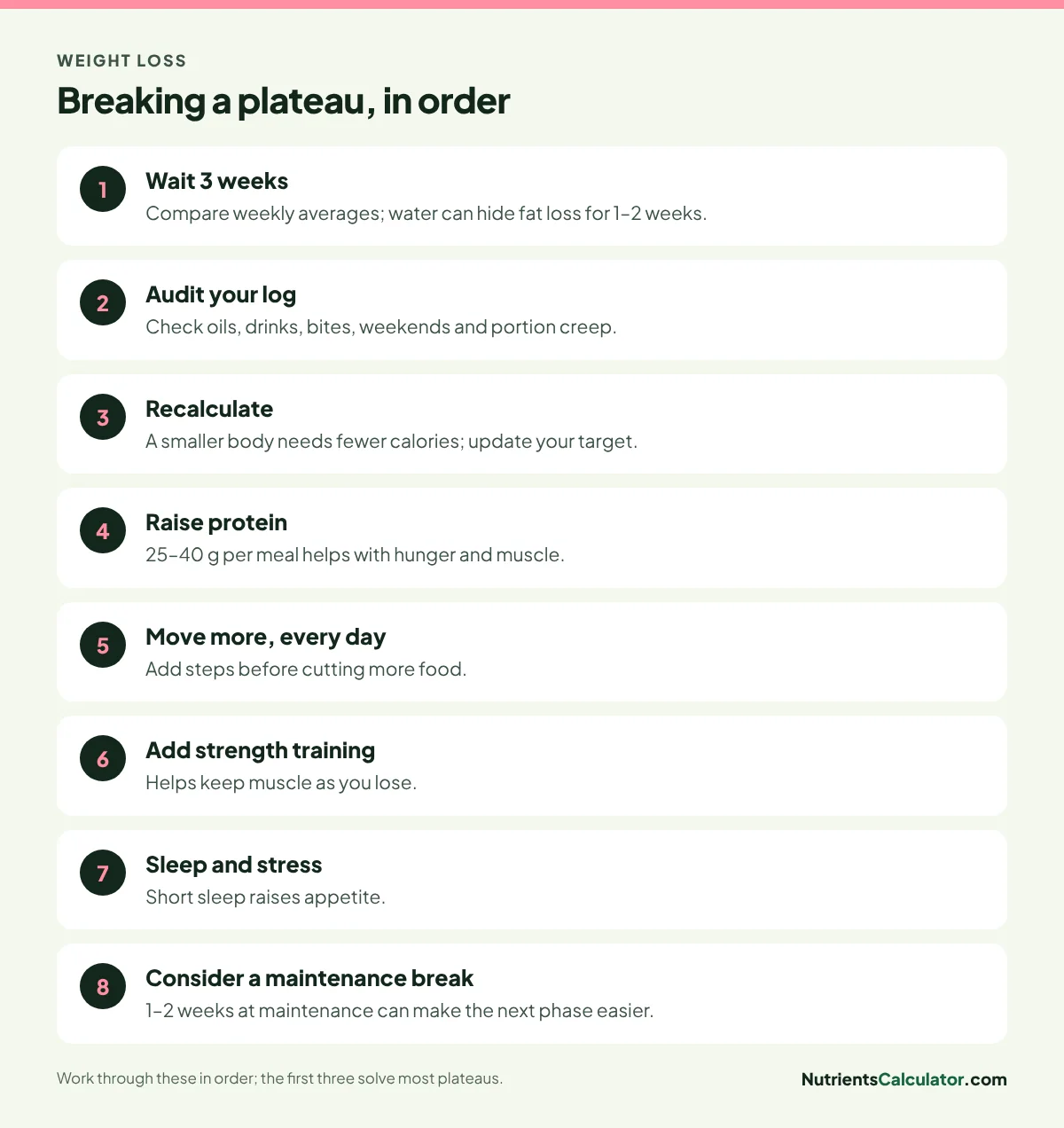
8 ways to break a weight loss plateau

1. Wait three weeks and look at averages
The cheapest fix is patience. Many “plateaus” end on their own once water shifts settle.
2. Audit your food log
The usual culprits are oils and butter, drinks (including alcohol), bites while cooking, weekend meals and portions that have quietly grown. For one week, measure the calorie-dense foods (oil, nut butter, cheese, cereal, pasta) instead of eyeballing them. If you don’t use a scale, our guide to estimating calories without a scale helps.
3. Recalculate your target
Use your current weight, not your starting weight. If you’ve lost 15–20 lb or more, your maintenance has dropped and your old target may now be close to it. See how many calories to lose weight, or plug your new weight into our calculator.
4. Raise your protein
Aim for 25–40 g at each meal. Protein is the most filling nutrient and helps preserve muscle, which supports your metabolic rate. Our guide to protein per meal has practical examples.
5. Move more during the day
Before cutting food further, add steps. A daily 30-minute walk adds roughly 100–200 calories of burn depending on your size, and daily activity often falls without people noticing when they diet. A step target is easier to keep than an extra hour at the gym.
6. Add strength training
Lifting weights two or three times a week helps you keep muscle while losing fat. It may not show up on the scale right away, but your waist and strength will reflect it.
7. Sleep and manage stress
Short sleep is linked to higher appetite and more snacking. Aim for 7–9 hours where you can.
8. Take a planned maintenance break
If you’ve been dieting for months and feel worn out, eating at maintenance for one to two weeks can restore energy and make the next phase easier. Keep tracking so “maintenance” doesn’t turn into overeating.
What not to do
- Don’t slash calories drastically. Very low intakes make hunger and muscle loss worse.
- Don’t rely on cheat days. There’s no good evidence that one big day “resets” anything, and it can cancel a week’s deficit.
- Don’t change five things at once. Make one or two changes, then give them three weeks.
When to talk to a doctor
If you’ve had a long plateau despite careful tracking, or notice symptoms such as constant fatigue, feeling cold, hair loss or changes in your periods, ask a doctor. Some medical conditions and medicines affect weight.
The bottom line
A weight loss plateau happens because a smaller body burns less and a dieting body feels hungrier. Confirm it’s real with three weeks of weekly averages, then tighten your logging, recalculate your target, prioritize protein and add movement. These steps solve most plateaus, and if you need the bigger picture, our pillar guide to creating a calorie deficit puts them together.
Frequently asked questions
How long does a weight loss plateau last?
It varies. Short stalls of one to two weeks are usually water retention. A true plateau, where your weekly average hasn't changed for three weeks or more, lasts until you adjust your intake or activity.
Why do I stop losing weight when I eat 1,200 calories?
Often the actual intake is higher than logged, especially from oils, drinks and weekends. If it really is 1,200, a very low intake can make you less active without noticing. Check your log carefully and talk to a doctor before going lower.
Does a weight loss plateau mean my metabolism is broken?
No. Your metabolism slows somewhat because you're smaller and your body adapts a little, but it still responds to changes in intake and activity.
Should I do a cheat day to break a plateau?
There's no good evidence that one big day 'resets' metabolism, and it can wipe out a week's deficit. A planned week or two at maintenance is a more reliable way to take a break.
Sources
- Hall KD, Kahan S. Maintenance of lost weight and long-term management of obesity. Med Clin North Am, 2018
- Hall KD et al. Quantification of the effect of energy imbalance on bodyweight. The Lancet, 2011
- Orsama AL et al. Weight rhythms: weight increases during weekends and decreases during weekdays. Obesity Facts, 2014
- NIDDK Body Weight Planner
This article is for general information and isn’t medical advice. Talk to your doctor or a registered dietitian about your own needs, especially if you have a health condition, are pregnant or take medication.