Part of our guide: How to Create a Calorie Deficit Without Feeling Starved
Key takeaways
- How fast should you lose weight? About 1–2 lb a week, or 0.5–1% of your body weight a week, is a safe, sustainable pace for most people.
- Faster loss is harder to keep up, costs more muscle and is more likely to be regained.
- The first week or two are usually faster because of water loss, then the pace settles.
- Loss naturally slows over time as your body gets smaller; plan for it.
When you decide to lose weight, you want results quickly. But the speed you lose weight at affects how much muscle you keep, how you feel day to day and, most importantly, whether the weight stays off. So how fast should you lose weight? Here’s what the evidence and health authorities suggest, what that means for your size, and realistic timelines.
How fast should you lose weight? The recommended rate

The CDC has long advised that people who lose weight gradually and steadily, about 1 to 2 pounds a week, are more successful at keeping it off (CDC). Because a pound means more to a 150 lb person than to a 300 lb one, many coaches express the same idea as a percentage: 0.5–1% of body weight per week.
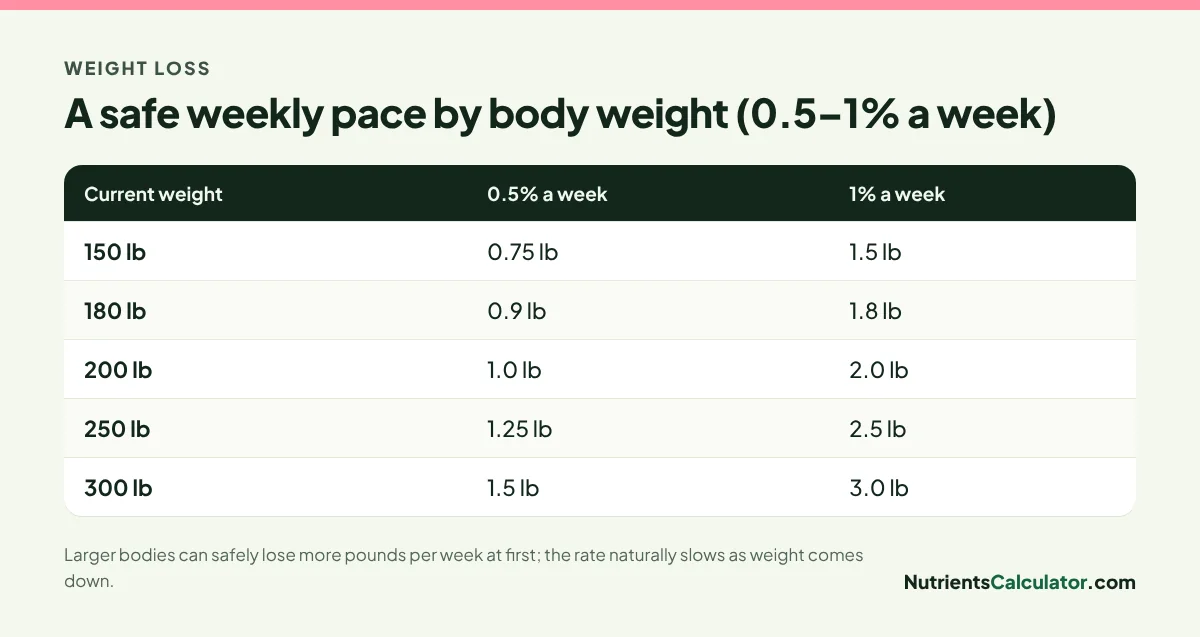
That table shows why a single number doesn’t fit everyone. A 150 lb person losing 2 lb a week is losing about 1.3% of their body weight weekly, which is fast. A 300 lb person losing 2 lb a week is losing 0.7%, a comfortable pace.

Etekcity Food Scale
0.1g accuracy — the perfect companion for exact portions.
Why faster isn’t better
- More muscle loss. Large deficits make it harder to hold on to muscle, especially with low protein intake.
- More hunger and fatigue. Big deficits drive appetite up, which makes the plan harder to sustain.
- Nutrient gaps. Very low intakes make it hard to get enough protein, fiber, vitamins and minerals.
- Gallstones. Rapid weight loss raises the risk of gallstones (NIDDK).
- Regain. Your body pushes back against weight loss with lower energy needs and higher appetite (Hall & Kahan, 2018). Habits built slowly are more likely to last.
Very low-calorie diets (under about 800 calories a day) can produce fast results but should be done only under medical supervision.
Why the first week is faster
Many people lose 3–5 lb in the first week, then less. That early drop is mostly water: when you eat fewer carbs and calories, your body uses some stored glycogen, which is held with water. There’s also less food in your gut. After the first week or two, the scale reflects fat loss more closely. Our guide to daily weight fluctuations explains the water side in detail.
Why loss slows down over time
As you lose weight, your maintenance calories drop, so the same intake creates a smaller deficit. NIH modeling shows weight loss naturally slows and levels off months into a diet, even with steady effort (Hall et al., 2011). Expect to recalculate your target every 10 lb or so (see how many calories to lose weight) and read our plateau guide when progress stalls.
Realistic timelines
At a steady 0.5–1% a week, with loss slowing slightly as you go:
| Goal | Rough timeline |
|---|---|
| Lose 10 lb | about 6–12 weeks |
| Lose 20 lb | about 3–5 months |
| Lose 5% of body weight | about 6–10 weeks |
| Lose 10% of body weight | about 3–5 months |
| Lose 50 lb | about 6–12 months |
Losing just 5–10% of body weight can bring meaningful health benefits for people with overweight, such as improvements in blood pressure, cholesterol and blood sugar (CDC). You don’t have to reach a “goal weight” to see benefits.
How to lose weight at the right pace

- Set a moderate deficit: about 300–500 calories below maintenance. Our pillar guide explains how to create a calorie deficit.
- Eat enough protein: about 25–40 g per meal.
- Strength-train two or three times a week to keep muscle.
- Weigh regularly and use weekly averages, not single days.
- Adjust in small steps: 100–200 calories at a time, after two to three weeks of data.
Signs you’re going too fast
- Losing more than about 1% of body weight a week for several weeks after the first two.
- Constant hunger, irritability or poor sleep.
- Workouts feel much harder and strength is dropping.
- Dizziness, hair shedding, or missed periods.
If you notice these, eat a little more. Slower progress that you can keep up beats fast progress you abandon.
Track your pace
Our dashboard logs your weight and meals and shows your weekly trend in your report card, so you can see whether your pace is on track.
The bottom line
How fast should you lose weight? About 1–2 lb a week, or 0.5–1% of your body weight, after the faster water losses of the first week or two. That pace protects muscle, keeps hunger manageable and gives you time to build habits that keep the weight off. Expect loss to slow as you get lighter, adjust your target in small steps, and measure success over months rather than days.
Frequently asked questions
Is losing 2 pounds a week too fast?
For most people with weight to lose, 2 lb a week is at the upper end of a healthy pace. For a smaller person, 2 lb a week may be more than 1% of body weight, which is harder to sustain and costs more muscle.
Why did I lose so much weight in the first week?
Early losses include water released along with stored carbohydrate (glycogen) and less food in your digestive system. After the first week or two, the rate usually settles to the true pace of fat loss.
How long does it take to lose 20 pounds?
At a steady 1–2 lb a week, about 10–20 weeks, often a little longer because loss slows as you get lighter. Planning for four to six months is realistic.
What are the risks of losing weight too fast?
Rapid loss is linked to more muscle loss, fatigue, nutrient shortfalls, gallstones and a higher chance of regaining weight. Very low-calorie diets should be medically supervised.
Sources
- CDC: Losing Weight (archived)
- Hall KD et al. Quantification of the effect of energy imbalance on bodyweight. The Lancet, 2011
- NIDDK: Symptoms and causes of gallstones
- Hall KD, Kahan S. Maintenance of lost weight and long-term management of obesity. Med Clin North Am, 2018
This article is for general information and isn’t medical advice. Talk to your doctor or a registered dietitian about your own needs, especially if you have a health condition, are pregnant or take medication.