Part of our guide: How to Create a Calorie Deficit Without Feeling Starved
Key takeaways
- Daily weight fluctuations of 1–4 lb are normal and mostly water, not fat.
- The biggest causes are salt, carbs, food in your gut, exercise, hormones and weekends.
- A pound of fat holds about 3,500 calories, so overnight jumps can’t be fat gain.
- Weigh under the same conditions and compare weekly averages to see the real trend.
You eat well all week, step on the scale and you’re 3 pounds heavier than yesterday. It’s discouraging, and completely normal. Daily weight fluctuations are mostly about water and the physical weight of food, not fat. Understanding what moves the scale makes weighing yourself useful instead of stressful.
Why one weigh-in tells you very little
Your body is about 55–60% water, and the amount it holds shifts constantly. On top of that, you carry the weight of whatever food and drink is in your digestive system. Fat changes slowly by comparison: a pound of body fat stores roughly 3,500 calories, so gaining one overnight would mean eating about 3,500 calories above your maintenance in a day.
That’s why weight researchers look at trends. A Finnish study that tracked daily weights found a clear weekly rhythm: people weighed most after the weekend and least by Friday, and those who lost weight over time still showed the same weekly pattern (Orsama et al., 2014).

Etekcity Food Scale
0.1g accuracy — the perfect companion for exact portions.
7 causes of daily weight fluctuations

1. Salt
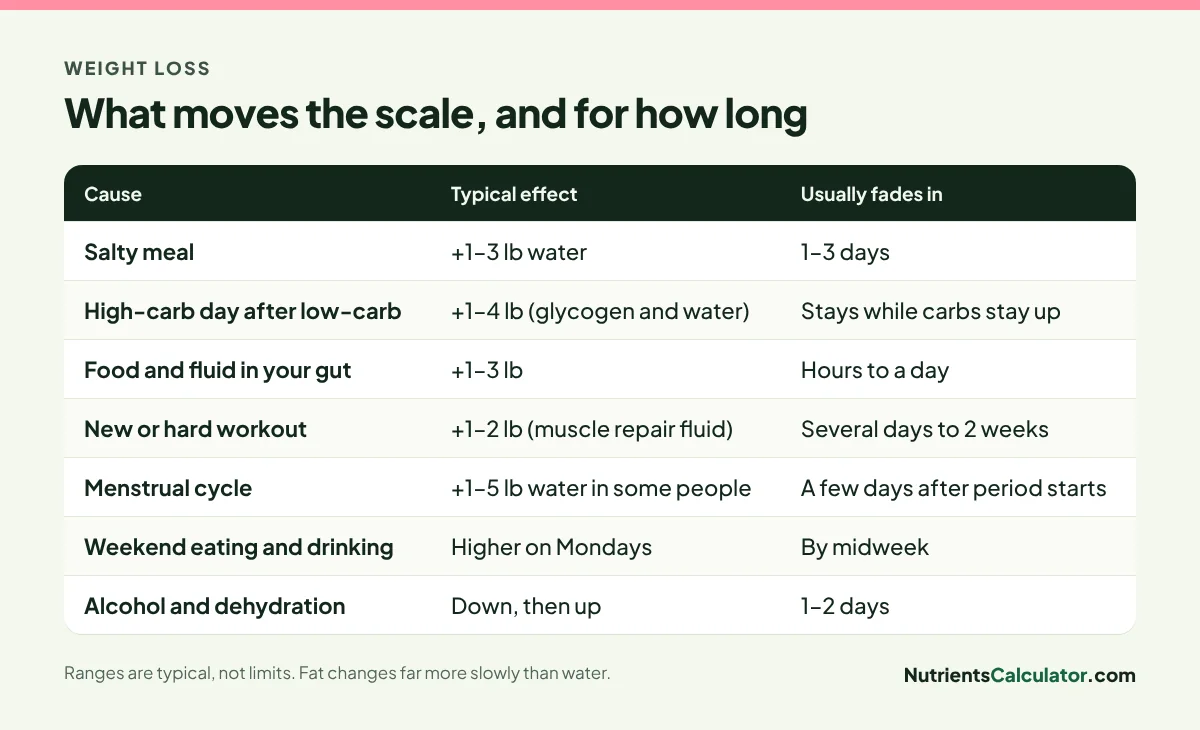
Sodium makes your body hold extra water to keep its balance. A salty restaurant meal, takeout or a big bag of chips can show up as 1–3 lb on the scale the next morning, fading over a couple of days as your kidneys catch up.
2. Carbohydrates
Your muscles and liver store carbohydrate as glycogen, and each gram of glycogen is stored with roughly three grams of water. After a high-carb meal or day, especially following a low-carb stretch, glycogen and its water refill and the scale jumps. It’s also why low-carb diets show a big drop in week one: much of it is glycogen water.
3. Food and fluid in your gut
A large dinner, a big salad or two liters of water all weigh something until they’re digested and passed. Weighing in the evening versus the morning can easily differ by 2–3 lb.
4. Exercise
New or hard workouts cause muscles to hold fluid as they repair, which can add a pound or two for days. Starting a new exercise plan sometimes hides fat loss for the first week or two. Your waist measurement and how clothes fit are better guides during this time.
5. Hormonal cycles
Many people retain water in the days before a period, sometimes several pounds, which drops after it starts. Comparing the same point in your cycle month to month gives a fairer picture.
6. Weekends
More food, saltier meals and drinks on Saturday and Sunday reliably push Monday’s weight up, as the Orsama study showed. By Wednesday or Thursday it usually settles.
7. Alcohol and fluid shifts
Alcohol increases urine output, so you may weigh less the morning after drinking, then more over the next day or two as your body rehydrates and processes the salty food that often comes with it. Read more in alcohol and weight loss.
Medications (such as some steroids) and health conditions can also cause fluid retention; if you notice sudden swelling or rapid unexplained gain, talk to a doctor.
How to weigh yourself smarter

- Same conditions every time: morning, after the bathroom, before eating or drinking, similar clothing.
- Same scale on a hard, flat floor.
- Weigh several times a week, or daily if it doesn’t bother you.
- Compare weekly averages. Add up the week’s readings and divide by the number of weigh-ins. Compare this week’s average with last week’s.
- Look at 3–4 weeks before changing anything. Fat loss shows up as a slow downward trend under the daily noise.
- Add another measure: waist measurement, a monthly photo or how a favorite pair of jeans fits.
A worked example
| Day | Weight (lb) |
|---|---|
| Mon | 182.4 |
| Tue | 181.2 |
| Wed | 180.6 |
| Thu | 181.8 |
| Fri | 180.2 |
| Sat | 180.0 |
| Sun | 181.4 |
The week’s average is 181.1 lb. If last week’s average was 181.9, you lost about 0.8 lb, even though Thursday and Sunday looked like gains.
When the trend really isn’t moving
If your weekly average hasn’t changed for three weeks or more, it’s probably not water anymore. Check your food log, recalculate your calorie target for your current weight, and read our guide to breaking a weight loss plateau.
Log it and let the trend do the work
Our free dashboard tracks your logged weight and meals and shows weekly averages in your report card, so one high morning doesn’t derail your week.
The bottom line
Daily weight fluctuations of 1–4 lb are normal and driven by salt, carbs, food in your gut, exercise, hormones, weekends and alcohol. None of them are fat. Weigh under consistent conditions, track weekly averages, and judge your progress over three to four weeks. For the bigger picture on steady fat loss, see our guide to creating a calorie deficit and how fast to lose weight.
Frequently asked questions
How much does weight normally fluctuate in a day?
A swing of 1–3 lb between morning and evening, or from one morning to the next, is common. Larger people can see bigger swings. These changes are mostly water and the weight of food and drink, not fat.
Is it better to weigh myself daily or weekly?
Either can work. Daily weighing gives more data to average out the noise; weekly weighing is less stressful for some people. If you weigh daily, look only at the weekly average.
Why do I weigh more after a workout day?
Hard or new exercise causes muscles to hold extra fluid while they repair, and your body stores more glycogen with water. It's temporary and a sign of adaptation, not fat gain.
Can you gain a pound of fat in one day?
It's very unlikely. A pound of body fat stores roughly 3,500 calories, so you'd need to eat about that much above your maintenance in a day. A sudden jump is almost always water and food weight.
Sources
- Orsama AL et al. Weight rhythms: weight increases during weekends and decreases during weekdays. Obesity Facts, 2014
- Hall KD et al. Quantification of the effect of energy imbalance on bodyweight. The Lancet, 2011
- Hall KD, Kahan S. Maintenance of lost weight and long-term management of obesity. Med Clin North Am, 2018
This article is for general information and isn’t medical advice. Talk to your doctor or a registered dietitian about your own needs, especially if you have a health condition, are pregnant or take medication.