Part of our guide: How Much Water Should I Drink a Day? What the Science Actually Says
Key takeaways
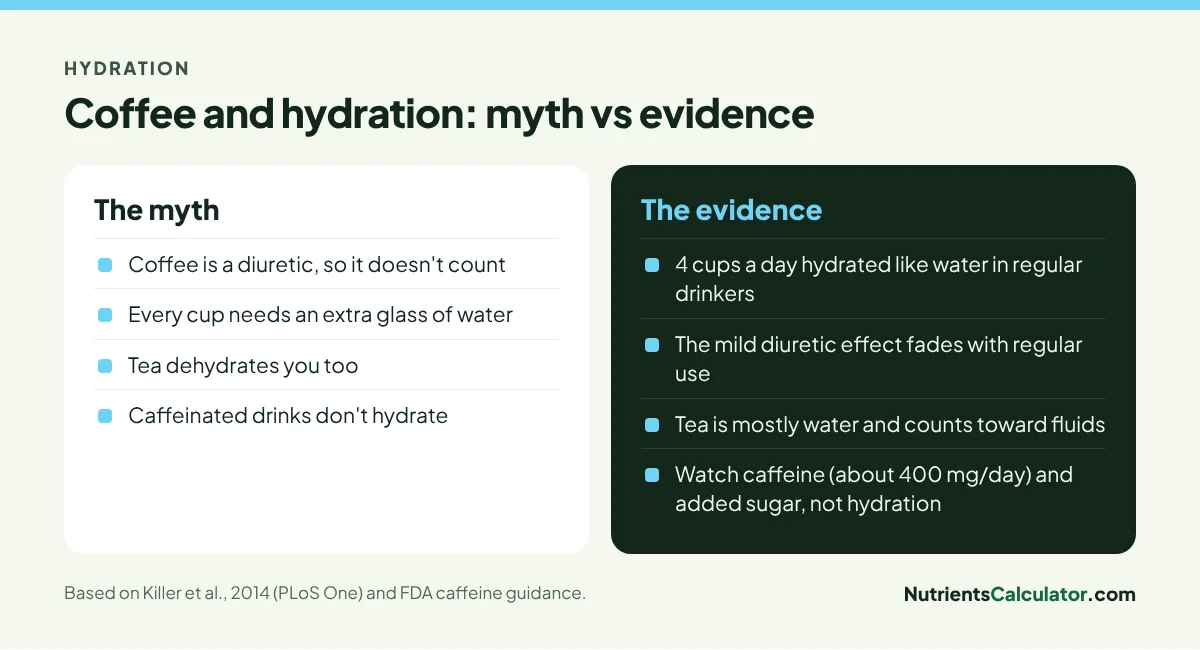
- Does coffee count as water? Yes. In regular coffee drinkers, moderate coffee hydrated about as well as water.
- Caffeine’s mild diuretic effect is mostly seen at high doses in people who aren’t used to it.
- The real limits are caffeine (about 400 mg a day for healthy adults) and added sugar and cream, not hydration.
- Tea counts too, with less caffeine. Herbal teas have none.
You’ve probably heard that coffee “doesn’t count” toward your daily water because caffeine makes you pee. It’s one of the most persistent hydration myths. So does coffee count as water? For most people who drink it regularly, the answer is yes. Here’s what the research shows, how much caffeine is sensible, and where coffee drinks can work against you.
Where the myth came from

Caffeine is a mild diuretic: in large doses, especially in people who rarely have it, it can increase urine output for a few hours. Older studies that gave non-coffee-drinkers big doses of caffeine found this effect, and the idea spread that coffee and tea dehydrate you.
The National Academies looked at the evidence when setting water intake references and concluded that caffeinated drinks contribute to daily total water intake (National Academies).

Etekcity Food Scale
0.1g accuracy — the perfect companion for exact portions.
Does coffee count as water? What the research found
The clearest test came from a 2014 study in 50 men who regularly drank coffee. On one occasion they drank four mugs of coffee a day (providing 4 mg of caffeine per kg of body weight) for three days; on another, the same amount of water. Researchers measured body mass, total body water, blood markers and urine volume. There were no meaningful differences in hydration between coffee and water (Killer et al., 2014).
Regular caffeine use builds tolerance to its diuretic effect, which is why habitual coffee drinkers don’t lose extra fluid from moderate amounts. Brewed coffee is also about 99% water by weight.
How much caffeine is OK?

The FDA says up to about 400 mg of caffeine a day is generally not associated with dangerous, negative effects in healthy adults (FDA). Typical amounts, from the FDA:
- 8 oz brewed coffee: about 80–100 mg.
- 8 oz black or green tea: about 30–50 mg.
- 12 oz caffeinated soda: about 30–40 mg.
- Energy drinks: 40–250 mg per 8 oz, depending on the brand.
So four or five cups of brewed coffee is about the limit for most adults. Coffee-shop sizes are often 16–20 oz, which can mean 300 mg or more in one drink. Some people are more sensitive and notice jitters, a racing heart or poor sleep at much lower doses. Pregnant people are usually advised to stay under 200 mg a day, and children and teenagers should have much less.
Tea, soda and energy drinks

- Tea counts toward your fluids and has less caffeine than coffee. Herbal teas (peppermint, chamomile, rooibos) are caffeine-free and count just like water.
- Diet soda hydrates, though it’s best as an occasional drink rather than your main fluid.
- Regular soda and energy drinks hydrate too, but bring sugar: a 12 oz cola has about 155 calories and 37 g of sugar, and an 8.4 oz Red Bull about 110 calories and 26 g of sugar, according to USDA data. See how much sugar is in sugary drinks.
Where coffee drinks can work against you
The hydration isn’t the problem; the extras can be:
- Sweetened, milky drinks. A cup of ready-to-drink sweetened milk coffee has about 170 calories and 26 g of sugar (USDA). A large flavored latte with syrup and whipped cream can pass 300.
- Late caffeine. Caffeine can affect sleep for many hours. A cut-off in the early afternoon helps many people.
- Replacing water entirely. If coffee is your only drink until evening, you’re probably under-drinking overall.
A simple approach
- Count coffee and tea toward your daily fluids. Our pillar guide on how much water to drink a day explains your total.
- Keep caffeine under about 400 mg (less if you’re sensitive, pregnant or have a heart condition).
- Pair each coffee with a glass of water. Not because coffee dehydrates you, but because it’s an easy habit that raises your total.
- Keep it simple: black coffee, or a splash of milk. Save syrups for treats.
Log coffee and tea in our water tracker and they count toward your day.
The bottom line
Does coffee count as water? Yes. For regular drinkers, moderate coffee and tea hydrate about as well as water. The limits that matter are caffeine (about 400 mg a day for most healthy adults) and the sugar and cream that turn coffee into a dessert. Keep both in check and coffee is a perfectly good part of your daily fluids. For more easy ways to hit your target, see how to drink more water and the signs of dehydration.
Frequently asked questions
Does coffee count toward your daily water intake?
Yes. A study in regular coffee drinkers found that four cups a day hydrated about as well as the same amount of water. Coffee is about 99% water.
How much coffee is too much?
The FDA says up to about 400 mg of caffeine a day is generally not associated with negative effects in healthy adults, roughly four or five 8 oz cups of brewed coffee. Pregnant people are usually advised to stay under 200 mg.
Does tea count as water?
Yes. Tea has less caffeine than coffee (about 30–50 mg per 8 oz cup of black or green tea) and counts toward your fluids. Herbal teas have no caffeine.
Do energy drinks hydrate you?
They contain water, but many also contain a lot of sugar and caffeine. An 8.4 oz regular Red Bull has about 110 calories and 26 g of sugar. They're not a good main source of fluid.
Sources
- Killer SC et al. No evidence of dehydration with moderate daily coffee intake. PLoS One, 2014
- FDA: Spilling the Beans — How Much Caffeine is Too Much?
- National Academies: Dietary Reference Intakes for Water, Potassium, Sodium, Chloride, and Sulfate (2005)
- USDA FoodData Central
This article is for general information and isn’t medical advice. Talk to your doctor or a registered dietitian about your own needs, especially if you have a health condition, are pregnant or take medication.